Highlight
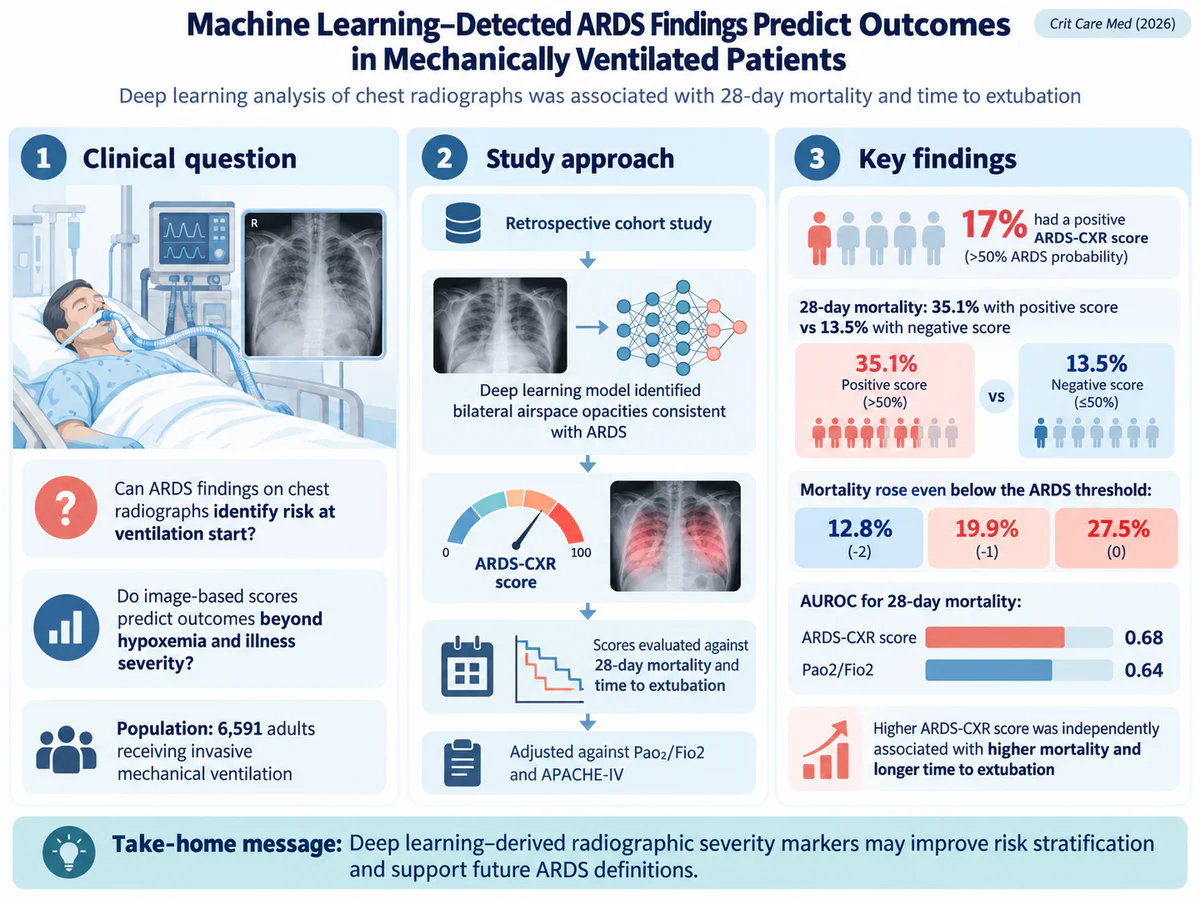
This retrospective study applies a validated deep learning model to chest radiographs of 6591 mechanically ventilated adults to detect radiographic features of acute respiratory distress syndrome (ARDS). The resulting ARDS-CXR scores stratify 28-day mortality risk beyond established markers like Pao2/Fio2 ratio and APACHE-IV illness severity scores. Higher ARDS-CXR scores independently correlate with increased mortality and longer time to extubation, demonstrating the potential for AI-driven imaging analysis to augment clinical prognostication in ARDS.
Study Background
Acute respiratory distress syndrome (ARDS) is a common and severe manifestation of acute lung injury characterized by bilateral pulmonary infiltrates and hypoxemia. It is a frequent indication for invasive mechanical ventilation in critically ill patients and is associated with high mortality and prolonged intensive care unit stays. The clinical definition of ARDS, including the Berlin criteria, relies on hypoxemia severity, chest radiograph findings of bilateral infiltrates, and exclusion of cardiac failure. However, chest X-ray interpretation is subject to interobserver variability, and traditional physiological indices such as the Pao2/Fio2 ratio do not fully capture lung injury heterogeneity or severity.
Recent advances in artificial intelligence (AI), particularly deep learning, can offer automated and objective assessment of imaging data to detect radiographic patterns suggestive of ARDS. This technology has potential to improve risk stratification and guide clinical decision-making by providing reproducible quantification of lung injury that complements physiological measurements and severity scores. However, evidence on whether ARDS radiographic findings detected by AI can independently predict patient outcomes remains limited.
Study Design
This study was a retrospective cohort analysis conducted at a single academic medical center. Adult patients who underwent chest radiographs at the initiation of invasive mechanical ventilation were included. The dataset consisted of 6591 patients receiving mechanical ventilation, with chest X-rays processed through a previously validated deep learning model designed to identify bilateral airspace opacities consistent with the radiographic diagnosis of ARDS.
The model generated an ARDS-CXR score corresponding to the probability of ARDS presence. The primary endpoints were 28-day mortality and time to extubation. Secondary analyses assessed the predictive discrimination of the ARDS-CXR score compared to established clinical markers including the Pao2/Fio2 ratio and the Acute Physiology and Chronic Health Evaluation-IV (APACHE-IV) score. Multivariable Cox proportional hazards and logistic regression models adjusted for these clinical covariates to evaluate the independent association of the ARDS-CXR score with outcomes.
Key Findings
The median ARDS-CXR score among the cohort was -2.09, corresponding to an approximate ARDS probability of 15%. A total of 1089 patients (17%) had a positive ARDS-CXR score, indicating greater than 50% probability of ARDS presence. Mortality at 28 days was substantially higher in patients with positive ARDS-CXR scores (35.1%) compared to those with negative scores (13.5%). Notably, even ARDS-CXR scores below the positive threshold stratified mortality risks, with progressively increasing mortality rates between scores of -2 to 0.
Performance metrics demonstrated that the ARDS-CXR score exhibited an area under the receiver operating characteristic (AUROC) curve of 0.68 (95% CI, 0.66-0.70) for predicting 28-day mortality, outperforming the Pao2/Fio2 AUROC of 0.64 (95% CI, 0.62-0.66). After adjusting for Pao2/Fio2 or APACHE-IV scores, each 1-point increase in the ARDS-CXR score was significantly associated with higher odds of 28-day mortality and prolonged time to extubation, underscoring its independent predictive value.
The findings suggest that quantitative radiographic assessment through deep learning not only reclassifies patients traditionally considered negative for ARDS based on other criteria but also identifies a spectrum of severity correlating with clinical outcomes. This indicates that AI-derived imaging biomarkers may capture pathophysiological features not fully reflected by oxygenation metrics or generalized illness scores.
Expert Commentary
The utilization of machine learning algorithms to extract prognostically significant features from chest radiographs represents an important advancement in critical care medicine. This study illustrates that AI can enhance the diagnostic and predictive utility of chest imaging by providing objective, reproducible measures of lung injury severity. The ARDS-CXR score’s independent association with mortality and ventilator liberation highlights its potential role in clinical decision-making, prognostication, and patient stratification for research trials.
Nevertheless, several considerations remain. The analysis was retrospective and single-center, which may limit generalizability. Validation in multicenter, prospective cohorts is needed. Additionally, integration of AI-generated imaging scores into existing clinical workflows and ARDS definitions requires careful prospective evaluation to determine impact on treatment decisions and outcomes. The model’s interpretability and ability to differentiate ARDS from other causes of bilateral infiltrates or comorbidities also warrant further study.
Conclusion
This study provides compelling evidence that a deep learning-based ARDS-CXR score derived from standard chest radiographs can independently predict mortality and time to extubation in mechanically ventilated patients, beyond traditional severity indices such as the Pao2/Fio2 ratio and APACHE-IV score. The quantitative imaging biomarker holds promise for augmenting clinical assessment, enabling more precise risk stratification and potentially informing tailored therapeutic approaches.
Future research should focus on prospective validation, integration with clinical parameters, and exploration of how AI-derived radiographic markers may refine ARDS definitions and guide personalized patient management.
Funding and ClinicalTrials.gov
No funding or clinical trial registration information was reported in the source article.
References
1. Zhong Y, Nuppnau M, Farzaneh N, Ansari S, Sjoding MW. Association of Acute Respiratory Distress Syndrome Radiographic Findings Identified by Machine Learning and Outcomes of Patients Receiving Invasive Mechanical Ventilation. Critical Care Medicine. 2026 Oct 23. PMID: 42919460.
2. ARDS Definition Task Force, Ranieri VM, Rubenfeld GD, et al. Acute respiratory distress syndrome: the Berlin Definition. JAMA. 2012;307(23):2526-2533.
3. Sjoding MW, Allegretti AS, Koyama T, et al. Quantitative Chest X-ray Evaluation and ARDS Prognostication. Am J Respir Crit Care Med. 2020;201(8):1016-1024.
4. Johnson AEW, Pollard TJ, Shen L, et al. MIMIC-III, a freely accessible critical care database. Scientific Data 2016;3:160035.