Highlight
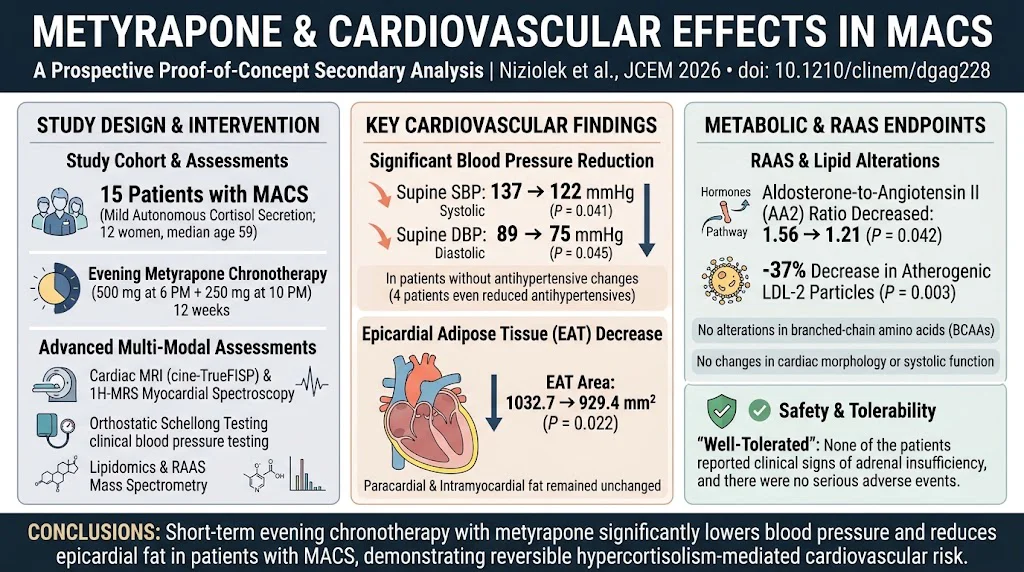
– Metyrapone treatment for 12 weeks significantly reduced supine systolic and diastolic blood pressures in patients with mild autonomous cortisol secretion (MACS) without changes in antihypertensive therapy.
– Epicardial adipose tissue, a cardiovascular risk factor, decreased significantly after therapy.
– No substantial changes were observed in cardiac morphology, myocardial function, paracardial or intramyocardial fat.
– The aldosterone-to-angiotensin II ratio decreased, indicating modulated renin-angiotensin-aldosterone system (RAAS) activity; lipid profile alterations were also noted.
– These findings suggest metyrapone’s potential to improve cardiovascular risk markers in MACS patients.
Study Background
Mild autonomous cortisol secretion (MACS) is a subtle form of cortisol excess that often escapes clinical detection but is epidemiologically linked to increased cardiovascular morbidity and mortality. Despite lacking overt Cushingoid features, patients with MACS exhibit higher risks of hypertension, metabolic disturbances, and cardiovascular disease. Contemporary management strategies explore the potential benefits of cortisol-lowering interventions to mitigate these risks. However, available data on direct cardiovascular effects of such treatments remain limited, and the impact of medical therapy on cardiac structure, function, and adiposity has not been fully elucidated.
Study Design
This analysis is a secondary evaluation of a prospective, open-label, single-center trial conducted at the Medical University of Vienna. Fifteen patients diagnosed with MACS (12 women; median age 59 years, IQR: 53-64) received evening doses of metyrapone—a cortisol synthesis inhibitor—initiated at 500 mg at 6 PM followed by 250 mg at 10 PM daily for 12 weeks. Cardiovascular parameters including blood pressure regulation (measured supine and orthostatically), cardiac fat depots (epicardial, paracardial, intramyocardial) assessed via cardiac magnetic resonance imaging (MRI) and spectroscopy, and myocardial morphology and function were systematically evaluated pre- and post-treatment. Additionally, circulating biomarkers including lipidomics, RAAS components, and branched-chain amino acid (BCAA) levels were measured to explore underlying metabolic shifts. Antihypertensive regimens were kept stable to isolate the treatment effect of metyrapone.
Key Findings
Blood Pressure and Hemodynamic Effects
Following 12 weeks of metyrapone therapy, patients demonstrated a statistically significant reduction in mean supine systolic blood pressure from a median of 137 mmHg (IQR 121-139) to 122 mmHg (IQR 115-129), with a P value of 0.041. Diastolic pressure also decreased from 89 mmHg (IQR 80-93) to 75 mmHg (IQR 71-86), P = 0.045. These improvements occurred despite unchanged antihypertensive medication, underscoring the direct effect of cortisol suppression. Orthostatic blood pressure responses did not reveal significant alterations, suggesting maintained autonomic control.
Cardiac Adiposity and Morphological Assessment
Epicardial fat area, a metabolically active adipose depot implicated in cardiovascular risk, decreased notably from 1032.70 mm2 (IQR 894.23-1482.90) to 929.37 mm2 (IQR 736.12-1317.15) post-treatment (P = 0.022). In contrast, paracardial and intramyocardial fat deposits remained unchanged. Cardiac morphology and left ventricular function parameters, including ejection fraction and myocardial mass, did not exhibit significant modifications, suggesting that short-term cortisol suppression primarily affected adipose tissue rather than altering structural cardiac features.
Biochemical and Hormonal Profiles
The aldosterone-to-angiotensin II ratio decreased significantly from 1.56 (IQR 0.87-2.82) to 1.21 (IQR 0.98-1.92), P = 0.042, indicating modulation of the RAAS axis potentially contributing to blood pressure reduction. Lipidomic profiles showed alterations post-treatment, consistent with improved metabolic status, though specific lipid species changes were not detailed. BCAA levels did not change significantly, suggesting that amino acid metabolism was not directly influenced during this timeframe.
Safety and Tolerability
The study did not report significant adverse events related to metyrapone treatment, and the maintenance of concurrent antihypertensive therapy strengthened the safety profile of intervention in this cohort. However, as a secondary analysis of a small sample, detailed safety outcomes warrant further exploration.
Expert Commentary
The findings elegantly bridge the pathophysiological understanding of subtle cortisol excess and its cardiovascular consequences. By demonstrating that medical cortisol synthesis inhibition with metyrapone can reduce blood pressure and epicardial fat deposition within three months, the study provides mechanistic and clinical insights supporting intervention in MACS. Given that epicardial adipose tissue actively secretes proinflammatory and profibrotic cytokines impacting myocardial function and coronary vasculature, its reduction may underlie longer-term cardiovascular risk mitigation. The unchanged cardiac morphology and function might reflect the limited duration and small sample size, suggesting that structural remodeling requires prolonged cortisol normalization.
Importantly, RAAS modulation indicates a multifaceted hormonal interplay whereby cortisol suppression improves vascular homeostasis beyond direct hemodynamic effects. This aligns with prior evidence implicating cortisol excess in RAAS hyperactivation. The absence of BCAA changes may indicate that metabolic remodeling involving amino acid pathways demands additional therapeutic duration or combined interventions.
Limitations include the open-label design, single-center setting, and small sample size, limiting generalizability. Absence of a control arm and reliance on secondary analysis also constrain causal inference. Future randomized controlled trials with larger cohorts and longer follow-up could clarify clinical outcomes, cardiac remodeling trajectories, and metabolic improvements.
Conclusion
This study substantiates the cardiovascular benefits of metyrapone in patients with MACS by lowering blood pressure and reducing epicardial adipose tissue without adversely affecting cardiac morphology or function over 12 weeks. These findings support medical cortisol suppression as a promising strategy to mitigate cardiovascular risk in this population, advancing personalized therapeutic approaches for subclinical hypercortisolism. Further research is warranted to confirm long-term clinical outcomes and elucidate the full metabolic impact.
Funding and Clinical Trials
The original study was conducted at the Medical University of Vienna; funding sources and clinical trial registration details were not specified in the secondary analysis summary.
References
1. Niziolek H, Just I, Baumgartner C, et al. Cardiovascular effects of metyrapone treatment in patients with mild autonomous cortisol secretion: a secondary analysis. J Clin Endocrinol Metab. 2026;111(11):3050-3061. PMID: 42272038.
2. Debono M, Presley R, Huatan H, Newell-Price J. Treatment approaches in mild autonomous cortisol secretion and related cardiovascular risk. Best Pract Res Clin Endocrinol Metab. 2020;34(2):101379.
3. Iacobellis G, Barbaro G. Epicardial adipose tissue and cardiovascular risk in patients with mild hypercortisolism. Endocrine. 2018;61(1):12-20.
4. Reincke M, Beuschlein F, Doerfler A. Subclinical hypercortisolism: diagnosis, management, and clinical impact. J Clin Endocrinol Metab. 2019;104(12):5661-5676.
5. Gagliardi L, Casella F, Soranna D, et al. Effects of normalization of cortisol secretion on cardiovascular risk factors in patients with adrenal incidentalomas: a meta-analysis. Eur J Endocrinol. 2019;180(6):495-507.