Highlights
- Distinct lipidomic signatures differentiate atherosclerosis (AS) and abdominal aortic aneurysm (AAA), with neutral lipids enriched in AS and phosphoglycerides in AAA.
- ACADM-mediated fatty acid β-oxidation (FAO) pathway is markedly altered between AS and AAA, underpinning divergent pathogenesis.
- Restoration of ACADM-mediated FAO mitigates AS progression by reducing lipotoxic metabolites and preserving mitochondrial function, with negligible effect on AAA.
- Machine learning models based on lipidomic features enable reliable discrimination between AS and AAA, guiding precision diagnostics.
Background
Atherosclerosis (AS) and abdominal aortic aneurysm (AAA) stand as two major vascular diseases with distinct pathological manifestations but overlapping risk factors. Both are intimately linked to metabolic dysregulation, particularly in lipid pathways, which contribute to vascular remodeling and disease progression. Despite the burden of cardiovascular morbidity and mortality driven by these conditions, their differential lipid metabolic disturbances remain incompletely understood, limiting targeted therapeutic interventions. Traditionally, AS has been characterized by lipid-rich plaques and foam cell accumulation, whereas AAA involves pathological dilation and weakening of the aortic wall. Recent advances in high-throughput lipidomics and multi-omics have offered new avenues to dissect disease-specific metabolic profiles and molecular mechanisms. Understanding these nuances is crucial for improving diagnostic accuracy and tailoring interventions.Key Content
Lipidomic Disparities Between AS and AAA
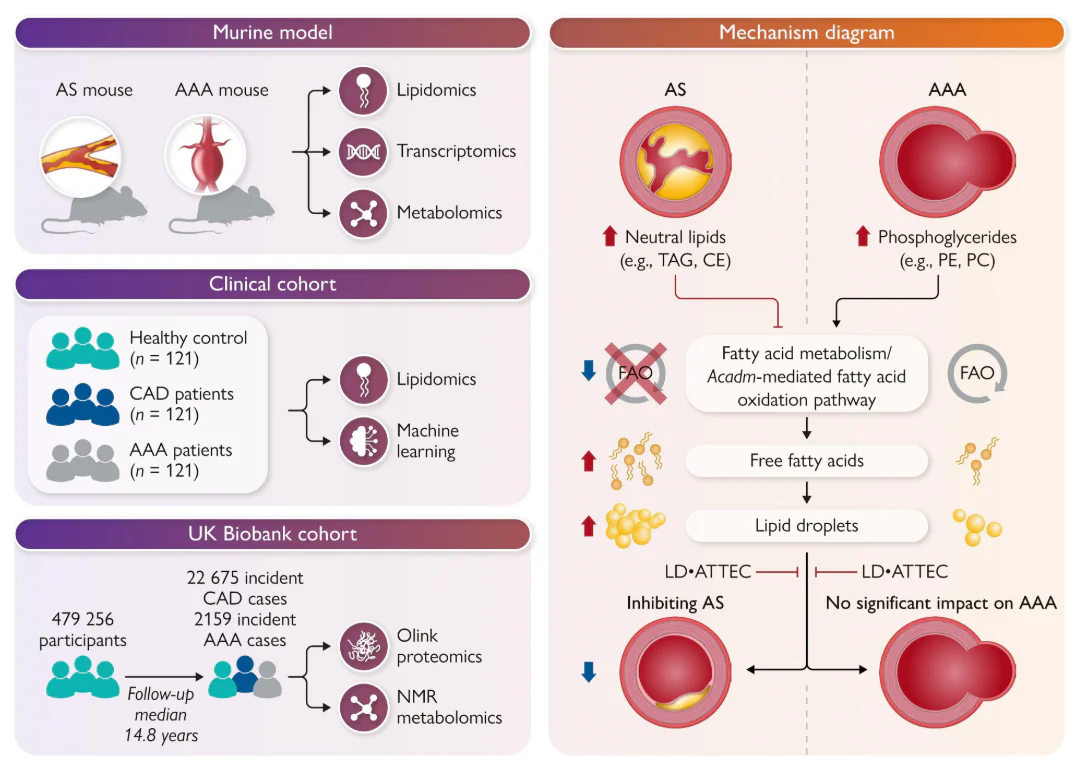
In the seminal work by Zhang et al. (2026), comprehensive lipidomic profiling across murine models and human patient cohorts revealed distinct lipid accumulation patterns: AS preferentially exhibits enrichment of neutral lipids such as triglycerides (TGs) and cholesterol esters (CEs), while AAA tissues show elevated levels of phosphoglycerides (PGs). Such differential lipid profiles were supported by large-scale epidemiological data from the UK Biobank, where serum TG, cholesterol, and fatty acid concentrations correlated positively with coronary artery disease risk (an AS subtype), yet phosphoglycerides inversely associated with AAA risk. This bifurcation suggests divergent lipid metabolic pathways influencing pathogenesis.ACADM-Mediated Fatty Acid β-Oxidation: A Central Metabolic Node
Integrative transcriptomic and metabolomic analyses identified the fatty acid oxidation pathway, especially mediated by ACADM (medium-chain acyl-CoA dehydrogenase), as a critical differential factor. ACADM catalyzes key steps in mitochondrial β-oxidation of medium-chain fatty acids, thus modulating lipid catabolism. In AS, impaired ACADM activity leads to lipotoxic metabolite accumulation, mitochondrial dysfunction, and promotion of inflammatory cascades contributing to plaque formation. Conversely, AAA pathogenesis appears less influenced by ACADM-mediated β-oxidation, possibly reflecting distinct cellular and inflammatory milieus.Functional and Therapeutic Implications
Targeted restoration of ACADM function via genetic and pharmacologic means in experimental AS models resulted in marked inhibition of disease progression. This was achieved by reducing intracellular neutral lipid deposits, normalizing mitochondrial homeostasis, and attenuating inflammatory responses. Use of lipid droplet autophagy-tethering compounds (LD·ATTECs), which selectively degrade intracellular lipid droplets, further substantiated the therapeutic potential in AS by enhancing fatty acid oxidation and dampening lipid-induced cellular stress. Such interventions had negligible effects in AAA models, underscoring metabolic pathway specificity.Diagnostic Advances: Machine Learning-Based Prediction Models
Leveraging lipidomic datasets, Zhang et al. constructed machine learning algorithms capable of accurately discriminating AS from AAA based on circulating lipid signatures. These predictive models herald a new era for non-invasive, metabolic-based vascular disease diagnostics, enhancing clinical differential diagnosis and personalized medicine.Expert Commentary
The elucidation of ACADM-mediated fatty acid β-oxidation as a pivotal differential mechanism marks a significant advance in vascular biology research. It underscores metabolic heterogeneity as a driver of disease specificity in ostensibly related vascular pathologies. Current guidelines recognize dyslipidemia as a central modifiable risk factor but lack nuanced approaches targeting distinct metabolic derangements within different vascular diseases. The insights from multi-omics integration advocate for therapeutic stratification focusing on restoring mitochondrial fatty acid oxidation in AS to mitigate progression. Limitations include translational gaps between murine models and human disease complexity. Additionally, the minimal effect of FAO correction on AAA hints at alternative metabolic or inflammatory drivers requiring elucidation. Future research should expand on tissue-specific metabolic flux analysis, cell-type contributions, and longitudinal metabolic profiling to unravel AAA pathobiology. The application of AI-based predictive models offers promise but necessitates validation across diverse populations with standardized lipidomic assay protocols to ensure reproducibility and clinical utility.Conclusion
Recent integrative research has delineated the ACADM-mediated fatty acid β-oxidation pathway as a critical nodal point differentiating atherosclerosis from abdominal aortic aneurysm. AS is characterized by an accumulation of neutral lipids and impaired mitochondrial β-oxidation, whereas AAA predominantly involves phosphoglyceride alterations with less dependence on ACADM activity. These metabolic distinctions permit the development of targeted therapies aimed at restoring fatty acid oxidation in AS, with emerging pharmacologic agents such as LD·ATTECs showing therapeutic promise. Moreover, lipidomic-informed machine learning models facilitate precise differential diagnosis. Addressing current gaps—particularly in AAA pathogenesis—and validating clinical applicability represent imperative next steps. Ultimately, these advances hold transformative potential for precision vascular medicine, improving patient outcomes through mechanism-based diagnostics and therapies.References
- Zhang H, Sun L, Xu T, Hou X, Zhong F, Shi F, Chen Y, Li Y, Wang Y, Lyu Y, Zhang W, Fu Y, Zhao Y, Yuan A, Chen L, Ji Y, Wang M, Lu B, Pu J. ACADM-mediated fatty acid β-oxidation pathway in atherosclerosis and abdominal aortic aneurysm. Eur Heart J. 2026 Oct 26;47(40):6051-6072. PMID: 42247143.
- Mensah GA, et al. Atherosclerosis: Epidemiology and Risk Factors. Curr Cardiol Rep. 2020;22(10):117.
- Michel JB, et al. Pathophysiology of abdominal aortic aneurysm: Inflammation, proteolysis, and extracellular matrix remodeling. Circ Res. 2018;122(7):1214-1238.
- Longo N, et al. Medium-chain acyl-CoA dehydrogenase deficiency: current perspectives. Appl Clin Genet. 2018;11:33-45.
- Gowda SP, Dhamgaye S, Biswas S. Lipid droplets and their autophagy in cardiovascular diseases. Front Pharmacol. 2022;13:830748.