Highlight
1. Active vitamin D analog eldecalcitol significantly increases lumbar spine bone mineral density (BMD) over three years in individuals with prediabetes.
2. The magnitude of BMD improvement is modulated by the patient’s metabolic trajectory, with greater gains seen in those reverting to normoglycemia compared to those progressing to type 2 diabetes.
3. Baseline glycemic control, quantified by HbA1c levels, independently predicts the skeletal response to active vitamin D therapy.
4. These findings implicate metabolic status as a key determinant of bone remodeling and therapeutic efficacy, supporting the concept of bone-metabolic coupling.
Study Background
Osteoporosis and metabolic disorders like diabetes mellitus constitute major public health challenges worldwide due to their prevalence and impact on morbidity and mortality. Active vitamin D analogs have established roles in enhancing bone mineral density (BMD), a surrogate for bone strength, and reducing fracture risk. However, clinical responses to active vitamin D display considerable inter-individual variability that remains poorly understood. Concurrently, metabolic status, particularly glycemic control and progression of glucose dysregulation, has increasingly been recognized to influence bone remodeling processes. The Diabetes Prevention with Vitamin D (DPVD) trial provided an opportunity to explore whether glycemic trajectories—namely progression to type 2 diabetes, persistent prediabetes, or regression to normoglycemia—alter skeletal responses to active vitamin D treatment with eldecalcitol among individuals at risk of diabetes.
Study Design
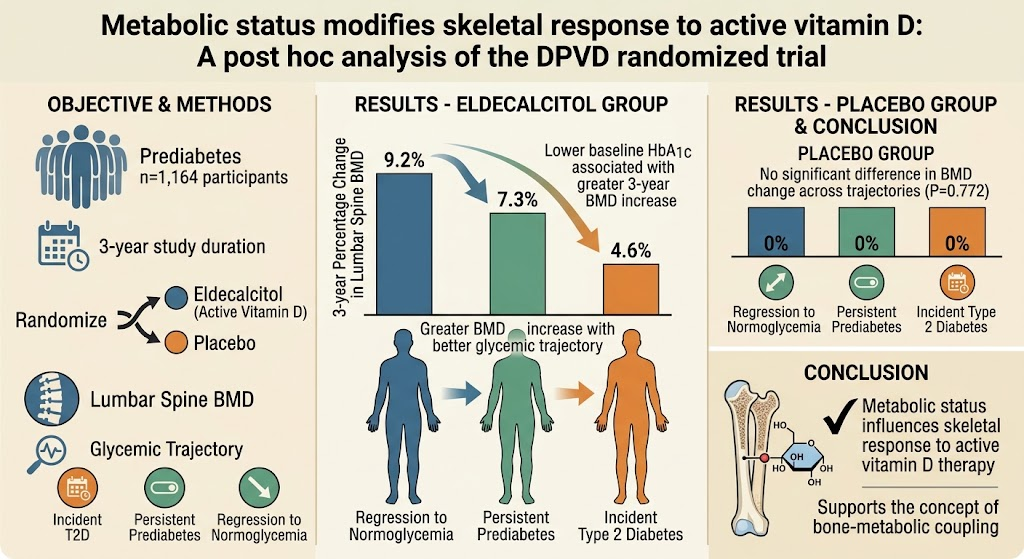
This post hoc cohort analysis utilized data from the DPVD randomized, placebo-controlled trial, which enrolled 1,256 individuals with prediabetes. For the present analysis, 1,164 participants with serial lumbar spine BMD measurements over a three-year period were included. Participants were assigned to receive either eldecalcitol—an active vitamin D analog—or placebo. Glycemic trajectory was categorized based on longitudinal glucose assessments into three groups: progression to type 2 diabetes, persistent prediabetes, and regression to normoglycemia. The primary endpoint was the percentage change in lumbar spine BMD over three years. A linear mixed-effects model evaluated the interaction between treatment assignment, glycemic trajectory, and time on BMD changes. Additionally, multivariable linear regression analyzed baseline clinical predictors associated with the extent of BMD improvement within the eldecalcitol group.
Key Findings
Interaction of Metabolic Trajectory and Vitamin D on BMD: The analysis revealed a significant three-way interaction (treatment-by-trajectory-by-time) indicating that the change in lumbar spine BMD over time differed depending on both active vitamin D treatment and glycemic trajectory (P=0.0307). This demonstrates that edo calcitol’s efficacy in improving BMD was influenced by metabolic status.
Magnitude of BMD Increases by Glycemic Trajectory: Among participants treated with eldecalcitol, the extent of 3-year lumbar spine BMD increase progressively correlated with metabolic improvement: 4.6% increase in those progressing to type 2 diabetes, 7.3% in those with persistent prediabetes, and 9.2% in those regressing to normoglycemia (trajectory-by-time interaction, P=0.0098). In contrast, the placebo group showed no significant BMD differences across metabolic trajectories (P=0.772), affirming that these changes were attributable to active vitamin D therapy modulated by metabolic status.
Baseline HbA1c as Predictor of Skeletal Response: In multivariable analysis within the eldecalcitol group, higher baseline HbA1c was independently associated with a diminished percentage increase in lumbar spine BMD over three years (β = -5.15 percentage points per 1% HbA1c increase; 95% confidence interval, -8.34 to -1.95; P=0.002). This finding underscores HbA1c as a potential biomarker predicting the skeletal benefit of vitamin D analog therapy.
Safety Profile: While the original trial’s safety outcomes were not the focus of this analysis, eldecalcitol is generally well tolerated, with adverse effects consistent with known vitamin D analog profiles, and no new safety signals were reported in this subanalysis.
Expert Commentary
The DPVD post hoc analysis provides compelling evidence linking systemic metabolic health with skeletal responsiveness to active vitamin D therapy. These data support the emerging concept of bone-metabolic coupling, where metabolic control exerts significant influence on bone remodeling and therapeutic outcomes. Mechanistically, hyperglycemia and associated metabolic disturbances may impair osteoblast function, enhance osteoclast activity, and alter vitamin D receptor signaling, collectively attenuating vitamin D’s efficacy on bone accrual. Conversely, improving glycemic status might restore bone cell function and optimize response to vitamin D analogs.
This study highlights the clinical importance of integrating metabolic management into osteoporosis and bone health paradigms, especially in populations with prediabetes or metabolic syndrome. It also raises the potential for individualized therapeutic strategies where vitamin D analog treatment may yield maximal skeletal benefit in the context of favorable metabolic trajectories.
Limitations: As a post hoc analysis, causal inferences are limited and findings require prospective validation. The study population focused on individuals with prediabetes, which may restrict generalizability to patients with established diabetes or normoglycemic individuals. Additionally, other confounders such as vitamin D status, calcium intake, physical activity, and concomitant medications warrant consideration.
Conclusion
This analysis demonstrates that metabolic status, specifically glycemic trajectories, modifies the skeletal response to active vitamin D analog eldecalcitol in individuals with prediabetes. Favorable metabolic changes correspond to greater increases in lumbar spine BMD, and lower baseline HbA1c predicts superior treatment response. These findings emphasize the interdependence of metabolic and bone health and suggest that optimizing glycemic control may enhance the efficacy of bone-targeted therapies. Future studies should validate these observations prospectively and explore mechanistic pathways, potentially guiding tailored interventions to address the dual burden of metabolic and skeletal disorders.
Funding and Trial Registration
The original DPVD trial was funded by respective governmental and academic institutions as listed in its primary publication. This post hoc analysis does not state additional funding. The DPVD trial details are accessible on clinicaltrials.gov under the respective registration number.
References
1. Kawahara T, Toda M, Kanagawa M, et al. Metabolic status modifies skeletal response to active vitamin D: A post hoc analysis of the DPVD randomized trial. J Clin Endocrinol Metab. 2026 Sep 29. PMID: 42809706.
2. Schwartz AV. Diabetes, bone loss, and fracture risk. Curr Osteoporos Rep. 2009;7(2):96-104.
3. Napoli N, Chandran M, Pierroz DD, et al. Mechanisms of diabetes mellitus-induced bone fragility. Nat Rev Endocrinol. 2017;13(4):208-219.
4. Holick MF. Vitamin D deficiency. N Engl J Med. 2007;357(3):266-281.
5. Rizzoli R, Biver E, Sansonnens A, et al. Relationship between bone and glucose metabolism. Diabetes Metab. 2017;43(2):163-170.