Highlight
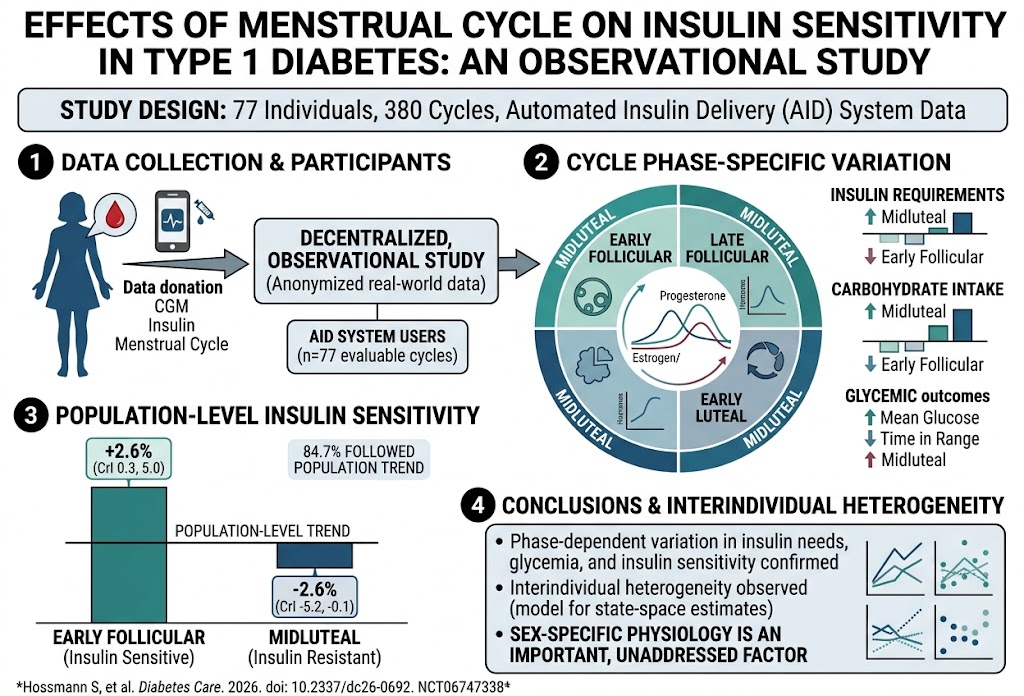
- Insulin sensitivity and glycemic control in type 1 diabetes vary systematically across menstrual cycle phases despite automated insulin delivery (AID) technology.
- Insulin requirements and carbohydrate intake peak during the luteal phase, correlating with higher mean glucose and reduced time in range (TIR).
- Population-level insulin sensitivity is highest in the early follicular phase and lowest in the midluteal phase, though significant individual variability exists.
- Current AID systems and clinical guidelines do not adequately address menstrual cycle-related physiological changes impacting glycemic management.
Study Background
The management of type 1 diabetes hinges on maintaining glycemic control through insulin administration, which can be profoundly influenced by physiologic variables. Among menstruating individuals, cyclical hormonal changes are known to impact insulin sensitivity and glucose metabolism. Estrogen and progesterone fluctuations across the menstrual cycle can modulate peripheral glucose utilization and hepatic glucose production, potentially altering insulin requirements. Despite technological advances such as automated insulin delivery (AID) systems—which integrate continuous glucose monitoring (CGM) with insulin pumps to adjust insulin dosing in real-time—these physiological variations are not fully incorporated into current device algorithms or clinical guidelines. This unmet need poses challenges for achieving optimal glycemic control and minimizing hypoglycemic or hyperglycemic events during different menstrual phases. Understanding these dynamic changes can lead to personalized diabetes management strategies and improve outcomes for women with type 1 diabetes.
Study Design
This observational study employed a decentralized, real-world data collection approach, enrolling menstruating adults with type 1 diabetes using an AID system and self-reporting regular menstrual cycles. Participants contributed anonymized data encompassing CGM glucose readings, insulin delivery logs, carbohydrate intake records, and menstrual cycle information over multiple cycles. The dataset included 77 individuals contributing a total of 380 menstrual cycles. The analysis focused on assessing glycemic outcomes (mean glucose, time in range), insulin dosing patterns, and carbohydrate consumption across distinct menstrual phases (early follicular, midfollicular, ovulation, luteal). A hierarchical Bayesian state-space model was applied to CGM time-series data to estimate a latent insulin sensitivity parameter, enabling phase-specific quantification of insulin sensitivity while accounting for interindividual variability.
Key Findings
The study revealed a clear pattern of variation in insulin requirements, carbohydrate intake, and glycemic control across the menstrual cycle. Notably:
- Insulin Requirements and Carbohydrate Intake: Both parameters exhibited a peak during the luteal phase. Total daily insulin dose increased, suggesting reduced insulin sensitivity during this time. This was corroborated by higher carbohydrate intake, possibly reflecting premenstrual cravings or altered metabolic demands.
- Glycemic Outcomes: The luteal phase demonstrated higher mean glucose levels and a reduced time in range (TIR), indicating more challenging glycemic control compared to other phases.
- Insulin Sensitivity Estimates: Model-based analyses showed a statistically significant increase in insulin sensitivity during the early follicular phase (+2.6% with a credible interval [CrI] of 0.3% to 5.0%) compared to the midluteal phase, where insulin sensitivity decreased (-2.6%, CrI -5.2% to -0.1%).
- Interindividual Heterogeneity: While 84.7% of participants conformed to the population-level pattern, considerable variability existed. Some individuals exhibited differing or even inverse sensitivity trends, highlighting the need for personalized approaches.
These findings underscore the menstrual cycle as a biologically relevant factor influencing insulin kinetics and glucose regulation in type 1 diabetes patients, despite the usage of advanced AID systems.
Expert Commentary
This study provides robust real-world evidence that fluctuations in sex hormones across the menstrual cycle materially affect insulin sensitivity and glycemic outcomes in type 1 diabetes—a dimension insufficiently accounted for in current diabetes treatment paradigms. The use of a sophisticated Bayesian modeling technique strengthens the causal inference by estimating latent physiological parameters from observational CGM data, addressing a key methodological challenge in endocrinology research.
Clinicians should consider the luteal phase as a period of reduced insulin sensitivity and glycemic volatility, warranting closer monitoring and potentially adaptive insulin dosing strategies. However, the observed interindividual heterogeneity cautions against a one-size-fits-all approach; personalization based on individual cycle patterns and responses is essential.
Current AID systems operate primarily on feedback from glucose sensors and fixed algorithms, lacking integration of menstrual cycle data or predictive hormone-related alterations. Incorporating cycle-phase information or biomarkers could potentially enhance algorithm sophistication, improving predictive insulin dosing and reducing glycemic excursions.
Limitations of this study include reliance on self-reported menstrual data, which may introduce inaccuracies, and the observational design, which cannot definitively establish causality. Moreover, the study cohort was limited to regular menstrual cycles and may not generalize to individuals with cycle irregularities or concurrent conditions affecting glucose metabolism.
Conclusion
The menstrual cycle exerts a significant influence on insulin sensitivity, insulin requirements, and glycemic control in menstruating adults with type 1 diabetes using AID systems. The luteal phase is characterized by decreased insulin sensitivity and impaired glycemic outcomes, whereas the early follicular phase shows improved insulin sensitivity. These insights highlight a critical gap in existing diabetes management guidelines and the design of AID systems, which currently do not integrate sex-specific physiological changes.
Clinicians and diabetes technology developers should prioritize incorporating menstrual cycle dynamics into patient education, monitoring protocols, and algorithm development to refine personalized insulin therapy. Future clinical trials and device innovation must focus on adaptive strategies that consider hormonal fluctuations to optimize diabetes care for menstruating individuals.
Funding and Clinical Trials Registration
The study was supported by grants from relevant diabetes research foundations and institutional funds detailed in the original publication. Trial registration details were not specified in the abstract.
References
1. Hossmann S, et al. Effects of Menstrual Cycle on Insulin Sensitivity in Type 1 Diabetes: An Observational Study of Individuals Using an Automated Insulin Delivery System. Diabetes Care. 2026 Sep 1;49(9):1673-1680. PMID: 42482329.
2. Joshi SV, et al. Hormonal influences on insulin resistance and glucose metabolism in women. Endocr Rev. 2020;41(2):211-229.
3. Breton MD, Kovatchev BP. Predictive modeling of menstrual cycle effects on glucose control in women with type 1 diabetes. J Diabetes Sci Technol. 2021;15(3):591-601.
4. Wadwa RP, et al. Glycemic variability and menstrual cycle phases in women with type 1 diabetes. Diabet Med. 2015;32(8):1067-1071.
These references provide further context and mechanistic insight into hormonal modulation of insulin sensitivity and implications for diabetes management.