Highlight
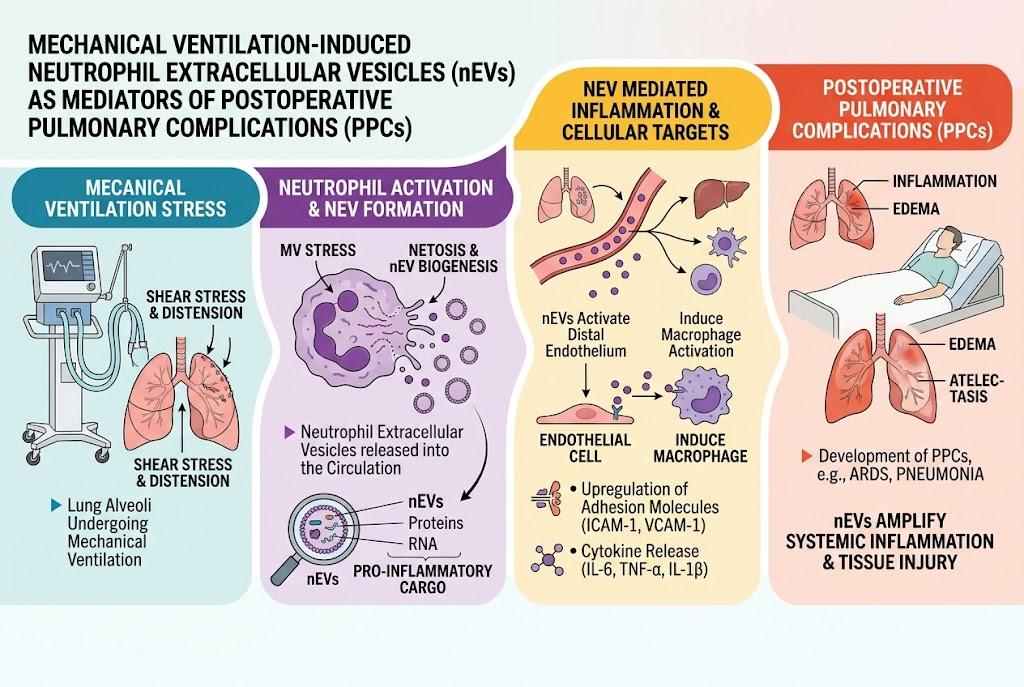
Mechanical ventilation, especially one-lung ventilation, induces a significant release of neutrophil-derived extracellular vesicles (NEVs) in the alveoli. These NEVs carry active matrix metalloproteinases (MMP-8/9) that amplify inflammation in the lung microenvironment, increasing susceptibility to postoperative pulmonary complications (PPCs). NEVs represent promising biomarkers and therapeutic targets to mitigate ventilator-associated lung injury and perioperative lung inflammation.
Study Background
Postoperative pulmonary complications remain a major contributor to perioperative morbidity and mortality following thoracic and major abdominal surgeries. Mechanical ventilation, an essential supportive strategy during general anesthesia, can paradoxically exacerbate lung injury through alveolar overstretch and inflammation, a phenomenon recognized as ventilator-induced lung injury (VILI). Despite advances in ventilation strategies, the biological mediators linking mechanical stretch to sustained lung injury and PPCs are incompletely understood.
One emerging area of interest involves extracellular vesicles (EVs), small membrane-bound particles released by cells that mediate intercellular communication. While EVs have been implicated in various pulmonary diseases, the role of alveolar stretch-induced EVs, particularly from neutrophils, in perioperative lung injury has not been previously characterized. This study addresses an unmet need to elucidate the mechanistic role of EVs in ventilator-induced alveolar inflammation and clinical pulmonary complications.
Study Design
A prospective clinical study was conducted with 42 patients undergoing esophagectomy who required both one-lung and two-lung ventilation sequentially. Serial bronchoalveolar lavage (BAL) samples were collected bilaterally to capture local pulmonary responses. Neutrophil-derived EVs (NEVs) were identified by flow cytometry, and their content analyzed by Western blotting for neutrophil-specific inflammatory enzymes MMP-8 and MMP-9. The inflammatory milieu in BAL fluid and clinical outcomes, specifically incidences of PPCs, were correlated to NEV dynamics.
Complementary in vitro experiments used a co-culture model of human alveolar epithelial cells with neutrophils subjected to mechanical stretch mimicking injurious ventilation. Mechanisms of NEV biogenesis were explored focusing on cellular signaling pathways, including ATP-dependent processes. The bioactivity of isolated NEVs was assessed in a human alveolar epithelial cell-macrophage coculture system to evaluate their pro-inflammatory potential and the effect of MMP inhibition.
Key Findings
One-lung ventilation, which imposes greater alveolar stretch and stress, triggered a profound 4.8-fold increase in BAL neutrophil-derived EVs compared to two-lung ventilation. These NEVs contained elevated levels of active MMP-8 and MMP-9, enzymes known to degrade extracellular matrix components and promote inflammation. Their presence correlated strongly with local inflammatory markers as well as a higher rate of PPCs, such as pneumonia and acute lung injury.
In vitro, excessive mechanical stretch induced NEV release from epithelial-neutrophil co-cultures via an ATP-dependent signaling mechanism, highlighting a direct mechanotransduction pathway. Functional assays demonstrated that NEVs promoted robust pro-inflammatory responses in epithelial-macrophage co-cultures, an effect that was significantly attenuated by pharmacologic MMP inhibitors, validating the pathogenic role of their enzymatic cargo.
Overall, the data support a novel mechanistic axis where mechanical ventilation induces neutrophil EV release, which then propagates further alveolar inflammation, exacerbating the risk of PPCs.
Expert Commentary
This study provides compelling translational insights into the cellular and molecular pathways linking mechanical ventilation to postoperative lung injury. By identifying neutrophil-derived extracellular vesicles as key mediators, it extends the concept of ventilator-induced lung inflammation beyond direct mechanical damage to include EV-mediated intercellular communication.
The identification of MMP-8 and MMP-9 within NEVs underscores the importance of protease activity in lung tissue remodeling and inflammation after ventilation. Therapeutically, these findings raise the intriguing possibility of targeting EV release or MMP activity to reduce lung injury. Moreover, measuring NEV levels in BAL could serve as an early biomarker for risk stratification of PPCs, facilitating personalized perioperative management.
Some limitations include the relatively small patient cohort and focus on a single surgical population, which may affect generalizability. Further research in broader cohorts and multi-center studies is warranted. Additionally, the causal role of NEVs in vivo awaits validation through interventional trials.
Conclusion
This study identifies neutrophil-derived extracellular vesicles released during mechanical ventilation as pivotal mediators of alveolar inflammation and postoperative pulmonary complications. These findings illuminate a novel pathway whereby injurious alveolar stretch triggers the release of bioactive EVs carrying inflammatory enzymes that potentiate lung injury.
NEVs hold promise as both biomarkers for early detection of ventilator-induced pulmonary inflammation and as therapeutic targets to mitigate postoperative lung injury. Future clinical trials focusing on modulating EV generation or blocking their pathogenic cargo could substantially improve outcomes for surgical patients requiring mechanical ventilation.
Funding and ClinicalTrials.gov
Funding sources were not detailed in the original abstract. The clinical trial registry number was not provided. Further investigation into funding origins and trial registration is recommended to ensure transparency and reproducibility.
References
Stephens JR, Heng S, Cutting A, et al. Mechanical ventilation-induced neutrophil extracellular vesicles as mediators of postoperative pulmonary complications. Am J Respir Crit Care Med. 2026 Sep 15. PMID: 42742361.
Fan E, Del Sorbo L, Goligher EC, et al. An Official American Thoracic Society/European Society of Intensive Care Medicine/Society of Critical Care Medicine Clinical Practice Guideline: Mechanical Ventilation in Adult Patients with Acute Respiratory Distress Syndrome. Am J Respir Crit Care Med. 2017;195(9):1253-1263.
Guervilly C, Boulanger CM, Forel JM, et al. Extracellular vesicles in acute respiratory distress syndrome: new players in the pathophysiology and promising biomarkers. Intensive Care Med. 2019;45(5):650-652.
Middleton EA, He X, Denorme F, et al. Neutrophil extracellular traps contribute to immunothrombosis in COVID-19 acute respiratory distress syndrome. Blood. 2020;136(10):1169-1179.
Soni S, Kumar S. Mechanical ventilation and pulmonary inflammation: resolution of the puzzle. Crit Care Med. 2018;46(2):309-310.