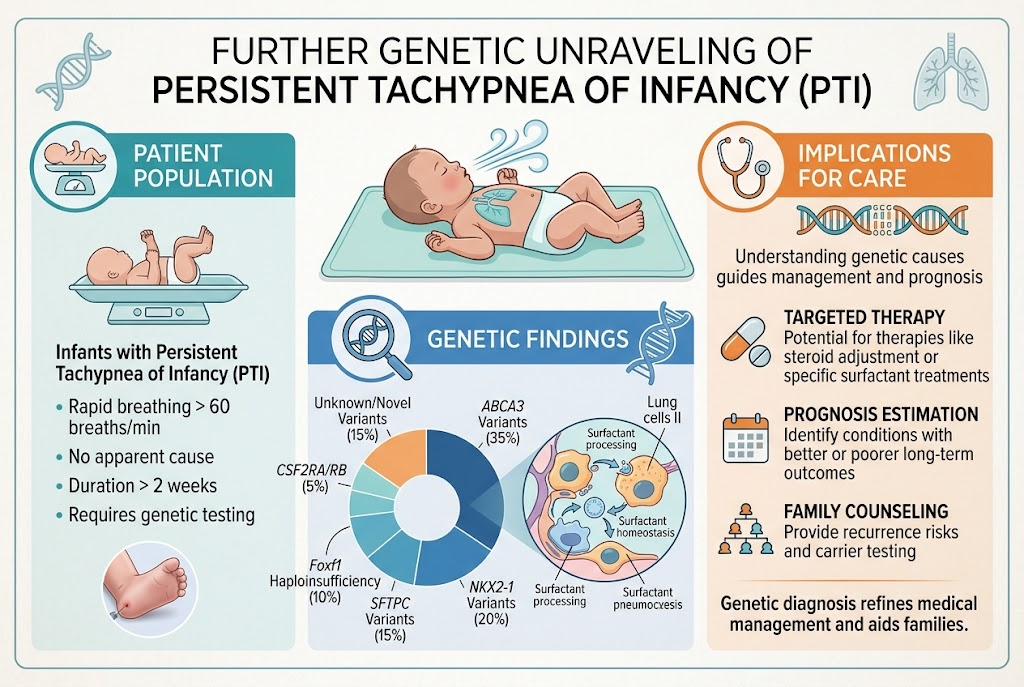
 Highlight
Persistent tachypnea of infancy (PTI), often known as neuroendocrine cell hyperplasia of infancy (NEHI), represents a phenotypic spectrum rather than a singular disease entity.
Broad genetic testing using exome sequencing identified potentially pathogenic variants in genes primarily associated with neurodevelopmental disorders in children diagnosed with PTI/NEHI.
Children with PTI/NEHI and neurodevelopmental comorbidities had a significantly higher rate of genetic diagnosis than those without such comorbidities, highlighting the value of comprehensive genetic evaluation.
Early exome sequencing is recommended for PTI/NEHI patients, especially those presenting with neurodevelopmental impairments, to reduce diagnostic delays and improve clinical management.
Study Background and Disease Burden
Childhood interstitial lung diseases (chILDs) are a rare, heterogeneous group of chronic pulmonary disorders presenting with nonspecific symptoms, often leading to underdiagnosis or misdiagnosis. Persistent tachypnea of infancy (PTI), frequently referred to as neuroendocrine cell hyperplasia of infancy (NEHI), is among the more common chILD presentations, characterized primarily by persistent rapid breathing in infants without clear etiology. Despite its relative frequency, the underlying causes of PTI/NEHI remain poorly understood, and diagnostic challenges persist due to overlapping clinical features and lack of definitive biomarkers.
Given the scarcity of targeted diagnostic tools and the significant impact of delayed or missed diagnosis on patient outcomes and family counseling, there is a critical need for improved diagnostic strategies. Genetic investigation represents a promising frontier, as various interstitial lung diseases have been associated with specific genetic mutations. However, PTI/NEHI’s genetic underpinnings have been elusive, with prior testing often limited to small gene panels or candidate genes.
Study Design and Methods
The referenced multi-center study aimed to evaluate the diagnostic yield of comprehensive genetic testing, specifically exome sequencing, in infants and children diagnosed clinically and radiologically with PTI/NEHI. A total of 79 patients with PTI/NEHI were compared to a chILD cohort who did not fulfill PTI/NEHI diagnostic criteria (non-PTI/NEHI group). Exome sequencing allowed broad genetic interrogation beyond established candidate genes.
The analysis assessed the detection of potentially pathogenic variants and correlation with clinical phenotypes, including neurodevelopmental status. Stratification based on comorbidities enabled evaluation of whether genetic findings clustered in subgroups, providing insights into disease heterogeneity and guiding genetic testing recommendations.
Key Findings
The study identified potentially pathogenic gene variants in 12 patients with PTI/NEHI, a notable finding given the historically limited genetic diagnoses in this population. Variants were found in genes associated predominantly with neurodevelopmental disorders: SRRM2 (5 patients), NAA10 (3 patients), and also BRWD3, DEPDC5, NKX2-1, and UBE3B.
These genes are involved in complex multisystem disorders, and their recurrence exclusively within the PTI/NEHI subgroup suggests a link between PTI/NEHI features and broader syndromic presentations rather than a standalone pulmonary disease. This convergence supports a conceptual model of PTI/NEHI as a phenotype with heterogeneous genetic etiologies.
Clinically, the rate of genetic diagnosis was substantially higher in patients who exhibited neurodevelopmental comorbidities (45.8%) compared to those without (1.8%). This statistical association (P < .001) emphasizes the importance of screening for neurological involvement during clinical assessment, which can aid in prioritizing patients for comprehensive genetic evaluation.
For the broader chILD population without PTI/NEHI features, genetic yield was comparatively lower, underscoring the specificity of these genetic findings within the PTI/NEHI phenotype.
Expert Commentary
This study advances our understanding of PTI/NEHI by providing compelling evidence that it should not be viewed solely as a discrete pulmonary diagnosis. Instead, the genetic overlap with neurodevelopmental disorders highlights a need for multidisciplinary evaluation involving pulmonologists, geneticists, and neurologists.
These findings challenge clinicians to reconsider diagnostic algorithms for infants with persistent tachypnea. Exome sequencing emerges as a valuable tool, especially for patients with neurodevelopmental features, enabling earlier diagnosis and informing tailored management plans, including genetic counseling and anticipatory guidance for multisystem involvement.
Limitations of the study include the relatively small sample size inherent to rare diseases and the interpretation challenges surrounding variants of uncertain significance. Future research should aim to replicate findings in larger cohorts and explore genotype-phenotype correlations longitudinally to clarify mechanisms linking neurodevelopmental genetics and pulmonary manifestations.
Conclusion
The current data decisively indicate that PTI/NEHI represents a phenotypic manifestation that frequently coexists with, or is part of, complex genetic syndromes predominantly characterized by neurodevelopmental delays. Integrating comprehensive genetic testing early in the diagnostic workup, particularly exome sequencing, substantially increases the likelihood of a definitive diagnosis in PTI/NEHI patients with neurological comorbidities.
This paradigm shift moves clinical care toward precision medicine approaches in rare pediatric lung diseases, reducing diagnostic delays and guiding multidisciplinary management strategies. Further studies are warranted to expand genetic panels, validate clinical predictors for testing prioritization, and ultimately improve outcomes and quality of life for affected infants and their families.
Funding and ClinicalTrials.gov
The original study was supported through multicentric academic collaboration. No specific clinical trial registration was detailed. Readers are encouraged to consult the original publication for detailed funding disclosures.
References
Rapp CK, Mauss-Schwarzer K, Kappler M, et al. Further Genetic Unraveling of Persistent Tachypnea of Infancy. Chest. 2026 May 14;170(3):834-845. PMID: 42140483.
Young LR, Deutsch GH, Popler J, et al. Neuroendocrine cell hyperplasia of infancy: clinical and histopathologic features. Pediatr Pulmonol. 2014 Jan;49(1):48-58.
Young LR. Childhood Interstitial Lung Disease. En: Fan LL, Brody AS, Hibbert M, editors. Evidence-Based Critical Care Pediatrics. Springer; 2020.
Bocker R, Hofmann S, Rost I. Advances in molecular diagnostics of childhood interstitial lung diseases. Pediatr Pulmonol. 2020;55(9):2468-2477.