Highlight
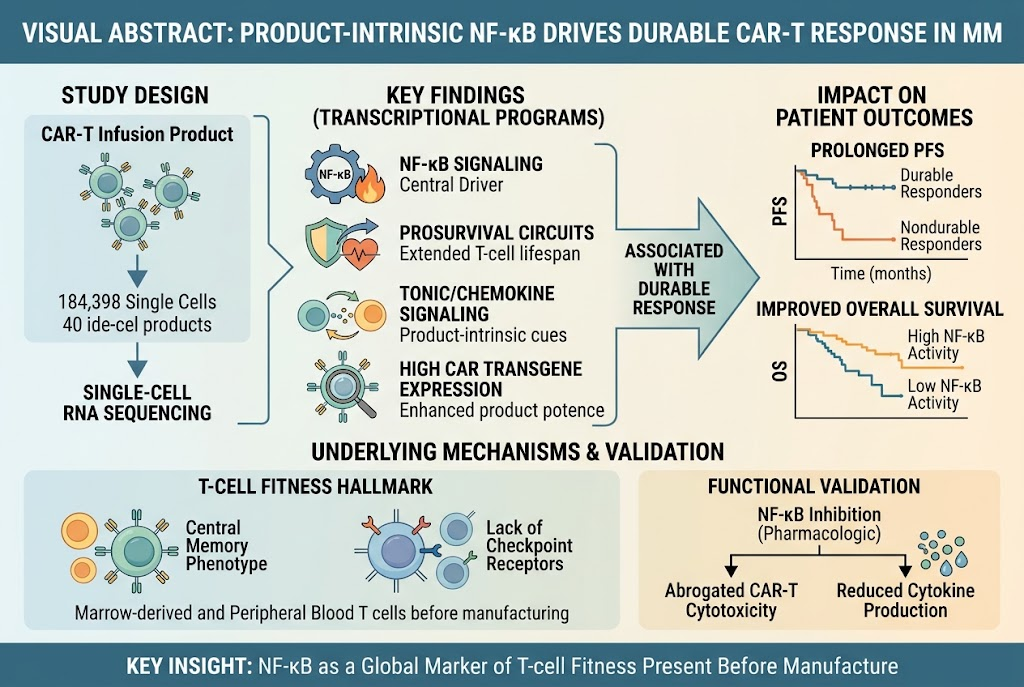
• Single-cell RNA sequencing of 40 idecabtagene vicleucel (ide-cel) products identified distinct transcriptional programs in CD4 CAR-T cells linked to durable therapeutic responses in multiple myeloma.
• NF-κB signaling and prosurvival gene circuits within these CAR-T cells were associated with improved progression-free and overall survival.
• Pre-manufacturing tumor microenvironment and peripheral blood T cells exhibiting elevated NF-κB activity correlated with T-cell fitness markers such as central memory phenotype and low checkpoint receptor expression.
• Pharmacological inhibition of NF-κB abrogated CAR-T cell cytotoxicity and cytokine production, confirming NF-κB’s functional relevance in CAR-T anti-myeloma activity.
Study Background
Multiple myeloma, a malignant plasma cell disorder, remains incurable despite advances in therapy. Recent developments of chimeric antigen receptor T-cell (CAR-T) therapies targeting B-cell maturation antigen (BCMA) have demonstrated deep responses in relapsed/refractory multiple myeloma patients. Idecabtagene vicleucel (ide-cel), an FDA-approved BCMA-directed CAR-T product, can induce remissions; however, more than 50% of patients relapse within one year post-infusion. This high relapse rate highlights a critical unmet need to understand intrinsic cellular determinants within CAR-T infusion products that predict durable response. Defining transcriptional programs at single-cell resolution can elucidate features that govern CAR-T persistence, function, and clinical outcome. Such insights can guide patient counseling, improve manufacturing protocols, and inform strategies for combinatory or adjunctive therapies to enhance treatment durability.
Study Design
This study profiled 40 ide-cel infusion products comprising 184,398 single CAR-T cells using single-cell RNA sequencing (scRNA-seq). The cohort included patients with relapsed/refractory multiple myeloma undergoing ide-cel therapy. The analysis focused on intrinsic transcriptional signatures within CD4+ and CD8+ CAR-T cells distinguishing durable responders from nondurable responders. Paired samples of apheresis collections and tumor microenvironment (bone marrow) T cells were evaluated to investigate pre-manufacture T-cell fitness markers. Functional assays examined the effect of pharmacological NF-κB inhibition on CAR-T cytotoxicity and cytokine release. The clinical endpoints were progression-free survival (PFS) and overall survival (OS), with transcriptional findings correlated to these outcomes.
Key Findings
Comprehensive scRNA-seq analysis revealed that CD4 CAR-T cells from patients with durable responses exhibited a distinctive transcriptional program prominently characterized by upregulated NF-κB signaling pathways. This transcriptional program also included activation of prosurvival circuits, tonic and chemokine signaling, and elevated expression of the CAR transgene itself. These molecular features were significantly associated with prolonged progression-free and overall survival, independent of conventional baseline clinical prognostic indicators.
Further paired sample analyses determined that elevated NF-κB activity was intrinsic to T-cell fitness prior to CAR-T product manufacturing. This NF-κB signature correlated strongly with a central memory T-cell phenotype, which is generally associated with long-term persistence and robust immune responses. Notably, T cells with higher NF-κB activity lacked expression of checkpoint inhibitory receptors such as PD-1 and CTLA-4, markers typically linked to T-cell exhaustion. These features were evident both in bone marrow-derived and peripheral blood T cells before genetic modification, suggesting a preexisting quality of T cells that favor durable CAR-T efficacy.
Pharmacologic inhibition studies underscored the functional importance of NF-κB signaling. In vitro blockade of NF-κB signaling abrogated CAR-T cytotoxicity against myeloma cells and significantly reduced cytokine production, demonstrating NF-κB as a critical signaling axis supporting CAR-T cell effector function.
The study firmly establishes NF-κB activation within CAR-T products as a predictive biomarker for durable response and as a mechanistic driver of effective anti-myeloma activity.
Expert Commentary
The identification of NF-κB-driven transcriptional programs as correlates of durable CAR-T response is a significant advancement in the multiple myeloma treatment landscape. It highlights the importance of T-cell intrinsic signaling pathways in modulating CAR-T fitness and functional longevity. The focus on CD4 CAR-T cells is notable, given that CD4 subsets contribute regulatory and helper functions critical for sustained anti-tumor immunity.
This work aligns with broader immunological evidence underscoring central memory T cells as superior substrates for adoptive cell therapy. Furthermore, understanding the NF-κB axis offers a strategic translational opportunity: enhancing NF-κB signaling during CAR-T manufacturing or selectively enriching NF-κB–active T cells could improve clinical durability. Conversely, care must be taken in combinatory regimens that might inadvertently inhibit NF-κB, thereby compromising CAR-T effectiveness.
A limitation is that the study focused primarily on transcriptional correlates from a single CAR-T product (ide-cel) and disease context. Future research should validate these findings across other CAR-T constructs and hematologic malignancies. Additionally, longitudinal studies examining post-infusion persistence and in vivo signaling dynamics will further clarify NF-κB’s role over time.
Conclusion
This study delineates that intrinsic NF-κB-driven transcriptional programs within CD4 CAR-T cells serve as crucial markers and mediators of durable responses in ide-cel therapy for relapsed/refractory multiple myeloma. Elevated NF-κB signaling reflects a pre-manufacturing T-cell fitness state characterized by a central memory phenotype and minimal exhaustion marker expression. These insights provide a rational basis for enhancing CAR-T durability through biomarker-guided patient selection and manufacturing optimizations aimed at preserving or augmenting NF-κB activity. Moreover, therapeutic modulation of NF-κB signaling may represent a promising avenue to improve CAR-T efficacy and overcome early relapse in multiple myeloma patients.
Funding and Clinical Trials
The study was supported by institutional research grants and collaborations among academic and clinical research centers specializing in CAR-T therapies. Specific funding sources were not detailed. The clinical trial registration for idecabtagene vicleucel in multiple myeloma can be found under NCT number NCT03274219.
References
1. Noble JD, Peixoto BC, Menges MA, et al. Product-intrinsic NF-κB-driven transcriptional programs connote durability of CAR-T response in multiple myeloma. Blood. 2026 Sep 10;148(11):1409-1422. PMID: 42275255.
2. Munshi NC, Anderson LD Jr, Shah N, et al. Idecabtagene vicleucel in relapsed and refractory multiple myeloma. N Engl J Med. 2021;384(8):705-716.
3. Fraietta JA, Lacey SF, Orlando EJ, et al. Determinants of response and resistance to CD19 chimeric antigen receptor (CAR) T cell therapy of chronic lymphocytic leukemia. Nat Med. 2018;24(5):563-571.
4. Gattinoni L, Klebanoff CA, Restifo NP. Paths to stemness: building the ultimate antitumor T cell. Nat Rev Cancer. 2012;12(10):671-684.
5. Chen X, Jensen SM, Miao G, et al. CAR-T cell therapy for hematologic malignancies: current opportunities and challenges. Leukemia. 2022;36(2):338-351.