Highlight
– Mazdutide, a dual agonist of glucagon and GLP-1 receptors, significantly reduces body weight in adults with obesity or overweight.
– Higher doses (10 mg and 16 mg) demonstrated superior weight loss efficacy compared to lower dose (3-6 mg) and placebo.
– The treatment was generally well tolerated, with gastrointestinal side effects being the most common adverse events.
Study Background
Obesity is a chronic, multifactorial disease associated with increased risk for type 2 diabetes, cardiovascular disease, and overall mortality. Despite the availability of multiple weight-loss medications, the quest for more effective and safe therapies continues, especially those that can provide substantial and sustained weight reduction. The glucagon-like peptide-1 (GLP-1) receptor agonists have transformed obesity management, improving weight loss and glycemic control, often combined with good tolerability. Recently, dual agonists targeting both GLP-1 and glucose-dependent insulinotropic polypeptide (GIP) receptors have shown promising results, opening new avenues for enhanced therapeutic efficacy.
Mazdutide is a novel dual agonist that activates both glucagon and GLP-1 receptors, representing a differentiated pharmacological approach in obesity therapy. Glucagon receptor activation has the potential to increase energy expenditure, while GLP-1 receptor activation reduces appetite and improves metabolic parameters. The potential dual effect may lead to superior bodyweight reduction compared to existing therapies.
Study Design
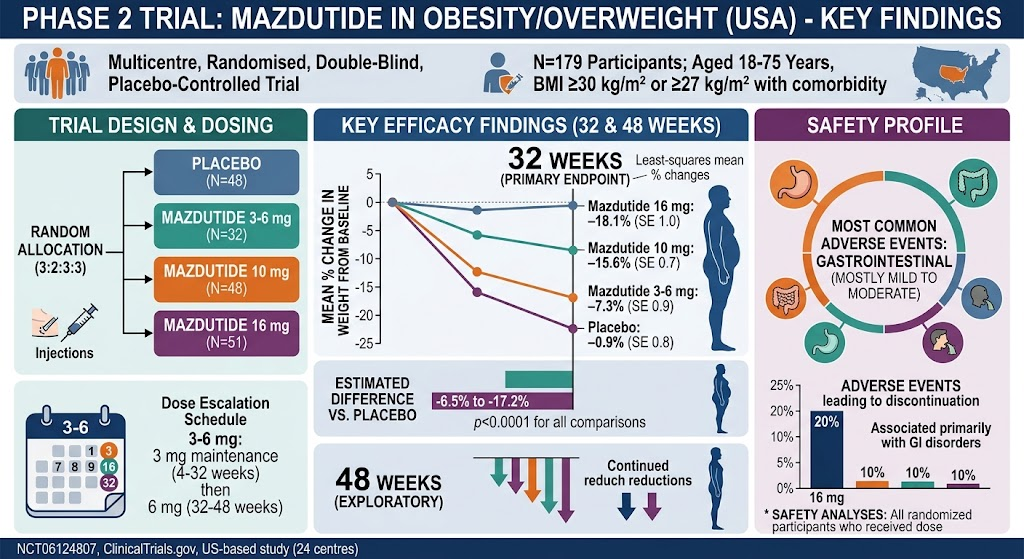
This phase 2, randomised, double-blind, placebo-controlled trial was conducted at 24 centers across the USA. The study enrolled 179 adults aged 18 to 75 years with obesity (body mass index [BMI] ≥30 kg/m2) or overweight (BMI 27-<30 kg/m2) with at least one weight-related comorbidity, excluding individuals with type 2 diabetes.
Participants were randomly allocated in a 3:2:3:3 ratio to receive once-weekly subcutaneous injections of placebo or mazdutide at doses of 3-6 mg, 10 mg, or 16 mg for 48 weeks. The 3-6 mg group began with 3 mg once weekly for the first 32 weeks, escalating to 6 mg thereafter to evaluate both doses as maintenance therapies. The primary endpoint was the percentage change in body weight from baseline to 32 weeks, measured using an efficacy estimand. Safety analyses included all participants who received at least one dose of the medication.
Key Findings
Baseline characteristics showed a mean age of 47.7 years (SD 12.3); 66% were female and 34% male. At 32 weeks, mazdutide resulted in substantial and dose-dependent bodyweight reductions compared to placebo:
- 3-6 mg group: -7.3% (SE 0.9%)
- 10 mg group: -15.6% (SE 0.7%)
- 16 mg group: -18.1% (SE 1.0%)
- Placebo group: -0.9% (SE 0.8%)
The estimated treatment differences compared to placebo were statistically significant (p<0.0001) across all doses, ranging from -6.5% to -17.2%. Extended treatment to 48 weeks yielded further additional weight loss, underscoring the durability and incremental benefit over time.
The safety profile was consistent with GLP-1 receptor agonism, predominantly gastrointestinal adverse events such as nausea, vomiting, and diarrhea, mostly mild to moderate in severity. Discontinuations due to adverse events were highest in the 16 mg group (20%), mainly attributed to gastrointestinal symptoms, suggesting increased dose-related tolerability challenges at the highest dose.
Expert Commentary
This trial solidifies mazdutide’s potential as a clinically meaningful treatment option for obesity management by leveraging dual receptor agonism. The superior weight reductions at higher doses exceed many current pharmacotherapies and are comparable with or possibly better than recently approved agents such as semaglutide or tirzepatide. The inclusion of glucagon receptor activation may contribute to increased energy expenditure, enhancing weight loss beyond appetite suppression alone.
However, the gastrointestinal side effect profile observed, particularly at 16 mg, requires careful consideration regarding dose selection and patient tolerance. Future studies should focus on optimizing titration schedules and evaluating long-term safety and cardiovascular outcomes. Moreover, inclusion of more diverse populations beyond the US setting and extended follow-up will be important for assessing generalizability and sustained benefit.
These results align with emerging evidence supporting multi-receptor targeting in obesity treatment and underscore the need for personalized approaches balancing efficacy and tolerability.
Conclusion
Once-weekly mazdutide administration leads to robust, dose-dependent weight loss in adults with obesity or overweight without type 2 diabetes. Higher doses (10 mg and 16 mg) offer additional bodyweight reduction, although with increased gastrointestinal adverse effects at the highest dose. Mazdutide stands as a promising novel pharmacotherapy that could expand and enhance current obesity treatment paradigms.
Further phase 3 trials are warranted to confirm long-term safety and effectiveness, explore cardiovascular and metabolic benefits, and define optimal dosing regimens to maximize patient adherence and clinical outcomes.
Funding and Registration
This study was funded by Eli Lilly and Company. The trial is registered with ClinicalTrials.gov under the identifier NCT06124807.
References
- Hsia SH, Bays HE, Billings LK, et al. Efficacy and safety of mazdutide in adults with obesity or overweight: a US-based, multicentre, phase 2, randomised, placebo-controlled clinical trial. Lancet Diabetes Endocrinol. 2026 Aug 21;PMID:42628555.
- Wilding JPH, Batterham RL, Calanna S, et al. Once-Weekly Semaglutide in Adults with Overweight or Obesity. N Engl J Med. 2021;384:989-1002.
- Frias JP, Nauck MA, Van J, et al. Efficacy and safety of tirzepatide, a dual GIP and GLP-1 receptor agonist, in patients with type 2 diabetes (SURPASS-2): a randomised, open-label, phase 3 trial. Lancet. 2021;398(10295):143-155.