Highlight
- Lung transplantation is a rare but critical treatment option for patients with progressive rheumatoid arthritis-related interstitial lung disease (RA-ILD).
- Risk factors associated with undergoing lung transplantation in RA-ILD include younger age, male sex, and select comorbidities such as diabetes, congestive heart failure, and chronic obstructive pulmonary disease (COPD).
- The median survival following lung transplantation in RA-ILD patients within a universal healthcare system is approximately 4.3 years, comparable to international data.
Study Background
Rheumatoid arthritis (RA) is a systemic autoimmune disorder primarily affecting joints but frequently accompanied by pulmonary manifestations, notably interstitial lung disease (ILD). RA-ILD significantly contributes to morbidity and mortality in RA populations. Despite advances in immunomodulatory therapies, a subset of patients experience progressive respiratory failure warranting lung transplantation. However, data regarding transplantation risk factors and outcomes in RA-ILD remain limited, particularly from universal healthcare environments that may influence access and longitudinal care.
Study Design
This retrospective observational cohort study utilized comprehensive administrative and clinical data from the Ontario Rheumatoid Arthritis Database, covering the period 2003 to 2022. Patients diagnosed with RA-ILD were identified, and those undergoing lung transplantation were examined. The study employed a cause-specific hazards model incorporating competing risks to identify factors associated with transplantation, and a Cox proportional hazards model to analyze post-transplantation survival outcomes.
Key Findings
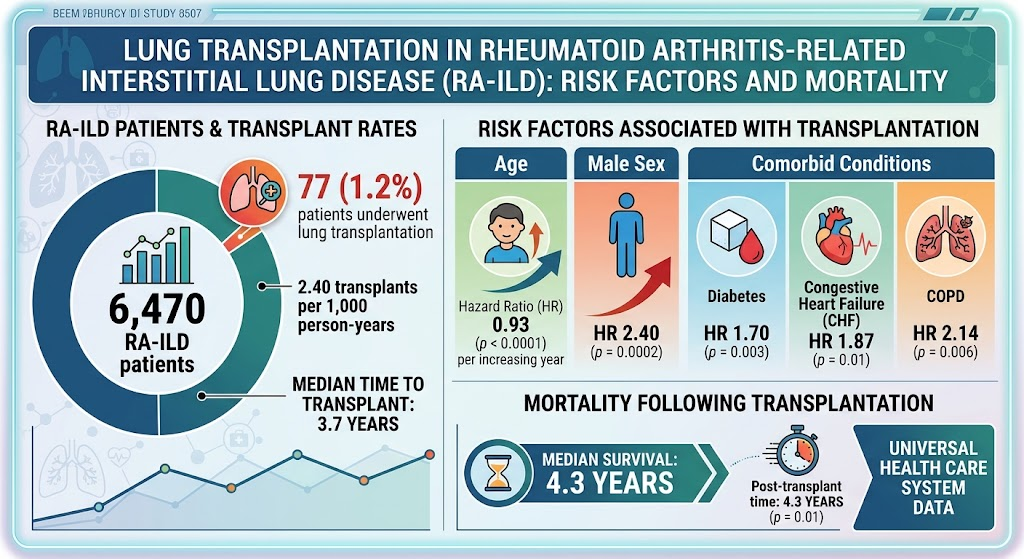
The cohort comprised 6,470 patients with RA-ILD. Among these, 77 patients (1.2%) received lung transplants, equating to an incidence rate of 2.40 transplants per 1000 person-years. The median time from RA-ILD diagnosis to transplantation was approximately 3.7 years.
Analysis revealed that younger age significantly increased the likelihood of transplantation, with each additional year decreasing the hazard by 7% (HR 0.93 per year, 95% CI: 0.91-0.95, p < 0.0001). Male sex was associated with over twice the risk compared to females (HR 2.40, 95% CI: 1.52-3.78, p = 0.0002).
Notably, comorbid conditions influenced transplantation probabilities: diabetes (HR 1.70, 95% CI: 1.06-2.73, p = 0.003), congestive heart failure (HR 1.87, 95% CI: 1.15-3.04, p = 0.01), and COPD (HR 2.14, 95% CI: 1.25-3.68, p = 0.006) were associated with increased likelihood of lung transplantation. These findings suggest complex clinical interactions possibly reflecting disease severity or referral patterns.
Post-transplant median survival was 4.3 years, aligning with previously reported survival data from other cohorts. This underscores lung transplantation as a viable intervention offering substantial survival benefit to patients with advanced RA-ILD.
Expert Commentary
The study meaningfully contributes to understanding lung transplantation in RA-ILD by leveraging a large, population-based database within a universal healthcare setting. Identification of patient characteristics and comorbidities linked to transplantation underscores the multifaceted nature of clinical decision-making in end-stage RA-ILD.
Comorbidities such as diabetes and congestive heart failure increasing transplantation risk may reflect patient selection nuances or systemic vulnerability necessitating transplantation. The observed survival post-transplantation suggests that RA-ILD patients derive outcomes comparable to other ILD populations, supporting transplantation referral when appropriate.
Limitations include the retrospective design and lack of granularity on disease severity indices, immunosuppressive regimens, and perioperative complications. Moreover, universal healthcare systems may differ internationally in transplant access, potentially limiting global generalizability.
Conclusion
Lung transplantation remains a rare but crucial therapeutic option for progressive RA-ILD. Younger age, male sex, and certain comorbid conditions correlate with increased transplantation likelihood. Post-transplant survival outcomes are consistent with prior data, affirming the procedure’s role in improving prognosis in an otherwise fatal disease trajectory. Further prospective studies are warranted to optimize patient selection and perioperative management, enhancing long-term outcomes in RA-ILD lung transplantation.
Funding and ClinicalTrials.gov
The original publication does not report specific external funding sources. This study was conducted using administrative health data from Ontario, Canada.
References
- Fidler LM, Arbiv OA, Munn JS, Fisher JH, Shapera S, Austin PC, Gershon AS. Lung Transplantation in Rheumatoid Arthritis Related Interstitial Lung Disease: Risk Factors and Mortality in a Universal Health Care System. Clin Transplant. 2026 Aug;40(8):e70644. PMID: 42599742.
- Fischer A, du Bois R. Interstitial lung disease in connective tissue disorders. Lancet. 2012;380(9842):689-698.
- Ahmad K, et al. Epidemiology and outcome of lung transplantation in interstitial lung disease. Respir Med. 2020;169:105987.
- Solomon JJ, et al. Rheumatoid arthritis-associated interstitial lung disease: diagnostic evaluation and management. Rheum Dis Clin North Am. 2014;40(4):637-654.