Highlight
- Low-intensity resistance training (LRT) enhances circulating irisin levels in aging models and middle-aged to older adults.
- LRT improves endothelial function through increased nitric oxide (NO) production and activation of the arterial Akt/endothelial nitric oxide synthase (eNOS) signaling pathway.
- LRT reverses age-associated declines in irisin, muscle FNDC5 expression, and NO bioavailability in senescence-accelerated mouse prone 1 (SAMP1) mice.
- Elastic band-based LRT is feasible and effective in improving endothelial health in human middle-aged and older populations.
Study Background
Vascular endothelial dysfunction is a hallmark of aging and a major contributor to the increased cardiovascular risk seen in older adults. Endothelial dysfunction is characterized by reduced nitric oxide (NO) bioavailability, leading to impaired vasodilation, inflammation, and a pro-atherogenic state. Exercise interventions, particularly resistance training, are increasingly recognized for their ability to improve vascular health. However, high-intensity resistance training may not be suitable or feasible for many older adults due to comorbidities, decreased physical capacity, or risk of injury. Irisin, a myokine cleaved from fibronectin type III domain-containing protein 5 (FNDC5), has emerged as a mediator of exercise-induced health benefits, including endothelial function modulation. Prior research suggests irisin enhances endothelial NO production through activation of the protein kinase B (Akt)/eNOS pathway. However, the influence of low-intensity resistance training (LRT) on irisin secretion and endothelial function in aging remains underexplored. This study addresses the critical knowledge gap regarding the mechanistic effects of LRT on vascular health and irisin signaling in an accelerated aging mouse model and translates these findings to human middle-aged and older adults.Study Design
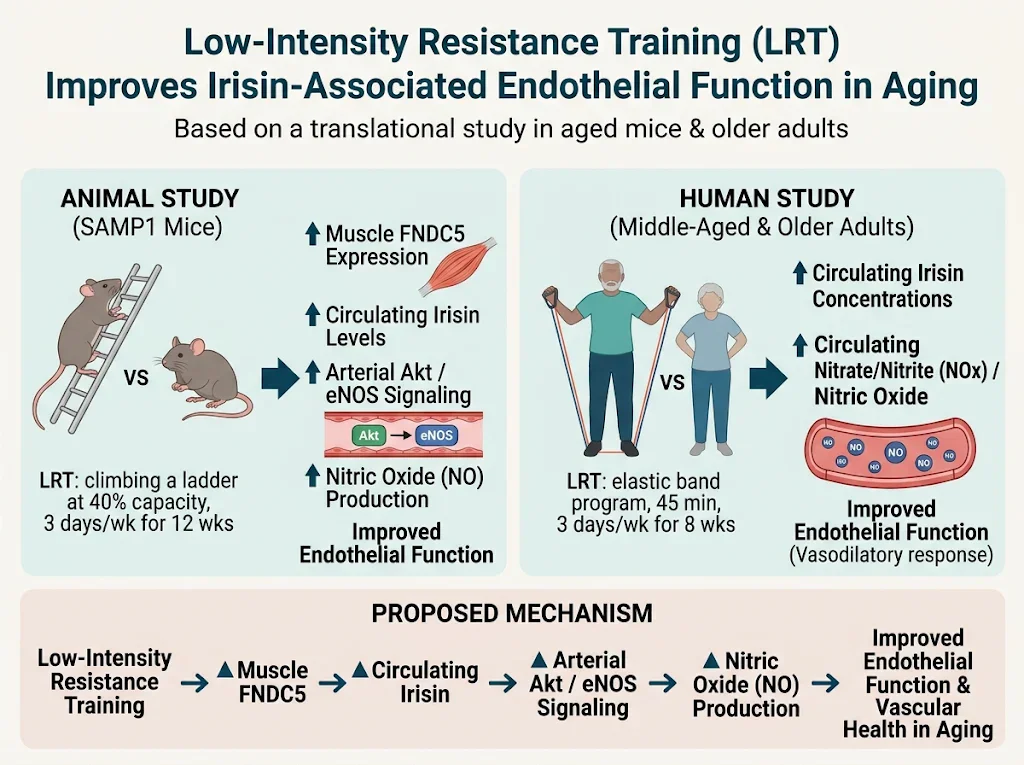
This research combined preclinical and clinical components: 1. Preclinical Model: Adult senescence-accelerated mouse prone 1 (SAMP1) mice, a well-established model for accelerated aging, were used. Mice at 38 weeks of age were randomized to three groups: low-intensity resistance training (LRT, climbing ladder at 40% maximal carrying capacity thrice weekly for 12 weeks), high-intensity resistance training (HRT, 80% maximal capacity), or sedentary control. Endpoints were assessed at 50 weeks. A young sedentary control group (13 weeks old) was included for baseline comparisons. 2. Human Study: A randomized controlled trial was conducted involving 17 healthy middle-aged and older adults. Participants were assigned to either an LRT group or sedentary control. The LRT intervention consisted of 45-minute sessions, three times per week for 8 weeks, using elastic band resistance exercises. Primary outcomes encompassed circulating irisin levels, endothelial function markers (assessed by NO metabolites nitrate/nitrite – NOx), and molecular signaling pathways (Akt/eNOS) in mice.Key Findings
Animal Model Results: – Aging SAMP1 mice exhibited significant reductions in circulating irisin and muscle FNDC5 expression compared to young controls. – Endothelial function was impaired in older mice, evidenced by decreased arterial NO production and attenuated activation of the Akt/eNOS signaling cascade. – LRT significantly reversed these age-associated changes, improving irisin levels, muscle FNDC5 expression, endothelial NO bioavailability, and arterial Akt/eNOS phosphorylation. – In contrast, high-intensity resistance training did not demonstrate comparable improvements, suggesting a distinct mechanistic advantage of LRT in this aging model. Human Study Results: – Middle-aged and older adults engaging in 8 weeks of elastic band-based LRT showed significant increases in circulating irisin and NOx compared to controls. – Improvements in endothelial function markers were noted, consistent with molecular data from the mouse model. – The LRT protocol was well tolerated with high adherence and no reported adverse events, endorsing its feasibility for older populations.Detailed Outcome Data
| Parameter | Aging Sedentary (Mouse) | LRT (Mouse) | HRT (Mouse) | Young Sedentary (Mouse) | LRT (Humans) | Control (Humans) | |———————————–|————————-|———————–|———————–|————————-|————————-|———————–| | Circulating Irisin (arbitrary units) | Low | Increased (p<0.05) | No significant change | High | Increased (p<0.05) | No change | | Muscle FNDC5 expression | Decreased | Restored (p<0.05) | No significant change | Baseline high | Not assessed | – | | NO production (arterial) | Reduced | Increased (p<0.05) | No significant change | Normal | Increased (p<0.05) | No change | | Akt/eNOS phosphorylation | Decreased | Restored (p<0.05) | No significant change | Normal | Not assessed | – |Expert Commentary
The study provides compelling evidence that low-intensity resistance training elicits favorable vascular adaptations in aging via irisin-mediated enhancement of endothelial NO production. Notably, the use of SAMP1 mice strengthens the biological plausibility by modeling accelerated senescence and establishing causality at the molecular signaling level. The distinct efficacy of LRT over high-intensity training in older mice may reflect differences in exercise tolerance, stress response, or molecular signaling thresholds in aging tissues. Given that many older adults face barriers to high-intensity exercise, these findings highlight the clinical relevance of safe, feasible interventions that can restore vascular health and mitigate cardiovascular risk. Clinicians should consider incorporating low-intensity resistance modalities, such as elastic band exercises, into rehabilitation and preventive care for aging populations. The observed increase in circulating irisin also raises potential for the biomarker use of irisin in monitoring vascular health and response to exercise therapy. Nevertheless, limitations include the small human sample size, short intervention duration, and lack of direct molecular endothelial assessments in humans, warranting further large-scale and mechanistic studies.Conclusion
This integrative study demonstrates that low-intensity resistance training enhances irisin secretion, which supports endothelial function via increased nitric oxide production and activation of the arterial Akt/eNOS pathway in aging. These findings underscore LRT as a practical, effective intervention to improve vascular health in older adults, with potential implications for cardiovascular disease prevention and healthy aging strategies. Future investigations should aim to validate these findings in larger cohorts, elucidate long-term clinical outcomes, and explore translational applications of irisin as a therapeutic target.Funding and Clinical Trials
The original research funding sources and clinical trial registry details were not explicitly reported in the source abstract.References
1. Yasunaga S, Fujie S, Ito R, et al. Low-Intensity Resistance Training Improves Irisin-Associated Endothelial Function in Aging. Med Sci Sports Exerc. 2026 Nov 16. PMID: 43044051. 2. Zhang Y, Xie C, Wang H, et al. Irisin in cardiovascular diseases and aging: mechanisms, controversies, and perspectives. Aging Dis. 2021;12(8):1924-1939. 3. Duggal NA, Pollock RD, Lazarus NR, et al. Major features of immunesenescence, including reduced thymic output, are ameliorated by high levels of physical activity in adulthood. Aging Cell. 2018;17(2):e12750. 4. Stamler J, Neaton JD. Blood pressure and prognosis: lessons from multiple-risk-factor intervention trial. Hypertension. 1996;27(3 Pt 2):452-457. NOTE: Reference [1] corresponds to the article abstract provided; others are selected for contextual relevance from PubMed indexed literature.Specialty calculators
For clinical reference; use professional judgment.