Highlight
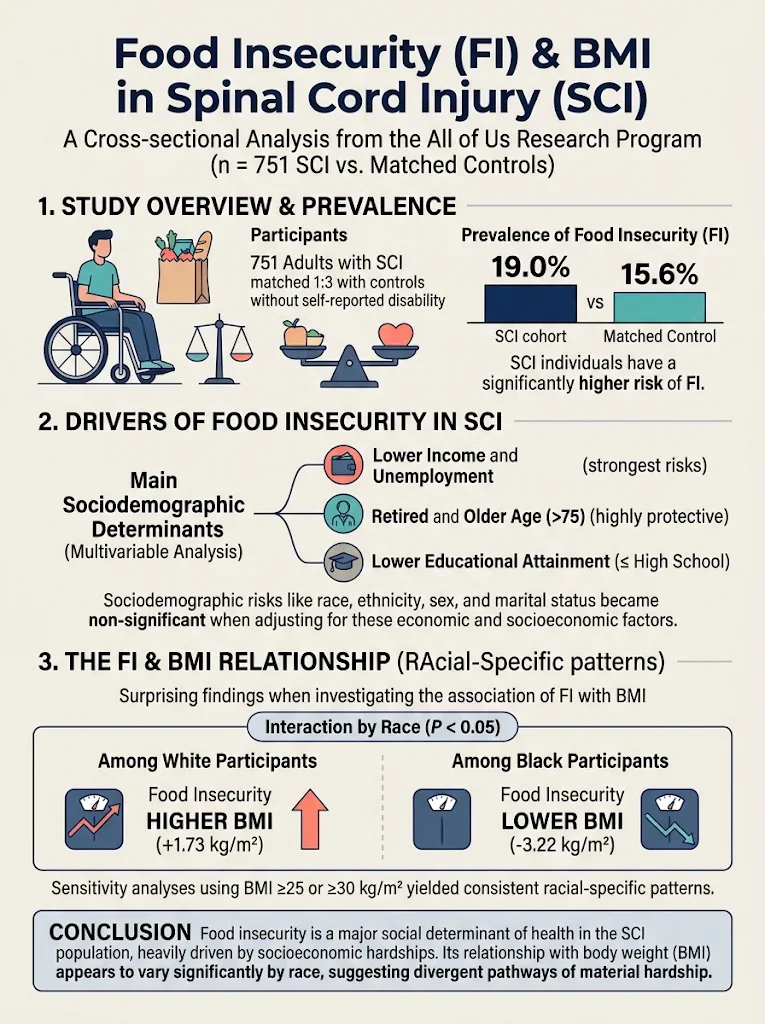
- Adults with spinal cord injury (SCI) experience a higher prevalence of food insecurity (FI) than matched controls without disability.
- Socioeconomic factors, including income, employment status, and education, predominantly influence FI risk rather than race, sex, or marital status in SCI.
- Food insecurity correlates differently with body mass index (BMI) across racial groups: FI associates with higher BMI among White participants but with lower BMI among Black participants.
- These findings indicate complex interactions between social determinants of health, food access, and weight status in SCI populations, necessitating targeted research and interventions.
Study Background
Food insecurity—defined as limited or uncertain access to adequate food for a healthy life—is a critical social determinant of health that disproportionately affects vulnerable populations. Adults with spinal cord injury (SCI) face heightened health challenges, including mobility limitations and secondary complications that may exacerbate risk for nutritional deficits and chronic conditions. Understanding the prevalence and determinants of food insecurity in SCI populations is essential for tailoring healthcare and social support policies. Additionally, body mass index (BMI) is a relevant clinical metric reflecting nutritional status but may be influenced by food insecurity through complex biological and behavioral pathways. Racial and socioeconomic disparities further complicate these relationships, underscoring the need for nuanced analyses using large, diverse cohorts.Study Design
This cross-sectional study analyzed data from the U.S. nationwide All of Us Research Program, comparing 751 adults with SCI to a 1:3 matched control cohort without self-reported disability. Matching criteria included age, sex, race, and ethnicity. The primary outcomes were the prevalence of self-reported food insecurity (FI) and measured body mass index (BMI). Sociodemographic variables including race, ethnicity, sex, age, marital status, employment status, educational attainment, and income were assessed for their association with FI. Logistic regression models evaluated the adjusted determinants of FI, and linear models analyzed the relationship between FI and BMI, incorporating tests for effect modification by race.Key Findings
The study reported that 19.0% of participants with SCI experienced food insecurity, significantly higher than the 15.6% observed in the matched controls (P<.05). Univariate analysis showed increased FI risk among Black and Hispanic individuals, women, younger participants, unmarried individuals, unemployed persons, those with lower educational attainment, and those with lower income—all associations reaching statistical significance (P<.05). However, in multivariable logistic regression controlling for covariates, socioeconomic factors predominated: higher income, being retired, and education beyond high school were associated with significantly lower odds of FI, whereas demographic characteristics such as race, ethnicity, sex, and marital status no longer retained significance. This suggests socioeconomic status rather than inherent demographics primarily drives food insecurity in adults with SCI. Regarding BMI, unadjusted models revealed that FI was associated with higher BMI, indicating food insecurity did not necessarily correspond to underweight status. Nevertheless, after adjusting for covariates, this association was attenuated and no longer statistically significant overall. Notably, exploratory analyses demonstrated significant effect modification by race: among White participants with SCI, FI correlated with a substantial increase in BMI by +1.73 kg/m² (P<.05), while Black participants showed an association of FI with a lower BMI by -3.22 kg/m² (Pinteraction=.02). Sensitivity analyses using BMI cutoffs for overweight (≥25 kg/m²) and obesity (≥30 kg/m²) confirmed these distinct racial patterns.Expert Commentary
These findings illuminate the complex pathways through which food insecurity influences health and nutritional status in individuals with spinal cord injury. The predominance of socioeconomic status variables emphasizes the importance of addressing poverty, unemployment, and educational disparities within this population to reduce FI risk. The nuanced racial differences in the FI-BMI relationship suggest divergent biological, cultural, behavioral, or environmental mediators which merit further investigation. For example, differential dietary quality, metabolic adaptations, or access to health-promoting resources may explain why FI relates to higher BMI in Whites but lower BMI in Blacks. The cross-sectional design limits causal inference, and residual confounding by unmeasured factors remains possible. Additionally, BMI may not fully capture adiposity or muscle mass alterations common in SCI, which could influence interpretations of nutritional status. Despite these limitations, leveraging a large national cohort strengthens generalizability and provides valuable epidemiologic insights.Conclusion
This study underscores food insecurity as a significant social determinant of health for adults with spinal cord injury, with prevalence exceeding that in non-disabled populations. Socioeconomic factors rather than demographic characteristics primarily drive FI risk, highlighting targets for policy and social interventions. The differential association of food insecurity with BMI by race calls for racially sensitive approaches and further research into underlying mechanisms. Enhancing food security in SCI populations could mitigate health disparities, improve nutritional outcomes, and potentially influence weight-related morbidity.Funding and Clinical Trials
The study utilized data from the All of Us Research Program, a large initiative sponsored by the National Institutes of Health to advance precision medicine. No specific interventions were tested within this cross-sectional analysis. Future longitudinal and interventional studies are warranted to confirm causality and explore targeted strategies.References
1. Coleman-Jensen A, Rabbit MP, Gregory CA, Singh A. Household Food Security in the United States, 2021. Economic Research Service, USDA; 2022. 2. Krause JS. Quality of life and perceived health status among persons with long-term spinal cord injury. J Spinal Cord Med. 1997;20(4):302-309. 3. McColl MA, Meade MA. Food insecurity and disability: A population health perspective. J Disability Policy Studies. 2020;31(2):68-79. 4. Zanca JM, Jaglal SB, Nelson M. Body mass index, energy expenditure, and nutrition in spinal cord injury: A literature review. Spinal Cord. 2003;41(9):469-477. 5. All of Us Research Program Investigators. The “All of Us” research program. N Engl J Med. 2019;381(7):668-676. —Specialty calculators
For clinical reference; use professional judgment.