Highlights
- SBRT is established for medically inoperable early-stage NSCLC but its role in operable stage IA NSCLC remains debated due to limited randomized data.
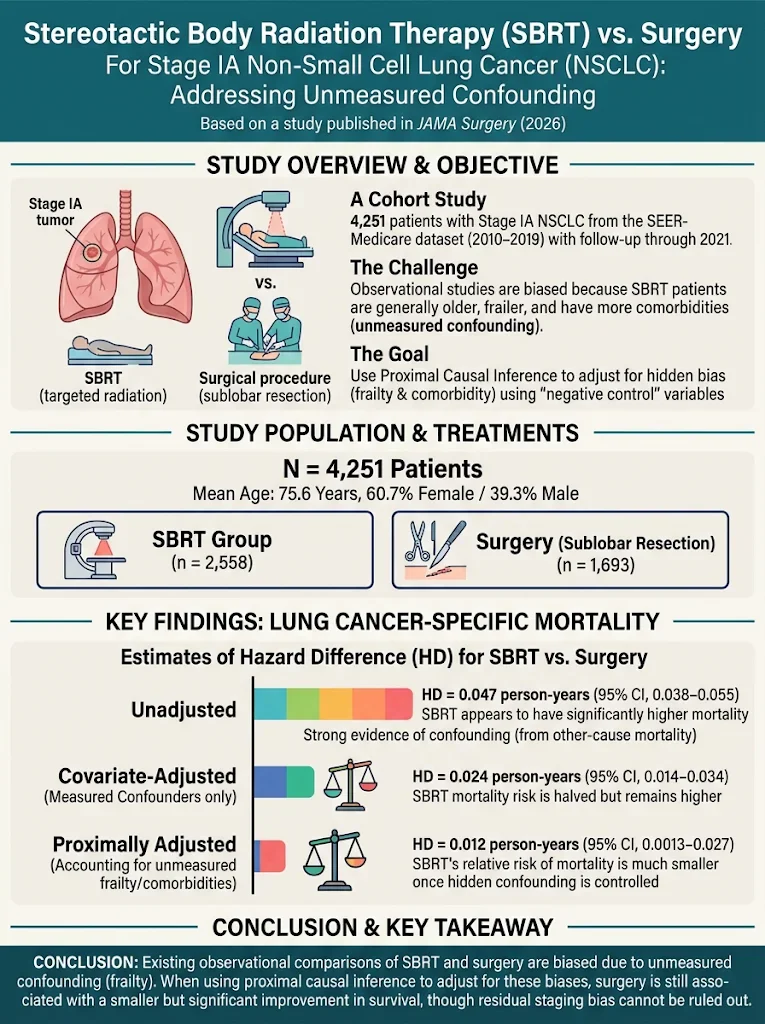
- Recent large database analyses employing proximal causal inference reveal that prior observational comparisons overestimate mortality differences due to unmeasured confounding from frailty and comorbidity.
- Adjusted analyses show surgery retains a modest but statistically significant advantage over SBRT in lung cancer–specific mortality after accounting for hidden confounders.
- Outcomes such as locoregional control and recurrence-free survival tend to favor surgery; however, overall survival differences may diminish in elderly or frail patient subsets, supporting individualized treatment decisions.
Background
Non-small cell lung cancer (NSCLC) remains the leading cause of cancer mortality globally. Early-stage IA NSCLC presents an opportunity for curative treatment. Historically, surgical resection—preferably lobectomy or sublobar resection in select cases—has been the standard of care with demonstrated superior long-term survival. However, a significant proportion of patients, often elderly or medically inoperable, are candidates for stereotactic body radiation therapy (SBRT), a form of highly focused, ablative radiotherapy providing excellent local control with a favorable safety profile. Despite extensive use of SBRT in nonoperable cases, its comparative effectiveness versus surgery in operable patients remains uncertain. Attempts to clarify this via randomized controlled trials (ROSEL, STARS, ACOSOG Z4099) were prematurely terminated due to poor accrual, limiting high-level evidence. Consequently, observational cohort analyses and meta-analyses have proliferated but are plagued by selection bias with SBRT cohorts typically older, frailer, and bearing greater comorbidity burden.Key Content
Chronological Development of Evidence
Early retrospective studies and propensity-matched analyses (e.g., Shirvani et al., and studies from 2014–2016) indicated that surgery yields superior recurrence-free survival and overall survival compared to SBRT, particularly in medically operable patients. However, these studies suffered from residual confounding. Randomized trials comparing SBRT and surgery (ROSEL, STARS) were closed early with limited patient numbers, unable to definitively establish equivalence or superiority. Nevertheless, exploratory findings suggested comparable short-term quality of life favoring SBRT with fewer early complications. A 2026 network meta-analysis by Li et al. incorporating 30 studies concluded lobectomy and segmentectomy offer superior overall survival over SBRT in clinical stage I NSCLC; interestingly, for stage IA specifically, overall survival differences were not statistically significant between SBRT and surgical modalities, suggesting potential equivalence in highly selected patients.Proximal Causal Inference and Addressing Unmeasured Confounding
Linderman et al.’s 2026 cohort study from the SEER-Medicare data innovatively applied proximal causal inference methods to adjust for unmeasured confounders related to frailty and comorbidities, using negative control exposures and outcomes. This advanced method contrasts with traditional regression adjustments which inadequately control hidden confounding, a notable limitation in the literature. In this cohort of 4251 patients with stage IA NSCLC undergoing either sublobar surgery or SBRT, standard analyses showed a higher lung cancer-specific mortality associated with SBRT (hazard difference [HD] 0.024 person-years), but substantial confounding was evident due to strong associations with other-cause mortality. Proximal causal inference attenuated this estimate markedly to an HD of 0.012 person-years (95% CI, 0.0013-0.027), confirming surgery’s continued but smaller survival advantage after more rigorous adjustment. This approach underscores the importance of advanced causal methods in comparative effectiveness research where randomized data are lacking.Outcomes by Treatment Modality and Patient Subgroups
Surgery, including sublobar resections like segmentectomy and wedge resection, generally provides superior locoregional control and recurrence-free survival compared to SBRT, as corroborated by propensity-matched observational studies (e.g., a 2014 Ann Thorac Surg study, and a 2016 Medicine journal study). For elderly and vulnerable populations, SBRT (including proton beam therapy in some cohorts) shows comparable overall survival and reduced treatment-related morbidity, highlighting its role as a feasible alternative when surgery risk is prohibitive. Emerging data identify specific risk factors for distant metastasis after SBRT, such as stage IB and lower/middle lobe tumors, informing patient selection and potential adjuvant therapy considerations.Technical Considerations and Quality Assurance
Advancements in imaging (e.g., 4D-CT) and dose prescription standardization (JCOG 1408 trial insights) continue to refine SBRT accuracy and safety, potentially improving outcomes.Expert Commentary
This synthesis emphasizes the nuanced clinical decision-making surrounding stage IA NSCLC management. Surgery, when feasible, remains the gold standard given its durable control and survival benefits. However, real-world data reflect that many operable patients harbor significant frailty and comorbidities, complicating direct comparisons. Proximal causal inference methodology offers a novel solution to biases inherent in nonrandomized studies and exemplifies methodological progress addressing confounding in observational data, a critical step given persistent trial recruitment challenges. Nonetheless, residual confounding due to pathological versus clinical staging differences, and the heterogeneous nature of sublobar resections (segmentectomy vs wedge) versus SBRT modalities, limit definitive conclusions. Clinical guidelines currently endorse surgery for operable stage IA NSCLC, but SBRT is recommended for nonsurgical candidates. The present evidence suggests that SBRT may be an acceptable alternative in select operable patients, necessitating prospective randomized trials with robust accrual or innovative trial designs. Mechanistically, differences in local tumor control rates and risk of occult nodal disease explain survival disparities, reinforcing a tailored approach incorporating tumor biology, patient comorbidities, and preferences.Conclusion
Stereotactic body radiation therapy presents an effective, less invasive option for early-stage NSCLC patients, with outcomes approaching surgery in selected populations. Advanced statistical methods reveal that previous observational analyses likely overestimated the mortality gap by failing to fully account for frailty and comorbidities. Surgery remains associated with a modest but statistically significant survival benefit after accounting for hidden confounders. Nevertheless, in vulnerable or elderly patients, SBRT offers comparable safety and survival, emphasizing personalized care. Future research priorities include completed adequately powered randomized trials, refined patient selection criteria, integration of molecular biomarkers, and further methodological innovation in real-world evidence evaluation.References
- Linderman GC, Li KQ, Potter AL, et al. Stereotactic Body Radiation Therapy vs Surgery for Stage IA Non-Small Cell Lung Cancer. JAMA Surg. 2026;doi:10.1001/jamasurg.2026.5510. PMID: 43050213
- Li W, Dai C, Chen L, et al. Comparison among stereotactic body radiation therapy, lobectomy, segmentectomy, and wedge resection for clinical stage I non-small cell lung cancer: a network meta-analysis. J Thorac Dis. 2025;17(12):10880-10896. PMID: 41522106
- Shirvani SM et al. A propensity-matched analysis of surgery and stereotactic body radiotherapy for early stage NSCLC in the elderly. Medicine (Baltimore). 2016;95(52):e5723. PMID: 28033277
- Chang JY, Senan S, Paul MA, et al. Stereotactic ablative radiotherapy versus lobectomy for operable stage I non-small-cell lung cancer: a pooled analysis of two randomized trials. Lancet Oncol. 2015;16(6):630-637. PMID: 25815792
- Haseltine JM, Komaki R, Patel PR, et al. Predictors of Distant Recurrence Following Stereotactic Body Radiation Therapy for Stage I Non-Small Cell Lung Cancer. Am J Clin Oncol. 2020;43(4):243-248. PMID: 31913907
- Verma V, Haas AR, Lefrak E, et al. Patient reported outcomes following stereotactic ablative radiotherapy or surgery for stage IA non-small-cell lung cancer: Results from the ROSEL multicenter randomized trial. Radiother Oncol. 2015;117(1):44-48. PMID: 26492839
Specialty calculators
For clinical reference; use professional judgment.