Highlight
1. Financial toxicity (FT) affects over 60% of patients with newly diagnosed lung and head and neck cancers.
2. Tobacco use and cigarette spending contribute bidirectionally to financial toxicity across material, psychosocial, and behavioral dimensions.
3. Nearly half of patients continue smoking at diagnosis, with monthly cigarette expenses imposing significant opportunity costs.
4. Integrating smoking cessation programs with financial toxicity screening and assistance is essential to mitigate burden in this high-risk population.
Study Background
Lung and head and neck cancers (L/HNC) account for a significant global cancer burden, often associated with tobacco use. These malignancies not only cause profound morbidity and mortality but also impose substantial financial hardships on affected individuals. Financial toxicity (FT)—a term describing the material, psychological, and behavioral financial distress resulting from medical costs—has emerged as a critical adverse outcome influencing cancer survivorship, treatment adherence, and quality of life.
Despite known high rates of persistent smoking after diagnosis in patients with L/HNC, the interplay between tobacco use, related monetary expenditures, and FT remains insufficiently characterized. Smoking may exacerbate FT by directly increasing out-of-pocket costs and potentially undermining health and treatment outcomes, while FT itself may influence smoking behavior as a maladaptive coping mechanism. Understanding this complex relationship is vital for designing targeted interventions that address both tobacco dependence and financial hardship simultaneously.
Study Design
This mixed-methods study enrolled 25 patients with newly diagnosed lung and head and neck cancers from March 2024 to March 2025 using convenience sampling. Qualitative data were collected through semi-structured interviews analyzed via content analysis until thematic saturation, capturing patient perceptions around FT and tobacco use.
Participants also completed validated quantitative instruments assessing different FT dimensions: the Comprehensive Score for Financial Toxicity (COST) questionnaire (range: 0–44, with lower scores indicating worse FT), the USDA Six-Item Short Form Food Security Module examining material deprivation, and a smoking-induced deprivation (SID) questionnaire capturing behavioral coping impacts of tobacco spending.
Key Findings
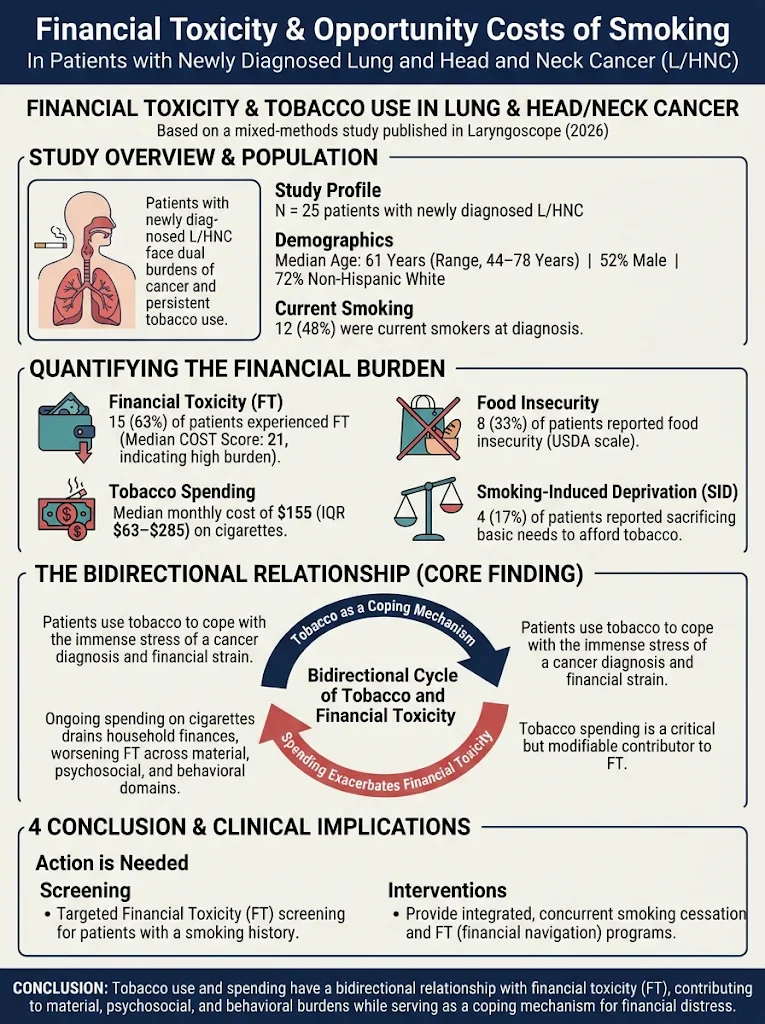
The cohort’s median age was 61 years (range 44–78), predominantly non-Hispanic White (72%), with 52% male. Nearly half (48%) were current smokers at diagnosis, underscoring the persistence of tobacco use despite cancer onset.
The median COST score was 21 (range 4–43), revealing that 63% (15/25) experienced significant financial toxicity (COST score < 26). One-third of patients (33%) faced food insecurity, highlighting material financial strain pervasive in this population.
On average, patients spent a median of $155 per month (interquartile range $63–$285) on cigarettes, representing a meaningful opportunity cost that could otherwise be allocated toward medical care or basic needs.
Behaviorally, 17% reported smoking-induced deprivation, indicative of spending on cigarettes at the expense of essential expenditures.
Qualitative data reinforced the conceptual FT framework, elucidating tobacco use and spending as both contributors to and consequences of FT. Patients described smoking as a coping mechanism for stress while recognizing that tobacco-related expenses exacerbated their financial distress, creating a vicious cycle.
Expert Commentary
This study importantly enriches the understanding of the multidimensional impact of smoking on FT in lung and head and neck cancer patients. The bidirectional nature of tobacco use and financial toxicity suggests that interventions addressing only smoking cessation or financial distress in isolation may be insufficient.
The identification of substantial cigarette-related spending amidst already vulnerable patients warrants the integration of tobacco control within financial counseling frameworks. Clinicians should be aware of the moderate to severe financial toxicity prevalence and consider routine screening using tools like COST to identify distressed patients.
Limitations include the relatively small sample size and potential selection bias from convenience sampling restricting generalizability. Further multicenter studies with more diverse populations are needed to corroborate these findings.
Conclusion
Patients with lung and head and neck cancers experience significant financial toxicity, compounded by ongoing tobacco use and associated spending. This bidirectional relationship underscores tobacco use as both a driver and a coping strategy of financial hardship, spanning material, psychosocial, and behavioral domains.
Effective management requires integrated approaches combining smoking cessation interventions with financial toxicity screening and support. Such comprehensive care models could improve treatment adherence, reduce financial strain, and enhance overall health outcomes in this high-risk population.
Funding and Clinicaltrials.gov
Details on funding sources and clinical trial registry were not reported within the original study abstract.
References
1. Stemme RA, Najjar W, Armache M, et al. Exploring the Financial Toxicity and Opportunity Costs of Smoking in Lung and Head and Neck Cancer. The Laryngoscope. 2026 Nov 16. PMID: 43039448.
2. Zafar SY, Abernethy AP. Financial toxicity, Part I: a new name for a growing problem. Oncology (Williston Park). 2013 Feb;27(2):80-1, 149.
3. Walker MS, Loprinzi CL, Rothman RL, et al. Smoking relapse during the first year after treatment for early stage non-small-cell lung cancer. Cancer Epidemiol Biomarkers Prev. 2006 Oct;15(10):2370-7.
4. Khera N, Somasundaram A, Kolli P, et al. Financial toxicity and its underrecognized impact on quality of life in head and neck cancer: a review of literature. Oral Oncol. 2021 Feb;114:105142.
5. National Cancer Institute. Assessing and addressing financial hardship in oncology: ASCO guideline summary. J Clin Oncol. 2022 Feb 20;40(6):633-637.
Specialty calculators
For clinical reference; use professional judgment.