Highlight
This nationwide Japanese survey identifies substantial discrepancies between the expected functions and perceived current duties of general medicine specialists, especially in managing patients with multiple concurrent conditions and providing cross-specialty and undifferentiated care. Different healthcare professional groups and care settings report varying perspectives on these role gaps, underscoring the urgency to clarify and align expectations of general medicine specialists across Japan’s healthcare system.
Study Background
Japan faces a rapidly aging population, accompanied by a rising prevalence of multimorbidity and complex chronic illness. These demographic and epidemiological changes have intensified the demand for general medicine specialists capable of providing comprehensive, patient-centered care across specialties and clinical settings. Concomitantly, mismatches in physician distribution and specialization necessitate an adaptive general medicine workforce to address undefined responsibilities and improve care continuity.
Despite this critical need, the spectrum of expected functions for general medicine specialists remains poorly defined and inconsistently perceived by healthcare providers. Understanding the gaps between expectations and actual practice is essential for targeted workforce development, policy formulation, and improving patient outcomes within diverse Japanese healthcare contexts.
Study Design
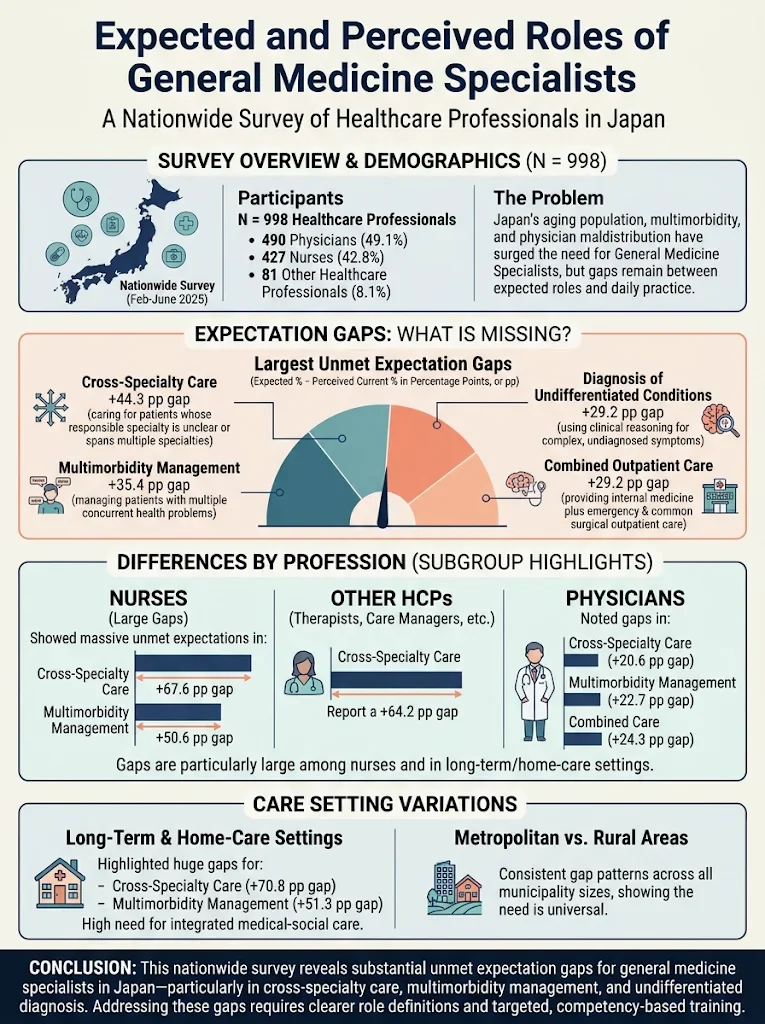
The research employed a nationwide, cross-sectional, online survey conducted from February to June 2025, targeting a diverse array of healthcare professionals across Japan. A total of 998 participants completed the survey, comprising 490 physicians, 427 nurses, and 81 other healthcare workers. The survey solicited respondent views on roles they expected general medicine specialists to fulfill and the roles they believed were currently delivered at their institutions.
Key roles assessed included care for patients with ambiguous or multi-specialty health needs, management of multimorbidity, clinical reasoning for undifferentiated symptoms, and the provision of internal medicine with emergency and common surgical outpatient services. Data were stratified by professional category, healthcare institution type (hospital, long-term care, community-based settings), and municipality size to detect subgroup variations.
Key Findings
The analysis revealed pronounced gaps between the anticipated and actual involvement of general medicine specialists. The largest unmet expectations were as follows:
- Caring for patients lacking a clear responsible specialty or whose conditions spanned multiple specialties, showing a 44.3 percentage points (pp) positive gap.
- Managing patients with multiple concurrent health problems (multimorbidity), with a 35.4 pp positive gap.
- Diagnostic evaluation of undifferentiated conditions through comprehensive clinical reasoning, showing a 29.2 pp gap.
- Providing integrated internal medicine care plus emergency and common surgical outpatient services, also reflecting a 29.2 pp gap.
Notably, nurses reported larger perceived gaps in cross-specialty patient care (67.6 pp) and multimorbidity management (50.6 pp) compared to physicians and other health professionals. Other healthcare professionals similarly noted substantial gaps in cross-specialty care (64.2 pp).
In non-acute settings such as long-term care, rehabilitation, home-care, and geriatric services, the gaps widened significantly: cross-specialty care expectations exceeded current perceived roles by 70.8 pp, and multimorbidity management by 51.3 pp.
Surprisingly, these patterns held consistent across varying municipality sizes, indicating that location-based differences did not markedly influence role perception gaps.
Expert Commentary
The survey’s findings resonate with global shifts toward integrated, patient-centered care models that emphasize holistic management of complex patients, particularly those with multimorbidity and overlapping specialty needs. The substantial perception gaps suggest a need for deliberate role clarification, enhanced training in cross-disciplinary competencies, and better communication among healthcare teams to optimize the utility of general medicine specialists.
Moreover, the divergent perceptions across professional groups underline the importance of interprofessional dialogue and collaboration to align expectations and foster mutual understanding of generalist roles. Given Japan’s unique demographic challenges and healthcare infrastructure, these insights can inform policy reforms and educational strategies to support a responsive general medicine workforce.
Limitations include the survey’s reliance on self-reported perceptions, which may be influenced by individual biases or institutional cultures. Further qualitative studies could elucidate underlying causes of role ambiguity and how to bridge expectation gaps effectively.
Conclusion
This comprehensive nationwide survey elucidates critical gaps in the expected versus perceived roles of general medicine specialists in Japan, with a pronounced emphasis on unmet need in cross-specialty care and multimorbidity management. The findings advocate for clearer role definitions, interprofessional engagement, and tailored workforce development to address the evolving demands of an aging society.
Addressing these gaps holds the potential to enhance care coordination, reduce fragmentation, and improve outcomes for patients with complex health needs. Future research should explore interventions to improve role clarity and integration of general medicine specialists within multidisciplinary care teams across diverse clinical environments.
Funding and Clinical Trials
The original article does not specify funding sources or clinical trial registration associated with this survey study.
References
- Kobayashi D, Shimbo T, Fukui T, et al. Expected and Perceived Current Roles of General Medicine Specialists: A Nationwide Survey of Healthcare Professionals in Japan. J Gen Intern Med. 2026; [PMID: 43045905]. Available from: https://pubmed.ncbi.nlm.nih.gov/43045905/
- Starfield B, Shi L, Macinko J. Contribution of primary care to health systems and health. Milbank Q. 2005;83(3):457-502.
- Smith SM, Soubhi H, Fortin M, Hudon C, O’Dowd T. Managing patients with multimorbidity: systematic review of interventions in primary care and community settings. BMJ. 2012;345:e5205.
Specialty calculators
For clinical reference; use professional judgment.