Highlight
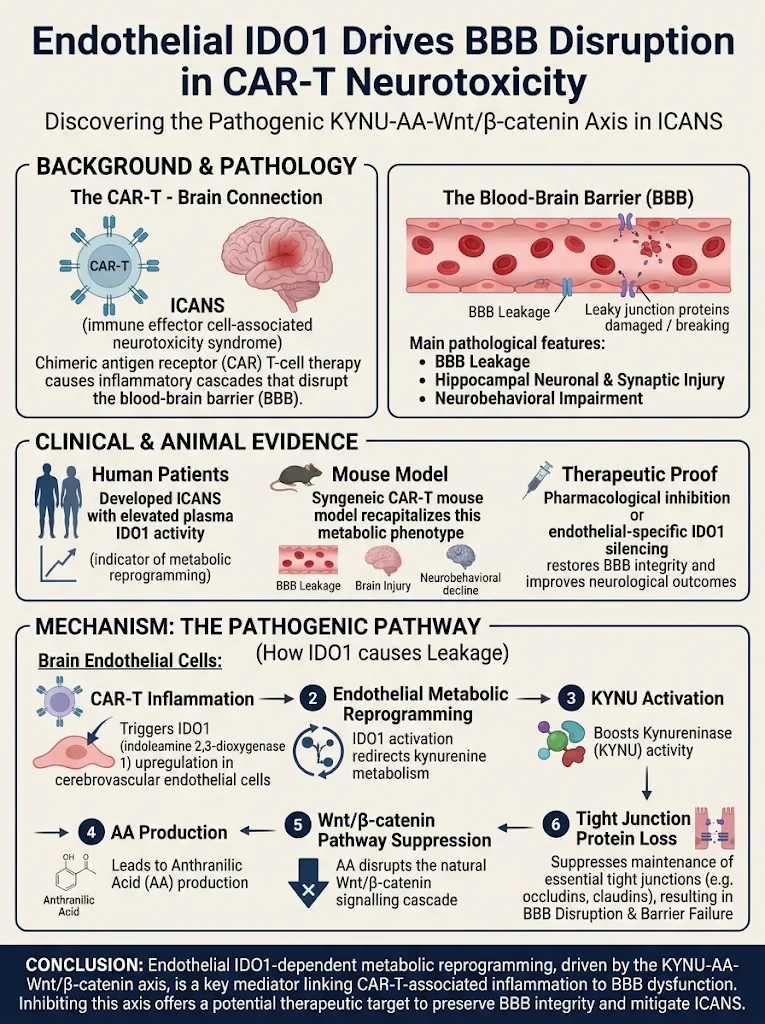
1. Elevated endothelial IDO1 activity contributes to blood-brain barrier (BBB) disruption in immune effector cell-associated neurotoxicity syndrome (ICANS) following CAR-T therapy.
2. IDO1-driven kynurenine metabolism redirects toward kynureninase (KYNU)-mediated anthranilic acid production, impairing Wnt/β-catenin signaling crucial for BBB integrity.
3. Pharmacological inhibition or endothelial-specific silencing of IDO1 restores BBB function and mitigates neurobehavioral deficits in preclinical models.
4. Targeting the endothelial IDO1-KYNU-AA-Wnt/β-catenin metabolic axis represents a promising therapeutic strategy to prevent or treat CAR-T-associated neurotoxicity.
Study Background
Chimeric antigen receptor (CAR) T-cell therapies have revolutionized the treatment landscape for hematological malignancies, demonstrating remarkable efficacy against various refractory cancers. However, a significant clinical challenge limiting their broader application is immune effector cell-associated neurotoxicity syndrome (ICANS), which manifests as a spectrum of neurological symptoms ranging from mild cognitive impairment and delirium to severe cerebral edema and life-threatening encephalopathy. Disruption of the blood-brain barrier (BBB) is a pivotal pathological event implicated in ICANS development, facilitating neuroinflammation and neuronal damage. Despite advances in clinical management, the molecular mechanisms driving BBB breakdown in ICANS remain incompletely understood, hindering the development of targeted interventions to mitigate neurotoxicity while preserving the anti-tumor benefits of CAR-T therapy.
Study Design
Zhang et al. employed a multidisciplinary approach involving translational patient plasma analysis, syngeneic murine CAR-T models, and molecular and cellular mechanistic studies in endothelial cells. Plasma samples from patients treated with CAR-T who developed ICANS were assessed for IDO1 enzymatic activity, correlating metabolic alterations with clinical neurotoxicity. The preclinical syngeneic CAR-T mouse model recapitulated BBB permeability changes alongside neuropathological and neurobehavioral impairments. In vitro and in vivo endothelial-specific manipulations of IDO1 expression and activity were performed to interrogate its causal role. Outcomes included assessment of endothelial activation, tight junction integrity, cerebral barrier function, neurobehavioral performance, and detailed profiling of key metabolic pathways focusing on the IDO1-driven kynurenine cascade and downstream signaling involving the Wnt/β-catenin pathway.
Key Findings
Clinical plasma analyses demonstrated significantly elevated IDO1 activity in patients experiencing ICANS compared to non-neurotoxic CAR-T recipients, implicating metabolic reprogramming in vascular compartments. The murine CAR-T model exhibited hallmark features of ICANS including pronounced BBB disruption evidenced by tracer leakage, hippocampal neuronal and synaptic injury, and measurable impairments in memory and behavior. Endothelial cells showed increased IDO1 expression, which induced cellular activation, reduced expression of junctional proteins (e.g., claudin-5, occludin), and consequent barrier dysfunction.
Mechanistic interrogation revealed that IDO1 activation altered endothelial kynurenine metabolism by promoting kynureninase (KYNU)-dependent conversion to anthranilic acid (AA). Elevated AA levels disrupted Wnt/β-catenin signaling, a key regulator of endothelial tight junction protein expression and BBB integrity. Interfering with IDO1 through pharmacological inhibitors or endothelial-targeted silencing restored tight junction protein levels, normalized barrier permeability, and improved neurological outcomes in the mouse model. These findings delineate a novel endothelial metabolic-inflammatory circuit whereby IDO1-driven kynurenine pathway metabolites mediate neurovascular injury in CAR-T-related neurotoxicity.
Expert Commentary
The study by Zhang et al. represents a significant advance in understanding the pathophysiology of ICANS by positioning endothelial metabolic reprogramming at the nexus of barrier dysfunction and neurotoxicity. The identification of the IDO1-KYNU-AA axis as a modulator of Wnt/β-catenin signaling bridges inflammation and endothelial structural integrity, providing molecular targets previously unaddressed in this context. These data align with emerging literature implicating tryptophan metabolism and its immunoregulatory metabolites in neuroinflammatory disorders. Importantly, the selective targeting of endothelial IDO1 holds promise for therapeutic strategies that maintain CAR-T efficacy while preventing neurotoxicity.
Nevertheless, some limitations warrant consideration. The translation of findings from murine models to human disease is complex, and the temporal dynamics of IDO1 activation during CAR-T therapy require further elucidation. In addition, systemic versus local effects of IDO1 inhibition on immune function need rigorous safety evaluations. Longitudinal studies in patients and integration with other established ICANS biomarkers will clarify patient subsets that might benefit from metabolic interventions.
Conclusion
Endothelial IDO1-mediated metabolic reprogramming emerges as a critical driver of BBB disruption in CAR-T-associated neurotoxicity. By modulating kynurenine pathway flux toward anthranilic acid and disrupting Wnt/β-catenin signaling, IDO1 compromises endothelial junctional integrity, leading to barrier leakage and neuronal injury. Therapeutic targeting of this metabolic axis offers a novel and rational approach to preserve BBB function, reduce neurotoxicity risk, and potentially improve the safety profile of CAR-T therapies. Further clinical translation of IDO1 inhibitors or metabolic modulators should be prioritized to address this unmet need in cancer immunotherapy.
Funding and clinicaltrials.gov
The original study was funded by national and institutional grants, details are noted in the primary publication. No current clinical trials have registered interventions targeting endothelial IDO1 specifically in CAR-T-associated neurotoxicity at this time, highlighting an important area for future research and clinical development.
References
1. Neelapu SS, et al. Chimeric antigen receptor T-cell therapy — assessment and management of toxicities. Nat Rev Clin Oncol. 2018;15(1):47–62.
2. Gust J, et al. Endothelial Activation and Blood-Brain Barrier Disruption in Neurotoxicity After Adoptive Immunotherapy with CAR-T Cells. Cancer Discov. 2017;7(12):1404–1419.
3. Zhang W, Chen Z, Wang Z, et al. Endothelial IDO1 Drives BBB Disruption in CAR-T-Associated Neurotoxicity Through KYNU-AA-Wnt/β-catenin Pathway. Blood. 2026 Nov 18;PMID: 43050395.
4. Platten M, et al. Tryptophan metabolism as a common therapeutic target in cancer, neurodegeneration and beyond. Nat Rev Drug Discov. 2019;18(5):379–401.
5. Winkler EA, et al. Blood–brain barrier dysfunction in disease. Nat Rev Neurol. 2011;7(3):158–169.
Specialty calculators
For clinical reference; use professional judgment.