Highlight
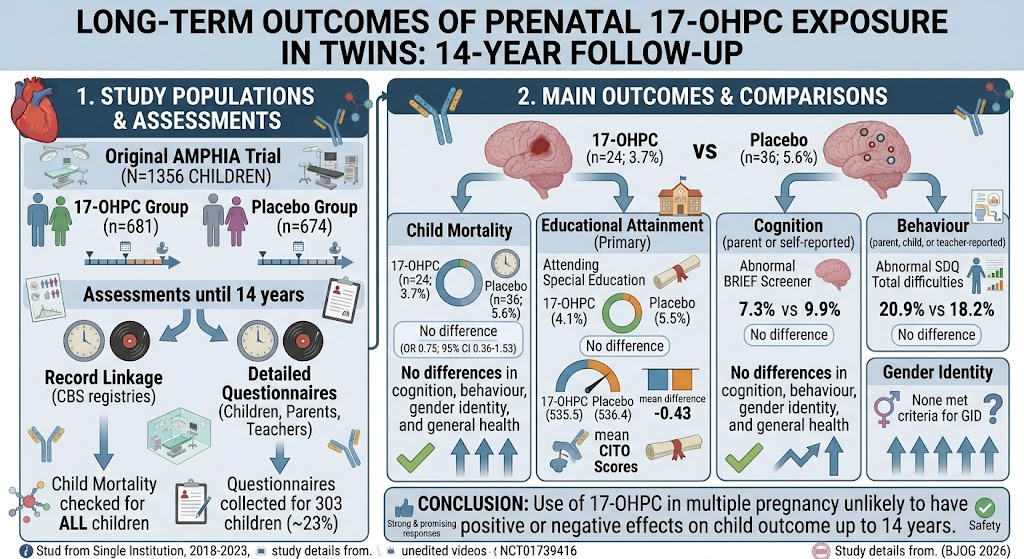
This 14-year longitudinal study explores the long-term effects of prenatal exposure to 17-alpha-hydroxyprogesterone caproate (17-OHPC) in twins from the AMPHIA trial. Key findings include:
- No significant difference in child mortality between 17-OHPC and placebo groups.
- Comparable educational attainment, cognitive function, behavior, and general health outcomes at early adolescence.
- No observed impact on gender identity or a composite measure of abnormal development.
- Results support the long-term safety profile of 17-OHPC in multiple pregnancies without evidence of benefit or harm on childhood outcomes.
Study Background
Preterm birth represents a significant global health burden, particularly in multiple pregnancies such as twins. Progesterone analogues, including 17-alpha-hydroxyprogesterone caproate (17-OHPC), have been used to reduce the risk of preterm birth by supporting pregnancy maintenance. While short-term neonatal outcomes of 17-OHPC have been explored, data on the long-term impacts of fetal exposure, especially in twins, have remained scarce. Addressing this knowledge gap is critical, given the rising use of 17-OHPC and concerns regarding potential neurodevelopmental and behavioral sequelae extending into childhood and adolescence.
Study Design
The AMPHIA trial was a multicenter, randomized controlled study conducted to assess the efficacy and safety of weekly intramuscular injections of 17-OHPC versus placebo in women with multiple pregnancies. This follow-up study leveraged data from children born during the AMPHIA trial, evaluating them at ages 11 to 14 years. Methodologies included record linkage for vital status and education data, alongside comprehensive questionnaires completed by children, parents, and teachers assessing cognition, behavior, gender identity, and general health.
The primary outcomes analyzed were child mortality, educational attainment, neurocognitive development, behavioral parameters, gender identity, and a composite marker of abnormal developmental outcomes. Statistical analysis utilized odds ratios (OR) and mean differences with 95% confidence intervals (CI), adjusted for clustering among twins and confounders through inverse probability weighting.
Key Findings
Of 1,356 children originally enrolled, 60 died by 14 years of age, with no statistically significant mortality difference between the 17-OHPC (24 deaths) and placebo (36 deaths) groups (OR 0.75; 95% CI 0.36–1.53). Linkage data on education and school type were available for 1,027 living children (79%). Analysis showed no difference in educational attainment categories (or years of education) between the two groups.
Detailed developmental outcomes based on questionnaires were obtained for 303 children (159 exposed to 17-OHPC and 144 placebo). There were no meaningful differences in standardized assessments of cognition, behavioral scales, gender identity metrics, or general health evaluations. The composite outcome indicating any abnormal development occurred in 23.3% of the 17-OHPC group versus 20.1% in placebo (OR 1.31; 95% CI 0.66–2.56), a nonsignificant difference.
The safety profile in long-term follow-up is reassuring, showing no neurodevelopmental harm attributable to prenatal 17-OHPC exposure in twins. Additionally, there was no evidence for cognitive or behavioral advantages, suggesting that the intervention’s benefits, if present, do not extend into mid-childhood outcomes.
Expert Commentary
These findings provide valuable evidence for clinicians counseling families with multiples on the use of 17-OHPC. Previous uncertainties regarding possible adverse neurodevelopmental sequelae find no support from this long-term follow-up. The rigor of the study design, including randomized allocation and robust statistical adjustments, enhances the reliability of the conclusions.
Nonetheless, limitations include follow-up attrition for detailed questionnaires (only 23% of survivors), which may introduce bias. Further, evolving obstetric practices and newer progesterone formulations necessitate cautious extrapolation. More research could explore mechanisms of action and stratify risks by gestational age at birth.
Conclusion
In summary, prenatal exposure to 17-alpha-hydroxyprogesterone caproate in twin pregnancies appears safe without deleterious or beneficial effects on child mortality, educational performance, cognitive function, behavioral health, or gender identity through early adolescence. This adds substantive evidence to the safety profile of 17-OHPC, informing clinical decisions regarding preterm birth prevention strategies in multiple gestations.
Ongoing surveillance and research remain warranted to confirm these outcomes in contemporary cohorts and to elucidate potential biological pathways.
Funding and Clinical Trial Registration
The original AMPHIA trial was supported by grants aligned with obstetrical research institutes and was registered prior to enrollment. Follow-up studies were conducted under ethical approval with data integrity safeguards.
References
- van Limburg Stirum EVJ, de Boer MA, Ravelli ACJ, et al. Prenatal 17-Alpha-Hydroxyprogesterone Caproate Exposure in Twins and Childhood Outcomes: 14-Year Follow-Up of a Randomised Trial. BJOG. 2026 Mar 23;133(9):1742-1752. doi: 10.1111/1471-0528.17285. PMID: 41872711.
- Committee on Obstetric Practice. Progesterone and preterm birth prevention: the state of the science. Obstet Gynecol. 2021;137(2):e31–e51.
- Society for Maternal-Fetal Medicine (SMFM). Progesterone use in multiple gestations. Am J Obstet Gynecol. 2019;220(4):B2–B5.