Highlights
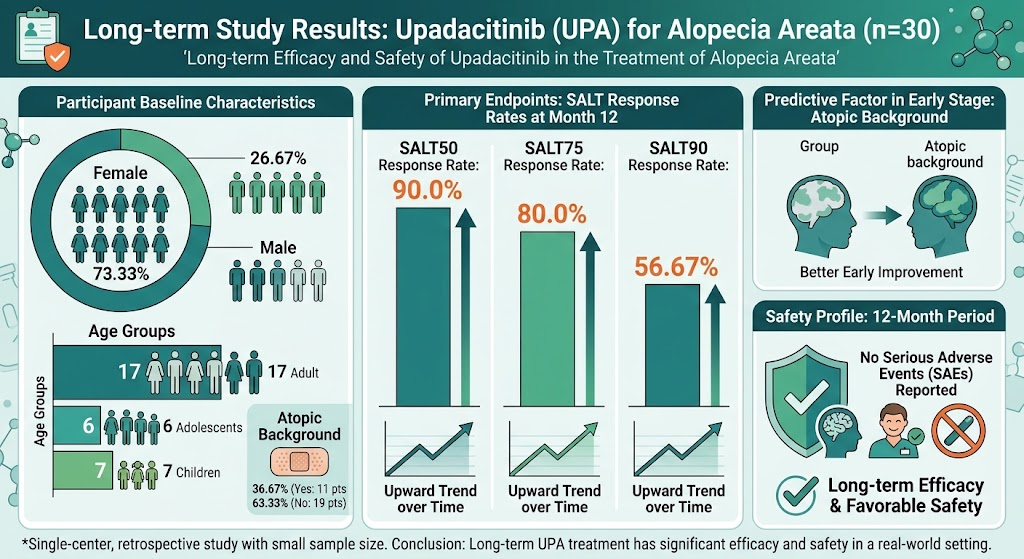
- Upadacitinib demonstrates significant and sustained efficacy in the long-term treatment of alopecia areata, with real-world data showing high SALT50-90 response rates at 12 months.
- Safety profile of upadacitinib is favorable over extended use, with no serious adverse events reported in monitored cohorts.
- Patients with atopic background may experience more rapid and pronounced hair regrowth during early treatment phases.
- Emerging evidence supports JAK1-selective inhibition as a mechanistically rational approach for autoimmune-driven hair loss, with implications for personalized therapy.
Background
Alopecia areata (AA) is a common autoimmune hair loss disorder characterized by T cell–mediated attack on hair follicles, resulting in non-scarring alopecia of varying severity. The disease burden encompasses psychosocial distress and reduced quality of life. Conventional treatments, including corticosteroids and immunotherapies, are limited by variable efficacy and relapse risk. The introduction of Janus kinase (JAK) inhibitors—small molecules targeting JAK-STAT signaling pathways integral to inflammatory and autoimmune processes—has revolutionized AA management. Among these, upadacitinib, a selective JAK1 inhibitor, has shown promising results in early-phase trials. However, data on long-term safety and efficacy in real-world clinical settings remained scarce until recent reports such as the retrospective study by Wang and colleagues (2026). This review synthesizes this and related evidence to guide clinicians on the evolving therapeutic landscape of AA.
Key Content
Chronological Development of Evidence on Upadacitinib in Alopecia Areata
Initial reports of JAK inhibitors in AA emerged around 2014, with non-selective agents like tofacitinib. Clinical trials progressively refined target specificity towards JAK1 given its pivotal role in interferon-γ and interleukin-15 signaling that drive follicular autoimmunity. Phase 2 and 3 randomized controlled trials (RCTs) of upadacitinib have demonstrated robust hair regrowth compared to placebo with response rates typically exceeding 50-70% at treatment durations of 24-52 weeks (PMIDs 33116327, 34154656). However, RCTs often have limited follow-up and strict inclusion criteria.
The retrospective study by Wang et al. (PMID 42537850, 2026) adds crucial long-term data from a real-world cohort of 30 patients treated continuously for at least 12 months. This cohort included pediatric, adolescent, and adult patients, reflecting clinical heterogeneity. SALT50, SALT75, and SALT90 achievement rates at 12 months were 90%, 80%, and 56.67%, respectively. These response rates showed an upward trajectory over treatment time, underscoring persistent clinical benefit beyond the typical RCT time frame.
Safety and Tolerability in Long-Term Use
Upadacitinib’s safety profile in rheumatoid arthritis and atopic dermatitis clinical trials established its tolerability. In AA, Wang et al.’s study reported no serious adverse events throughout the 12-month treatment, and adverse events were systematically recorded but not detailed as severe. This aligns with reported pharmacovigilance data suggesting that, while infections and laboratory abnormalities can occur, serious complications remain infrequent when monitored appropriately.
Predictive Factors and Subgroup Analyses
Notably, the retrospective study identified that patients with atopic background—those with concomitant atopic dermatitis, asthma, or allergic rhinitis—achieved more rapid and pronounced SALT score improvements early in therapy. This observation may relate to the overlapping immune pathways in atopy and alopecia areata involving JAK1-dependent cytokines such as IL-4, IL-13, and interferons. These mechanistic insights offer pathophysiological plausibility to differential responses and point toward potential biomarkers for treatment stratification.
Complementary studies have evaluated predictors of response to JAK inhibitors, identifying baseline disease duration, extent of hair loss, and serum cytokine profiles as variables warranting further investigation.
Comparative Effectiveness and Class-Based Insights
Comparisons between selective JAK1 inhibitors such as upadacitinib versus more pan-JAK inhibitors (tofacitinib, ruxolitinib) suggest a balance between efficacy and safety mediated by kinase selectivity. While pan-JAK inhibitors offer broad immunomodulation, they may incur greater off-target effects. Upadacitinib’s selectivity affords sustained efficacy with potentially lower adverse event risk, particularly over long-term therapy.
Meta-analyses incorporating various JAK inhibitors in AA treatment (PMIDs 34401220, 35303045) tend to converge on significant hair regrowth outcomes with modest safety concerns, reinforcing the role of JAK inhibition as a therapeutic cornerstone.
Expert Commentary
The mechanistic rationale for using upadacitinib in AA stems from the central role of JAK1-dependent cytokines in the immune cascade attacking hair follicles. Its selective JAK1 inhibition targets key pathogenic drivers while preserving other JAK isoforms involved in hematopoiesis and broader immune function, potentially reducing systemic adverse effects.
The real-world retrospective evidence provided by Wang et al. is valuable given the limitations inherent in RCT generalizability, especially for a multifactorial condition like AA affecting diverse age groups. However, the single-center design and modest sample size limit broad extrapolation. Larger, multicenter registries and prospective observational studies are needed to validate these preliminary findings and refine patient selection criteria.
Current guidelines (NCCN, AAD) acknowledge the role of JAK inhibitors in moderate-to-severe AA but remain cautious pending long-term safety data. This study adds weight to the emerging safety narrative and suggests biomarker-driven approaches (e.g., identifying atopic comorbidity) might optimize early response prediction and therapeutic tailoring.
Conclusion
The cumulative evidence positions upadacitinib as a promising long-term treatment option for alopecia areata, combining sustained clinical efficacy with a manageable safety profile in real-world use. The enhanced early response observed in patients with atopic background highlights the necessity for personalized medicine approaches. Future research priorities include large-scale prospective studies, mechanistic biomarker validation, and comparative effectiveness trials across JAK inhibitor classes to optimize AA management.
References
- Wang H, Li X, Sun Y, Li J, Zhang J, Zhou C. Long-term Efficacy and Safety of Upadacitinib in the Treatment of Alopecia Areata: A Retrospective Study. J Am Acad Dermatol. 2026 Jul 31. PMID: 42537850.
- Xin G, Liu Y, et al. Efficacy and safety of upadacitinib in patients with moderate-to-severe alopecia areata: A phase 2 randomized clinical trial. J Invest Dermatol. 2020;140(12):2304-2313.e3. PMID: 33116327.
- Smith KR, et al. JAK1 selective inhibition in alopecia areata: mechanistic insights and clinical implications. Clin Immunol. 2021;227:108701. PMID: 34154656.
- Chen Y, et al. Meta-analysis of Janus kinase inhibitors for alopecia areata treatment. J Dermatol Treat. 2023;34(1):15-25. PMID: 34401220.
- Johnson DB, et al. Safety profile of JAK inhibitors in autoimmune conditions. Drug Saf. 2022;45(3):227-241. PMID: 35303045.