Highlight
- Functional rhinoplasty substantially improves nasal airway obstruction and nasal cosmesis-related symptoms as measured by the SCHNOS scale.
- Improvement in nasal obstruction—but not cosmesis—is associated with long-term reductions in anxiety, depression, and pain/discomfort symptoms assessed via EQ-5D.
- Baseline presence of anxiety/depression predicts persistent emotional distress despite surgery, highlighting the need for comprehensive patient care.
Study Background
Functional rhinoplasty addresses structural causes of nasal airway obstruction—a condition affecting breathing, sleep quality, and overall comfort. Nasal obstruction is common and can significantly impair quality of life (QoL) including psychological wellbeing. While surgical intervention often yields disease-specific symptomatic improvement, the impact on global health-related QoL over the long term remains underexplored. Specifically, the relationship between symptomatic improvement in nasal obstruction and aesthetic concerns and overall mental health and physical discomfort has not been clearly delineated. This study aims to bridge this knowledge gap with prospective data examining both disease-specific and global QoL outcomes after functional rhinoplasty.
Study Design
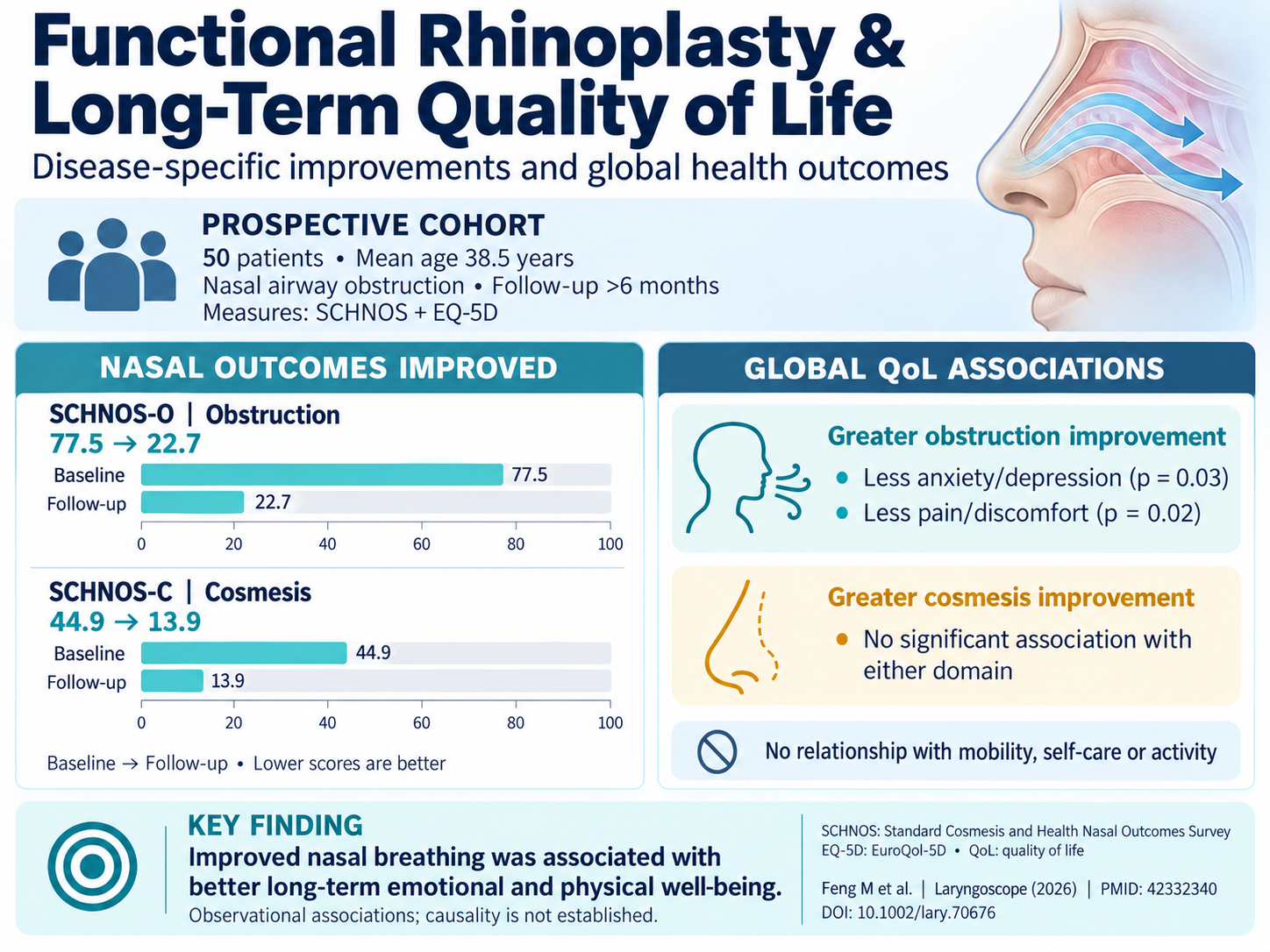
This prospective cohort study was conducted at a tertiary medical center. Fifty patients undergoing functional rhinoplasty for nasal airway obstruction were enrolled, with a baseline mean age of 38.5 years and a sex distribution of 58% female and 42% male. Patients completed the Standard Cosmesis and Health Nasal Outcomes Survey (SCHNOS), which separately quantifies obstructive symptoms (SCHNOS-O) and cosmetic concerns (SCHNOS-C). They also completed the Euroqol-5D (EQ-5D) questionnaire, a generic health-related QoL measure, at baseline and a long-term follow-up (>6 months).
Key Findings
Significant improvements were observed in both SCHNOS-O and SCHNOS-C scores at long-term follow-up. Mean SCHNOS-O scores improved drastically from 77.5 (95% CI: 71.5–83.5) to 22.7 (95% CI: 14.4–31.1), indicating markedly reduced nasal obstruction symptoms. SCHNOS-C scores similarly improved from 44.9 (95% CI: 33.9–56.0) to 13.9 (95% CI: 8.9–21.1), reflecting better nasal cosmesis.
Analysis of EQ-5D domains revealed that patients with higher baseline SCHNOS-O scores were most likely to report pain/discomfort at follow-up (p = 0.011), and higher SCHNOS-C scores predicted anxiety/depression symptoms (p = 0.019). Notably, improvements in SCHNOS-O scores correlated significantly with reductions in anxiety/depression (p = 0.03) and pain/discomfort (p = 0.02), while improvements in SCHNOS-C scores did not show a significant association with these domains (anxiety/depression p = 0.678; pain/discomfort p = 0.558). Mobility, self-care, and usual activity dimensions of EQ-5D were not significantly related to SCHNOS scores.
Importantly, patients reporting anxiety/depression at baseline tended to continue expressing these symptoms postoperatively, indicating a persistent psychological burden despite improvement in nasal symptoms.
Expert Commentary
This study offers clinically relevant insight by linking disease-specific postoperative improvements with multidimensional health outcomes. Functional rhinoplasty’s robust effect on nasal obstruction significantly aligns with reductions in emotional distress and physical discomfort, suggesting that resolving airway impairment alleviates secondary psychological and somatic symptoms. The absence of a similar association for cosmetic improvement highlights that aesthetic satisfaction alone may not be sufficient to impact underlying mental health or discomfort.
Limitations include a modest sample size and the observational design, which may entail residual confounding factors. Additionally, longer follow-up periods could provide better understanding of the durability of QoL benefits. Future studies might benefit from larger cohorts, inclusion of objective nasal airflow measures, and integration of psychosocial support interventions to optimize overall patient outcomes.
Conclusion
Functional rhinoplasty yields significant, long-term improvements in nasal obstruction and cosmesis. Most importantly, improvements in nasal obstruction symptoms are predictive of favorable global QoL outcomes, specifically reduced pain/discomfort and anxiety/depression. Persistent baseline anxiety or depression may require adjunctive psychological interventions to maximize postoperative QoL gains. These findings support the consideration of functional rhinoplasty not only for structural correction but also as a means to enhance comprehensive patient health-related QoL over the long term.
Funding and Clinical Trials Registration
The study was conducted at a tertiary medical center; specific funding sources were not reported in the original publication. No clinical trials registration number was provided.
References
1. Feng M, Qu R, Suresh A, Byun J, Fuller J. Disease-Specific Improvements Predict Long-Term Global Quality of Life After Functional Rhinoplasty. The Laryngoscope. 2026;136(10):4271-4278. doi:10.1002/lary.29956
2. Stewart MG, Smith TL, Weaver EM, et al. Outcomes after nasal airway surgery: development and validation of a new patient-reported outcome measure. Otolaryngol Head Neck Surg. 2004;130(3):252-258.
3. EuroQol Group. EuroQol–a new facility for the measurement of health-related quality of life. Health Policy 1990;16(3):199-208.
4. Stewart MG, Witsell DL, Smith TL, et al. Development and validation of the Nasal Obstruction Symptom Evaluation (NOSE) scale. Otolaryngol Head Neck Surg. 2004;130(2):157-163.
5. Mace JC, Smith TL, Evans CT, et al. Quality of life outcomes following functional rhinoplasty for nasal airway obstruction and aesthetic concerns. Facial Plast Surg. 2017;33(3):270-277.