Highlight
Limbic-predominant age-related TDP-43 encephalopathy neuropathologic change (LATE-NC) is frequently observed in aging brains and independently associated with cognitive decline. This large, ethnoracially and socioeconomically heterogeneous Brazilian autopsy cohort study confirms LATE-NC’s co-occurrence with hippocampal sclerosis, Alzheimer disease neuropathologic change, and Lewy body pathology. Adjusted analyses demonstrate a robust relationship between advanced LATE-NC stages and worse cognitive performance, comparable in magnitude to moderate/severe Alzheimer disease neuropathology.
Study Background
Cognitive impairment and dementia in older adults often involve overlapping neuropathological changes. Limbic-predominant age-related TDP-43 encephalopathy neuropathologic change (LATE-NC) has emerged as a key, yet under-recognized contributor to cognitive decline distinct from classical Alzheimer disease (AD) and Lewy body disease. LATE-NC is characterized by neuronal inclusions of the TDP-43 protein in limbic brain regions, especially the hippocampus and amygdala. The clinical and neuropathological profiles of LATE-NC have been primarily studied in ethnoracially homogeneous cohorts from high-income countries, leaving gaps in understanding its prevalence and impact in more diverse populations. Addressing this knowledge gap is crucial because ethnoracial and socioeconomic factors may influence neuropathology development and cognitive resilience.
Study Design
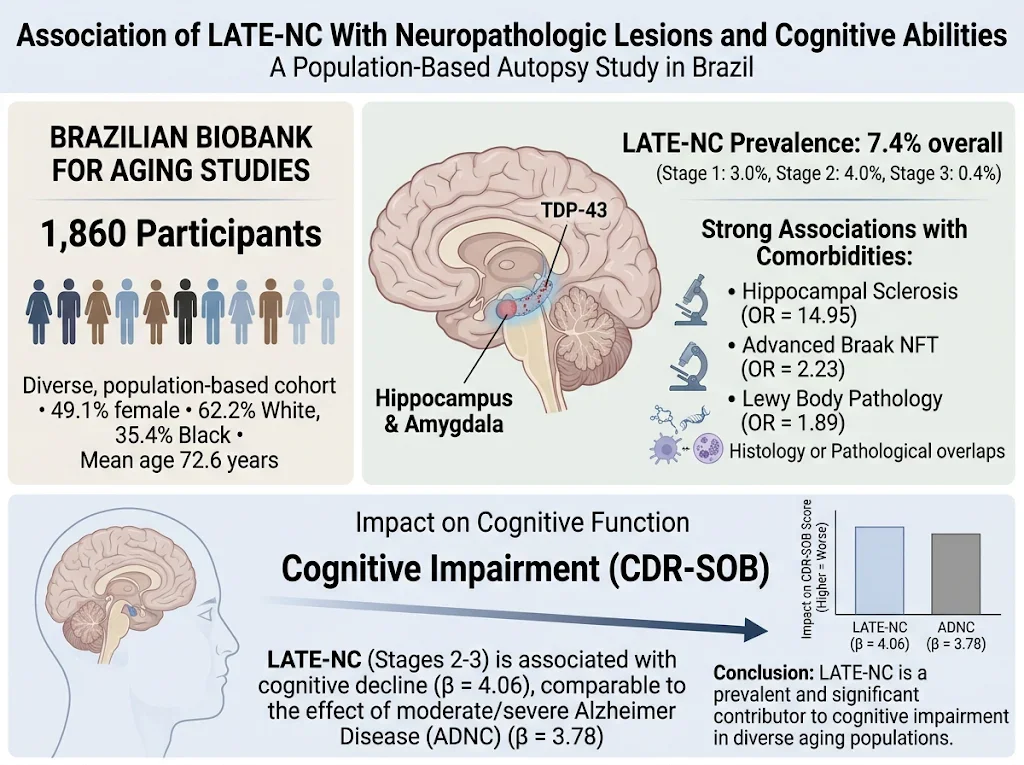
This cross-sectional autopsy study utilized data from the Biobank for Aging Studies at the University of São Paulo, Brazil, encompassing autopsies conducted from 2004 to 2024. Inclusion criteria were adults aged 18 years or older with available informants knowledgeable about the deceased’s cognitive status. The study population was ethnoracially diverse (62.2% White, 35.4% Black) and spanned various socioeconomic strata.
Neuropathologic assessments followed standardized international protocols to gauge LATE-NC staging and identify coexisting lesions including Alzheimer disease neuropathologic change (ADNC) quantified by Braak neurofibrillary tangle (NFT) staging, Lewy body pathology (LBP), hippocampal sclerosis, lacunar infarcts, small vessel disease, and cerebral amyloid angiopathy. Cognitive abilities proxied by ante-mortem clinical dementia severity were assessed using the Clinical Dementia Rating Scale Sum of Boxes (CDR-SOB) from informant interviews.
Statistical analysis involved logistic regression to examine relationships between LATE-NC and neuropathologies, and linear regression models adjusted for age, sex, ethnoracial background, education, clinical variables, and other neuropathologies to evaluate associations between LATE-NC and cognitive impairment.
Key Findings
The study cohort comprised 1,860 participants with a mean age of 72.6 years (SD 14.2), balanced gender representation (49.1% female), and significant ethnoracial diversity. LATE-NC was present in 7.4% of cases, distributed as stage 1 in 3.0%, stage 2 in 4.0%, and stage 3 in 0.4%.
Advanced LATE-NC (stages 2–3) showed strong associations with hippocampal sclerosis (odds ratio [OR] 14.95, 95% CI 7.42–30.27; p < 0.001), advanced Braak NFT stages indicative of AD neuropathology (OR 2.23, 95% CI 1.32–3.83; p = 0.003), and Lewy body pathology (OR 1.89, 95% CI 1.02–3.37; p = 0.036). These associations persisted after controlling for confounders.
Regarding cognition, LATE-NC independently predicted more severe cognitive impairment, with a CDR-SOB score increase of 4.06 points (95% CI 2.95–5.18; p < 0.001). This effect size was comparable to that of moderate/severe AD neuropathology (β = 3.78; 95% CI 3.14–4.42; p < 0.001). These findings establish LATE-NC as a significant contributor to cognitive decline in an ethnoracially and socioeconomically diverse population.
Expert Commentary
This study significantly advances the understanding of LATE-NC outside of highly selected or homogeneous cohorts, confirming the pathology’s presence and impact in middle- and older-aged adults from a diverse, developing country setting. The strong link between LATE-NC and hippocampal sclerosis aligns with previous research suggesting a mechanistic interplay that contributes to limbic neurodegeneration. Additionally, the coexistence of LATE-NC with Alzheimer and Lewy body pathologies highlights the complexity of neurodegenerative disease etiology in aging brains.
Importantly, the magnitude of cognitive impairment associated with LATE-NC rivals that caused by well-established Alzheimer disease neuropathology, emphasizing the clinical relevance of this pathology for dementia diagnosis and management. Clinicians should consider LATE as a differential or co-pathology in cognitive disorders, especially when classical AD biomarkers are incongruent with clinical progression.
Limitations include the cross-sectional autopsy design which precludes causal inference and limits temporal resolution of neuropathological progression. The relatively small number of stage 3 LATE-NC cases resulted in wide confidence intervals for some estimates, recommending cautious interpretation and further replication. Nonetheless, this work serves as a foundation for future longitudinal and biomarker studies in diverse populations.
Conclusion
This population-based autopsy study from Brazil underscores LATE-NC as a prevalent and clinically significant neuropathologic contributor to cognitive aging in a multiethnic, socioeconomically varied cohort. The findings support the integration of LATE-NC assessment into research and clinical diagnostics for neurodegenerative dementias worldwide. Further investigation into underlying mechanisms, longitudinal trajectories, and potential therapeutic interventions targeting TDP-43 proteinopathy remain priorities.
Funding and ClinicalTrials.gov
The study was supported by the Biobank for Aging Studies, University of São Paulo. Details on funding sources and clinical trial registration were not reported in the primary publication.
References
- Matos Silva C et al. Association of LATE-NC With Neuropathologic Lesions and Cognitive Abilities: A Population-Based Autopsy Study. Neurology. 2026 Nov 5;107(11):e218694. PMID: 42987245.
- Nelson PT, et al. Limbic-predominant age-related TDP-43 encephalopathy (LATE): consensus working group report. Brain. 2019;142(6):1503-1527.
- Josephs KA, et al. TDP-43 and Alzheimer’s disease neuropathologic change in aging and Alzheimer’s disease. Acta Neuropathol. 2017;134(3):383-404.
Specialty calculators
For clinical reference; use professional judgment.