Highlight
This pilot clinical exploration demonstrated that low-dose blinatumomab infusion in two patients with autoimmune diseases resulted in rapid peripheral B-cell depletion and sustained clinical improvement without severe adverse events. Immune profiling revealed transient T-cell activation and a return to immune homeostasis by 12 weeks, underscoring blinatumomab’s potential as an immune-modulatory therapy in refractory autoimmune conditions.
Background and Disease Burden
Dermatomyositis (DM) and antineutrophil cytoplasmic antibody (ANCA)-associated vasculitis (AAV) are severe autoimmune diseases characterized by inflammatory damage to muscles, skin, and small- to medium-sized blood vessels, respectively. Both conditions can be refractory to standard immunosuppressive therapies, leading to persistent morbidity and poor quality of life. Currently approved treatments often fail to achieve durable remission and are associated with considerable toxicity, making novel targeted therapies urgently needed.
Unmet Medical Need in Autoimmune Disease Therapy
Refractory cases of DM and AAV pose significant therapeutic challenges, with existing regimens such as corticosteroids, cyclophosphamide, and rituximab sometimes insufficient to control disease activity. Novel biotherapeutic approaches targeting distinct immune pathways represent a promising avenue to better control immune dysregulation and improve outcomes.
Study Design
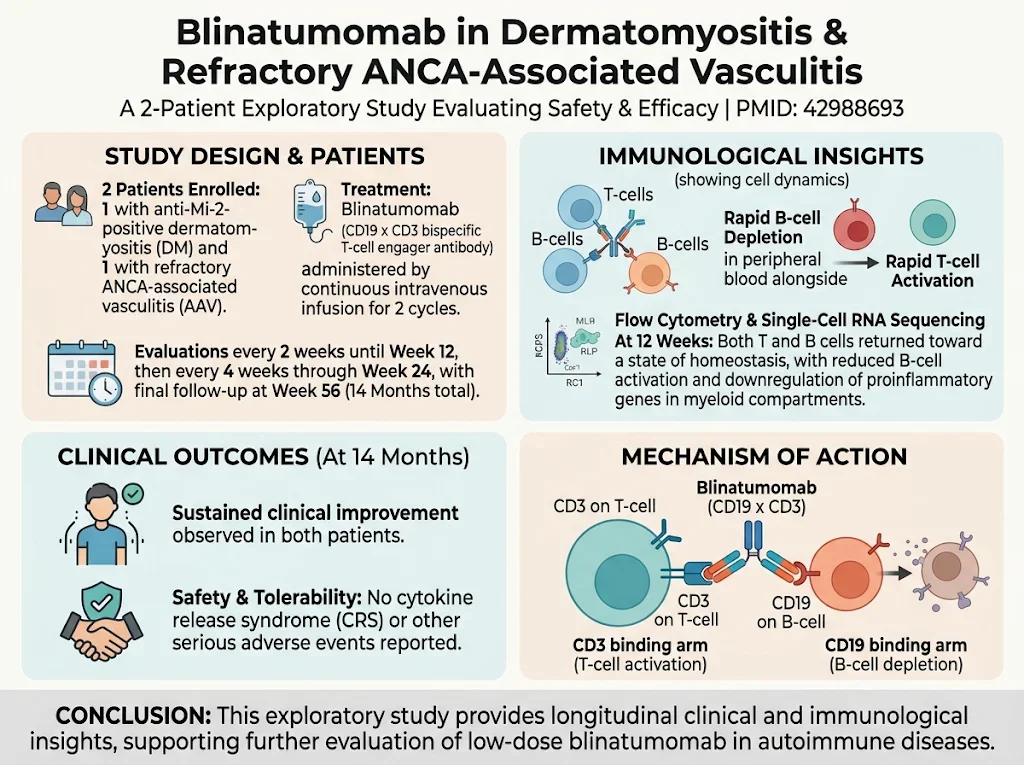
This exploratory study involved two adult patients: one diagnosed with anti-Mi-2-positive dermatomyositis and another with refractory ANCA-associated vasculitis. Both received blinatumomab, a bispecific T-cell engager antibody that simultaneously binds CD19 on B cells and CD3 on T cells, facilitating T-cell–mediated B-cell cytotoxicity.
Blinatumomab was administered via continuous intravenous infusion for two cycles. Clinical and immunological assessments occurred biweekly until week 12, then monthly until week 24, with a final evaluation at week 56. Immune response dynamics were characterized by flow cytometry and single-cell RNA sequencing to profile peripheral blood mononuclear cells.
Key Findings
The treatment with blinatumomab achieved rapid and sustained peripheral B-cell depletion in both patients, correlating with marked clinical improvement in muscle strength, skin manifestations, and vasculitis symptoms. Importantly, no serious adverse events or cytokine release syndrome were observed over the 14-month follow-up period.
Immune profiling revealed an initial surge in T-cell activation paralleling B-cell depletion, suggestive of effective engagement of the immune immune system by the bispecific antibody. By week 12, immune cell populations began to normalize, with a notable reduction in markers of B-cell activation and downregulation of proinflammatory genes in myeloid cells, indicating a shift toward immune homeostasis.
Clinical and Immunological Correlations
The temporal kinetics of immune modulation corresponded well with clinical measures of disease activity, supporting the mechanistic rationale that targeted B-cell depletion mediated via blinatumomab may restore immune balance in refractory autoimmune diseases.
Safety Profile
Neither patient experienced cytokine release syndrome or other severe adverse events, highlighting the tolerability of low-dose continuous infusion used in this context. This favorable safety profile contrasts with the typical immunosuppressive agents, which carry higher risks of infection and systemic toxicity.
Expert Commentary
Blinatumomab, initially developed for B-cell malignancies, shows promising translational potential in autoimmune diseases by harnessing T-cell cytotoxicity to selectively target autoreactive B cells. This study extends the therapeutic scope of bispecific T-cell engagers and underscores their relevance beyond oncology.
However, given the very limited sample size and exploratory nature, these results should be interpreted cautiously. Larger, controlled clinical trials are needed to confirm efficacy, optimal dosing strategies, and long-term safety. Additionally, mechanistic studies could elucidate the interplay between the T-cell activation phase and subsequent immune reset observed here.
Conclusions
This two-patient exploratory study provides initial evidence that blinatumomab can safely induce peripheral B-cell depletion and yield sustained clinical improvement in anti-Mi-2-positive dermatomyositis and refractory ANCA-associated vasculitis. The immunological findings of transient T-cell activation followed by restoration of immune homeostasis highlight a promising therapeutic mechanism.
These promising preliminary results warrant further investigation in larger cohorts to define the role of blinatumomab as a novel immunomodulatory agent in refractory autoimmune diseases.
Specialty calculators
For clinical reference; use professional judgment.