Highlight
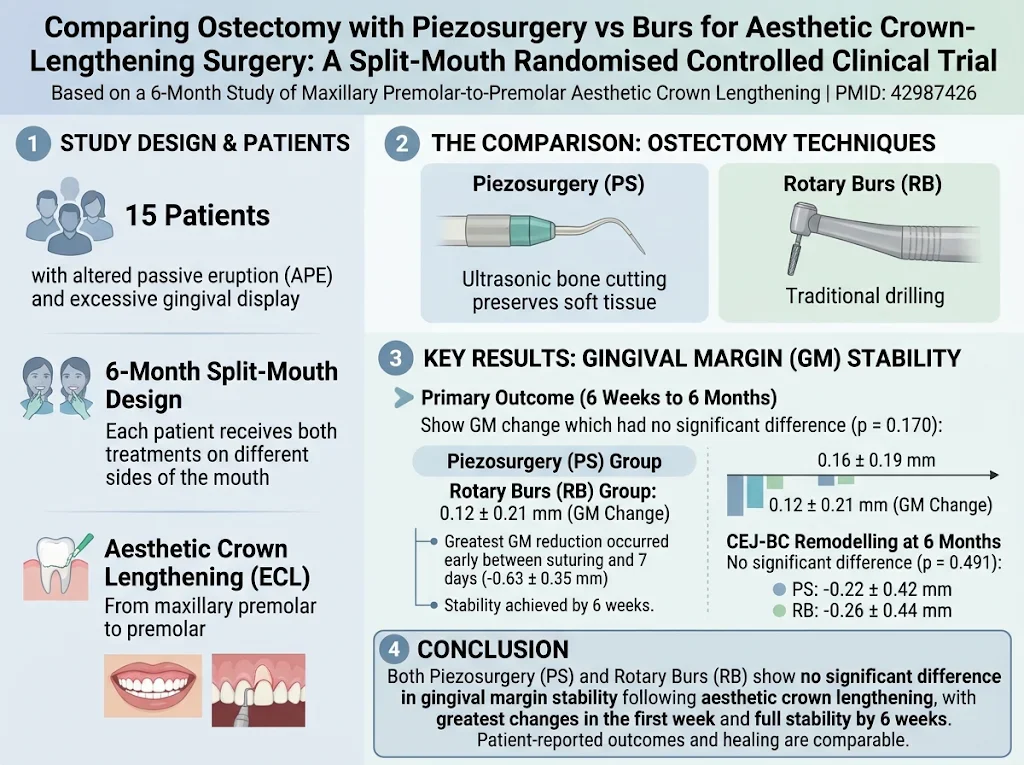
This randomised controlled clinical trial compared the outcomes of ostectomy performed using piezosurgery (PS) versus rotary burs (RB) during aesthetic crown-lengthening surgery. The key findings were: 1) no significant difference in gingival margin (GM) stability between PS and RB groups at 6 months, 2) greatest crown height reduction occurred within the first week after surgery, and 3) comparable bone remodeling measured radiographically between groups over 6 months.
Study Background
Aesthetic crown lengthening (ECL) is a common periodontal procedure aimed at improving the gingival contour and clinical crown exposure, often indicated in cases of altered passive eruption where excessive gingival coverage compromises esthetics. Typically, an ostectomy is performed to reposition the bone and provide adequate biological width to prevent relapse. Conventional rotary burs (RB) have been the standard tool for ostectomy, but piezosurgery (PS), which uses ultrasonic microvibrations, has emerged as a technique purported to offer more precise cutting with minimal trauma to surrounding tissues.
Assessing whether PS offers clinical advantages over RB in ECL, including gingival margin stability, bone remodeling, and patient experience, is critical for evidence-based surgical selection and optimizing esthetic outcomes.
Study Design
This split-mouth randomised controlled clinical trial enrolled 15 patients with altered passive eruption requiring ECL in the maxillary premolar-to-premolar region.
Each patient underwent bilateral surgical procedures, with ostectomy performed using PS on one side and RB on the contralateral side, randomly allocated. Follow-up extended over 6 months to assess both early and late post-operative changes.
Primary outcome: change in gingival margin (GM) position measured between 6 weeks and 6 months postoperative.
Secondary outcomes included clinical crown height changes (profilometric assessment), radiographic bone remodeling measured by CEJ-to-bone crest distance changes, and patient-reported outcomes (comfort, pain, satisfaction).
Statistical analysis utilized a linear mixed model treating treatment as a fixed effect and patient as a random effect.
Key Findings
Gingival Margin Stability: The primary outcome analysis showed minimal and statistically insignificant differences in GM position changes at 6 months postoperatively, with mean change of 0.16 ± 0.19 mm in the PS group versus 0.12 ± 0.21 mm in the RB group (p = 0.170). This indicates comparable long-term gingival margin stability with either technique.
Profilometric Crown Height Changes: The greatest drop in crown height occurred early postoperatively between suturing and day 7 (-0.63 ± 0.35 mm), signifying an initial tissue shrinkage phase. After this period, the crown height remained stable through 6 months, with no significant differences between PS and RB groups.
Radiographic Bone Remodeling: Bone crest remodeling, quantified by the cemento-enamel junction (CEJ) to bone crest (BC) distance change, was minimal and statistically comparable between groups over 6 months: -0.22 ± 0.42 mm (PS) vs -0.26 ± 0.44 mm (RB) (p = 0.491).
Patient-Reported Outcomes: Although secondary, the study reported no significant differences in patient comfort, pain, or satisfaction between the two techniques, indicating similar postoperative experience.
Expert Commentary
This trial provides robust evidence supporting the clinical equivalence of piezosurgery and rotary burs for ostectomy during aesthetic crown lengthening in terms of gingival margin stability and bone remodeling. Piezosurgery’s advantages, such as precision and minimal trauma, might offer theoretical benefits; however, these did not translate into measurable clinical or patient-reported superiority in the present study.
Limitations include the relatively small sample size and focus on a single anatomical region (maxillary premolars to premolars), which may limit broader generalizability. Also, long-term outcomes beyond 6 months and cost-effectiveness analyses remain necessary.
From a biological standpoint, the minimal bone remodeling observed aligns with established post-surgical healing patterns after ostectomy. The early shrinkage phase within the first postoperative week underscores the importance of timing when assessing surgical outcomes.
Conclusion
This well-designed split-mouth randomised controlled trial demonstrates that ostectomy performed via piezosurgery or rotary burs during aesthetic crown lengthening yields comparable gingival margin stability, radiographic bone remodeling, and patient satisfaction over 6 months. Early postoperative tissue changes occur predominantly within the first week, followed by stabilization.
Clinicians may therefore select either technique based on availability, surgical preference, and cost considerations without compromising clinical outcomes. Further studies with larger cohorts and extended follow-up periods are warranted to confirm these findings and evaluate potential differences in wound healing dynamics or operative efficiency.
Funding and ClinicalTrials.gov
The study details did not specify funding sources or clinical trial registration information.
References
1. Janaphan K, Sathitthammaphon T, Budsaba K, et al. A Split-Mouth Randomised Controlled Clinical Trial: Comparing Ostectomy Performed With Piezosurgery Versus Burs for Aesthetic Crown-Lengthening Surgery. J Clin Periodontol. 2026 Nov;43(11):1290-1298. PMID: 42987426.
2. Misch CE. Contemporary Implant Dentistry. 4th ed. Elsevier; 2015. Chapter on piezosurgery and bone cutting techniques.
3. Rosenberg ES, Harrel SK. Periodontal soft tissue management: principles and techniques for crown lengthening. J Periodontol. 2006 Oct;77(10):1651-1657.
Specialty calculators
For clinical reference; use professional judgment.