Highlight
– Identification of rs2129019 variant near SLC2A2 gene significantly influences glycemic response to glimepiride.
– Variant carriers, enriched among African/African American populations, demonstrate increased risk of metabolic failure on sulfonylurea therapy.
– Functional studies including OGTT, acute sulfonylurea challenge, and zebrafish model confirm impaired β-cell function and reduced drug efficacy.
– Findings support genetics-informed personalized treatment to optimize type 2 diabetes management.
Study Background
Type 2 diabetes mellitus (T2DM) is a chronic metabolic disorder characterized by insulin resistance and progressive β-cell dysfunction, necessitating sequential addition of glucose-lowering medications beyond metformin. Sulfonylureas like glimepiride remain widely used as second-line agents due to their insulin secretagogue effects, but exhibit wide interindividual variability in glycemic efficacy and risk of adverse events such as hypoglycemia. Current guidelines lack personalized tools to predict patient-specific response, often leading to trial-and-error therapy adjustments. Thus, identifying genetic markers influencing drug response is a critical step toward precision medicine in diabetes care.
Study Design
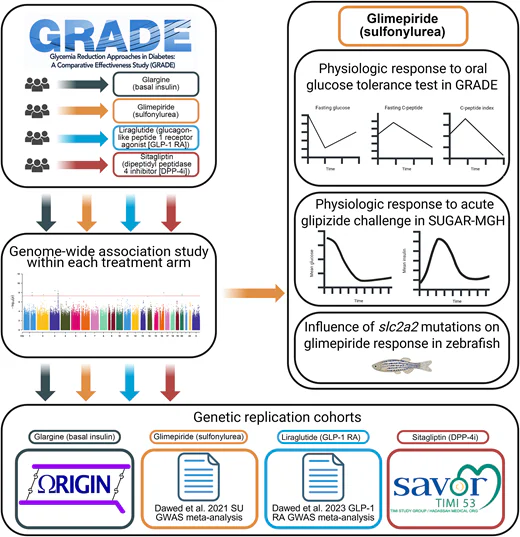
The Glycemia Reduction Approaches in Type 2 Diabetes: A Comparative Effectiveness Study (GRADE) is a multicenter, randomized clinical trial. This pharmacogenomic genome-wide association study (GWAS) was embedded within the GRADE trial framework, focusing on participants with T2DM inadequately controlled on metformin monotherapy. Four additional glucose-lowering drugs—insulin glargine, glimepiride, liraglutide, and sitagliptin—were compared. The GWAS investigated genetic predictors of time to metabolic failure, defined primarily as glycated hemoglobin (HbA1c) levels reaching ≥7.0% and secondarily as HbA1c >7.5%. Replication cohorts validated findings. Functional assessments included oral glucose tolerance testing (OGTT), acute glipizide challenge, and a zebrafish model genetically engineered to carry slc2a2 mutations.
Key Findings
The GWAS revealed that rs2129019, a common genetic variant near the SLC2A2 gene encoding the glucose transporter GLUT2, was significantly associated with glycemic response to glimepiride. Carriers of the A allele exhibited a 38% higher risk of metabolic failure during sulfonylurea therapy (P = 1.55 × 10⁻⁸). This variant was notably enriched in African/African American participants, indicating population-specific genetic influences.
Functional correlations demonstrated that carriers of the variant had impaired pancreatic β-cell function, as evidenced by a lower C-peptide index during OGTT, a marker reflecting diminished endogenous insulin secretion. Additionally, response to an acute sulfonylurea (glipizide) challenge was attenuated in these individuals, illustrating a mechanistic link between SLC2A2 variation and drug efficacy.
The zebrafish model with targeted slc2a2 disruption further corroborated these findings. Mutant zebrafish showed blunted glucose-lowering responses to glimepiride, substantiating the role of SLC2A2 in mediating sulfonylurea pharmacodynamics.
Expert Commentary
These findings contribute significantly to the understanding of pharmacogenomics in diabetes management by pinpointing a genetic locus that modulates sulfonylurea response. GLUT2 is fundamentally involved in glucose sensing and insulin secretion, and variation here can logically lead to differential drug effects. The population-specific enrichment of the risk allele underscores the importance of including diverse ethnic groups in pharmacogenomic research to tailor therapy equitably.
Nevertheless, the study has limitations including the complexity of T2DM pathophysiology where multiple genetic and environmental factors interplay, and the challenge of translating genetic risk into clinical action. Further prospective studies are needed to assess whether genetic screening for rs2129019 can improve clinical outcomes by guiding therapy choice, potentially favoring alternative agents for low-response allele carriers.
Conclusion
This comprehensive pharmacogenomic investigation establishes SLC2A2 genetic variation as a significant predictor of glycemic response to glimepiride in patients with T2DM. Incorporating such genetic data may enhance precision medicine approaches, optimizing second-line therapy selection beyond the current empirical paradigms. Future clinical implementation depends on integration of genetic testing in routine care and validation in diverse populations to reduce treatment failures and advance personalized diabetes management.
Funding and ClinicalTrials.gov
The GRADE study was supported by the National Institute of Diabetes and Digestive and Kidney Diseases (NIDDK). Clinical trial registration: NCT01794143.
References
1. Li JH, et al. Common Genetic Variants Near SLC2A2 and Glycemic Response to Glimepiride in the GRADE Comparative Effectiveness Clinical Trial. Diabetes Care. 2026; Nov 5. PMID: 42986362.
2. McCarthy MI. Genomics, Type 2 Diabetes, and Obesity. N Engl J Med. 2010;363(24):2339-2350.
3. Pearson ER. Personalized medicine in diabetes: the role of ‘omics’ and biomarkers. Diabetologia. 2019;62(5):791-799.
4. Florez JC, et al. Effects of Common Genetic Variants on Drug Response in Type 2 Diabetes. Diabetes. 2014;63(8):2601-2613.
Specialty calculators
For clinical reference; use professional judgment.