Introduction and Context
Hepatitis D virus (HDV) infection is an uncommon but severe form of viral hepatitis that occurs only in persons with hepatitis B virus (HBV) infection. When present, HDV accelerates liver disease—raising the risk of cirrhosis, hepatic decompensation, and hepatocellular carcinoma (HCC) compared with HBV infection alone. Historically, management options were limited: pegylated interferon (peg‑IFN) offered low sustained response rates and significant toxicity, and diagnosis was often missed because testing for HDV was inconsistent. In response to evolving evidence and the availability of a targeted antiviral—bulevirtide (Hepcludex)—the American Association for the Study of Liver Diseases (AASLD) commissioned an Expert Practice Opinion (EXPO) to provide practical, consensus-based guidance on screening, diagnosis, staging, treatment, and follow-up of HDV infection. The EXPO, published in Hepatology (Lim et al., 2026), aims to close clinical gaps, standardize care, and translate new therapeutic options into practice. Why this EXPO matters now – Underdiagnosis of HDV remains a global problem: many people living with chronic HBV are never tested for HDV, delaying care and worsening outcomes. – New therapeutics and emerging trial data provide options beyond peg‑IFN. – Clinicians need clear, practical recommendations covering testing pathways, treatment candidacy, monitoring, and management of special populations.New Guideline Highlights
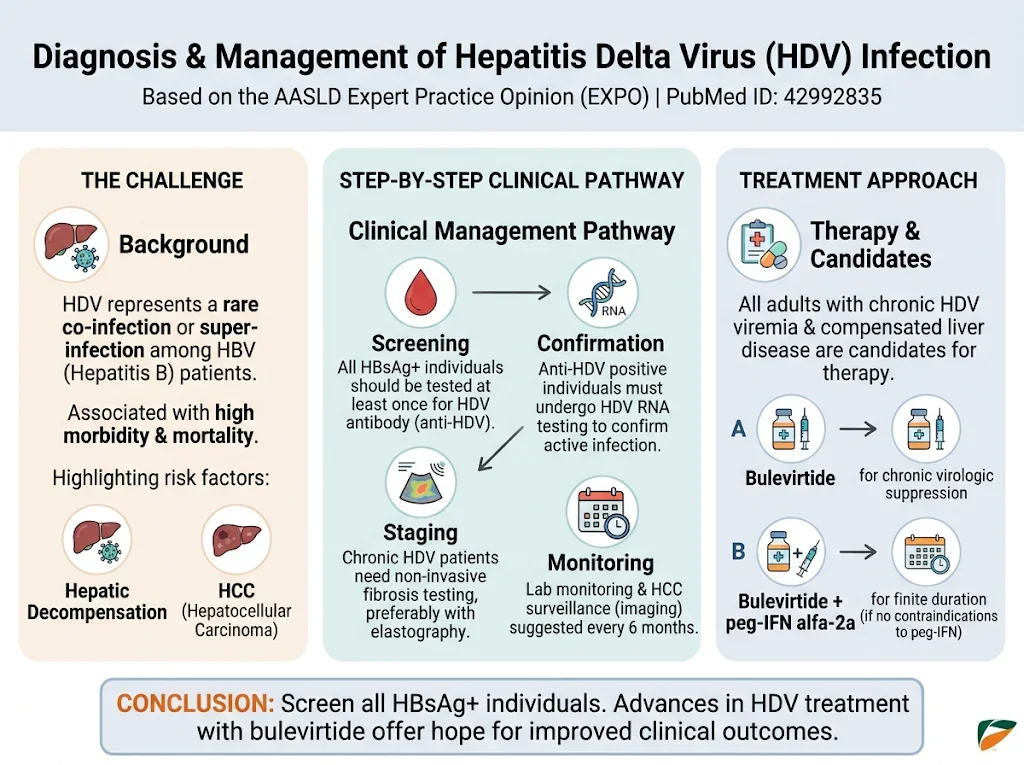
Major takeaways from the AASLD EXPO – Universal once-only testing: All individuals who are HBsAg-positive should be tested at least once for anti-HDV (HDV antibody). – Confirm active infection: Persons who are anti-HDV positive should undergo HDV RNA testing to confirm active viremia. – Staging and surveillance: All persons with chronic HDV should undergo fibrosis assessment—noninvasive testing is preferred, with elastography recommended—and should receive lab monitoring and HCC surveillance imaging every 6 months. – Treatment candidacy broadened: All adults with chronic HDV viremia and compensated liver disease should be considered candidates for HDV therapy. Bulevirtide is the primary therapeutic recommendation for chronic virologic suppression; an option to combine bulevirtide with peg‑IFN alfa‑2a is available for selected patients seeking a finite treatment duration and who have no contraindications to interferon. – Practical detail: The EXPO summarizes dosing, monitoring, patient selection, assessment of response, and how to manage special populations (including decompensated disease, pregnancy, HIV coinfection, and liver transplant candidates). Key clinical implications – Routine, systematic screening will identify more patients who can benefit from therapy. – Bulevirtide changes the therapeutic landscape: clinicians should become familiar with indications, expected outcomes, and monitoring needs. – The EXPO provides pragmatic, consensus-based recommendations intended to be rapidly implementable in clinical practice.Updated Recommendations and Key Changes from Prior Practice
What’s different compared with earlier guidance or typical practice – Testing policy: Previously, HDV testing was often risk‑based or inconsistent. The EXPO moves to universal one-time testing of all HBsAg-positive individuals—a major shift intended to reduce underdiagnosis. – Treatment eligibility: Earlier practice often reserved therapy for a subset (e.g., elevated ALT, advanced fibrosis). The EXPO expands candidacy to all adults with chronic HDV viremia and compensated liver disease, reflecting the availability of more tolerable and effective drugs. – Preferred therapy: Where peg‑IFN was the only practical option previously, bulevirtide is now the cornerstone of therapy for many patients. Combination strategies (bulevirtide plus peg‑IFN) are endorsed for select patients seeking a finite regimen. – Monitoring cadence: The EXPO endorses structured monitoring—including HDV RNA testing and imaging—at defined intervals, emphasizing 6‑monthly HCC surveillance for those at risk. Drivers of the updates – Regulatory approval and clinical data for bulevirtide demonstrating antiviral activity and biochemical improvement in many patients. – Recognition of widespread underdiagnosis and the clinical harms of missed HDV. – Accumulating evidence on noninvasive fibrosis assessment (e.g., elastography) that allows more accurate staging without liver biopsy.Topic-by-Topic Recommendations
Screening and diagnosis – Who to test: All persons who are HBsAg positive—regardless of ALT, HBV DNA, or demographics—should be tested at least once for anti-HDV. Re‑testing is reasonable in the setting of new risk exposures or clinical change. – Confirmatory testing: Any anti-HDV–positive individual should undergo HDV RNA testing to determine active viremia. If the initial HDV RNA is negative, consider repeat RNA testing (different assay or repeat after 1–3 months) if clinical suspicion is high; low-level intermittent viremia can occur. – Laboratory panel at diagnosis: Baseline tests should include ALT/AST, bilirubin, albumin, platelet count, INR, quantitative HBV DNA, HBsAg quantitation if available, and HDV RNA (quantitative). Staging and risk stratification – Noninvasive fibrosis assessment: All persons with chronic HDV should undergo fibrosis staging. Elastography (transient elastography or equivalent) is preferred. Serologic fibrosis scores (FIB‑4, APRI) may be used adjunctively but have limitations in HDV. – Imaging and HCC surveillance: For persons with cirrhosis or high-risk fibrosis, HCC surveillance with ultrasound (with or without AFP) is recommended every 6 months. The EXPO recommends 6-month imaging frequency for persons with chronic HDV who meet standard HCC surveillance criteria. Treatment strategies and selection – Who to treat: All adults with chronic HDV viremia and compensated liver disease should be considered candidates for HDV therapy. For persons with decompensated disease, treatment choices must be individualized; interferon is contraindicated in many cases, and bulevirtide can be considered with specialist input, often in the context of transplant evaluation. – First-line therapy: Bulevirtide (an entry inhibitor preventing HBV/HDV entry into hepatocytes) is recommended for chronic HDV to achieve virologic suppression and biochemical improvement. – Combination therapy: For patients without contraindications to peg‑IFN alfa‑2a who desire a finite-duration regimen, combination therapy (bulevirtide plus peg‑IFN) is an option. The EXPO outlines that combination therapy may increase the chance of more sustained responses in some patients, but carries interferon-related risks and requires careful patient selection. – Pegylated interferon alone: Peg‑IFN remains a potential option where bulevirtide is unavailable, or in selected patients, but clinicians should counsel on modest sustained response rates and treatment toxicity. Monitoring on therapy and response assessment – Virologic monitoring: Quantitative HDV RNA should be measured at baseline and periodically during therapy (commonly at weeks 12 and 24, then at intervals determined by the treating clinician). HDV RNA suppression (to undetectable levels) is the primary virologic goal; sustained suppression off therapy is desirable but may not be achievable in all patients. – Biochemical and safety labs: Monitor ALT, AST, bilirubin, albumin, platelets, and HBV DNA on a regular schedule while on therapy. Bulevirtide is generally well tolerated but requires clinical and laboratory monitoring. – Stopping rules and duration: Clear, universally accepted stopping rules are not yet established. Decisions to stop therapy should be individualized based on virologic response, tolerability, and patient preferences. The EXPO emphasizes shared decision‑making and close follow-up after treatment cessation to detect relapse. Special populations – Decompensated cirrhosis: Peg‑IFN is generally contraindicated. Bulevirtide may be considered on a case-by-case basis with transplant center collaboration; goals of care should be defined, and patients considered for transplant when appropriate. – Pregnancy and breastfeeding: Data on bulevirtide in pregnancy are limited. The EXPO advises caution and specialist consultation; interferon is contraindicated in pregnancy. – HIV coinfection: Coinfected patients should receive integrated care; interactions between antiretroviral therapy and HDV therapy should be considered. – Pediatric patients: Data remain sparse; pediatric use of bulevirtide requires specialist referral and often inclusion in clinical protocols. – Post‑liver transplant: HDV may recur; management requires multidisciplinary care with antiviral and transplant teams.Expert Commentary and Insights
What the committee emphasized – Underdiagnosis is the biggest immediate threat: By recommending universal testing of HBsAg‑positive persons, the EXPO panel aims to identify patients earlier and offer them effective therapy. – Bulevirtide represents a paradigm shift: Panel members highlighted bulevirtide’s role in changing expectations for disease control. However, they stressed that real-world experience, long-term outcomes, and data on hard endpoints (decompensation, HCC, mortality) are still maturing. – Need for individualized decisions: Despite broader treatment candidacy, experts agreed that patient comorbidities, bleeding risk, pregnancy plans, and access/cost concerns must shape management. Areas of controversy and research priorities – Optimal treatment duration: The field lacks definitive data on how long to continue bulevirtide to maximize sustained off‑treatment responses. – Best endpoints: Whether sustained HDV RNA negativity, HBsAg loss, or durability of biochemical improvement is the ideal target remains debated. – Access and cost-effectiveness: Bulevirtide is approved in Europe but not universally available or affordable; health-system level issues may limit implementation. – Combination strategies and novel agents: Other classes of drugs (e.g., prenylation inhibitors, RNA-targeted agents) are in development; combination strategies may ultimately prove superior.Practical Implications for Clinicians
Simple steps to adopt the EXPO recommendations in practice – Test every HBsAg-positive patient once for anti-HDV during routine follow-up; add reflex HDV RNA testing for positives. – For anti-HDV–positive patients, arrange quantitative HDV RNA and noninvasive fibrosis staging (elastography if available). – For adults with chronic HDV and compensated liver disease, refer to or initiate HDV therapy discussion—bulevirtide is now the central pharmacologic option. – Establish a monitoring schedule: HDV RNA and liver tests during therapy, and HCC surveillance every 6 months where indicated. – Engage multidisciplinary support for complex cases (decompensated cirrhosis, pregnancy, transplant candidates, HIV coinfection). Practical vignette Maria is a 45-year-old woman with chronic HBV (HBsAg‑positive) followed in primary care. Historically her ALT has been normal and she was never tested for HDV. Under the EXPO recommendation, her clinician orders anti-HDV; it is positive. Quantitative HDV RNA confirms viremia, and elastography suggests F2–F3 fibrosis. After referral to hepatology, the team discusses treatment: Maria is offered bulevirtide therapy with planned HDV RNA monitoring and 6‑monthly HCC surveillance. Because she prefers a finite course and has no contraindications to interferon, the team also discusses the option of combined bulevirtide plus peg‑IFN, including risks and benefits—allowing shared decision‑making.References
– Lim JK, Debes JD, Feld JJ, Idilman R, Terrault NA. AASLD EXPO: Diagnosis and management of hepatitis delta virus (HDV) infection. Hepatology (Baltimore, Md.). 2026 Nov 6. PMID: 42992835. https://pubmed.ncbi.nlm.nih.gov/42992835/ – European Medicines Agency. Hepcludex (bulevirtide) — EPAR, product information and regulatory approval documents. (Hepcludex authorized in the EU in 2020). https://www.ema.europa.eu/en/medicines – World Health Organization. Global hepatitis report 2017. Geneva: World Health Organization; 2017. https://www.who.int/publications/i/item/9789241565455 Note: The AASLD EXPO is an expert practice opinion designed to provide timely, pragmatic guidance ahead of full practice guidelines. Where evidence is limited, recommendations reflect panel consensus and are intended to be updated as new data emerge.Bottom line
The AASLD EXPO standardizes a modern, proactive approach to HDV: universal screening of all HBsAg‑positive persons, confirmatory HDV RNA testing, systematic fibrosis staging with elastography, and broadened treatment candidacy anchored by bulevirtide (with combination options). The EXPO addresses a critical care gap—underdiagnosis—and equips clinicians with practical pathways to identify and treat HDV in the era of new antiviral options.Specialty calculators
For clinical reference; use professional judgment.