Highlight
This qualitative study of people living with Parkinson’s disease (PD) highlights that pain in PD is multifaceted and deeply intertwined with motor and non-motor symptoms. Patients’ descriptions depict pain not only as a physical sensation but also as an emotional and psychological burden with substantial interference in daily functioning and quality of life. This contextual understanding supports tailored and comprehensive pain assessment and management approaches in clinical practice.
Study Background
Parkinson’s disease is a progressive neurodegenerative disorder primarily characterized by motor symptoms such as tremor, rigidity, and bradykinesia. However, non-motor symptoms, including pain, are increasingly recognized as significant contributors to disability and decreased quality of life in PD. Pain prevalence estimates vary, with studies indicating that up to 85% of people with PD experience some form of pain during the disease course. Despite its high frequency, pain in PD remains under-recognized, undertreated, and poorly understood, partly due to its subjective and complex nature.
Understanding patients’ perceptions and experiences of pain is crucial to improving pain management. Because pain in PD can be multifactorial, involving musculoskeletal, neuropathic, and central mechanisms related to the underlying neurodegeneration and its treatment, a qualitative, patient-centered approach offers rich insights beyond quantitative measures.
Study Design
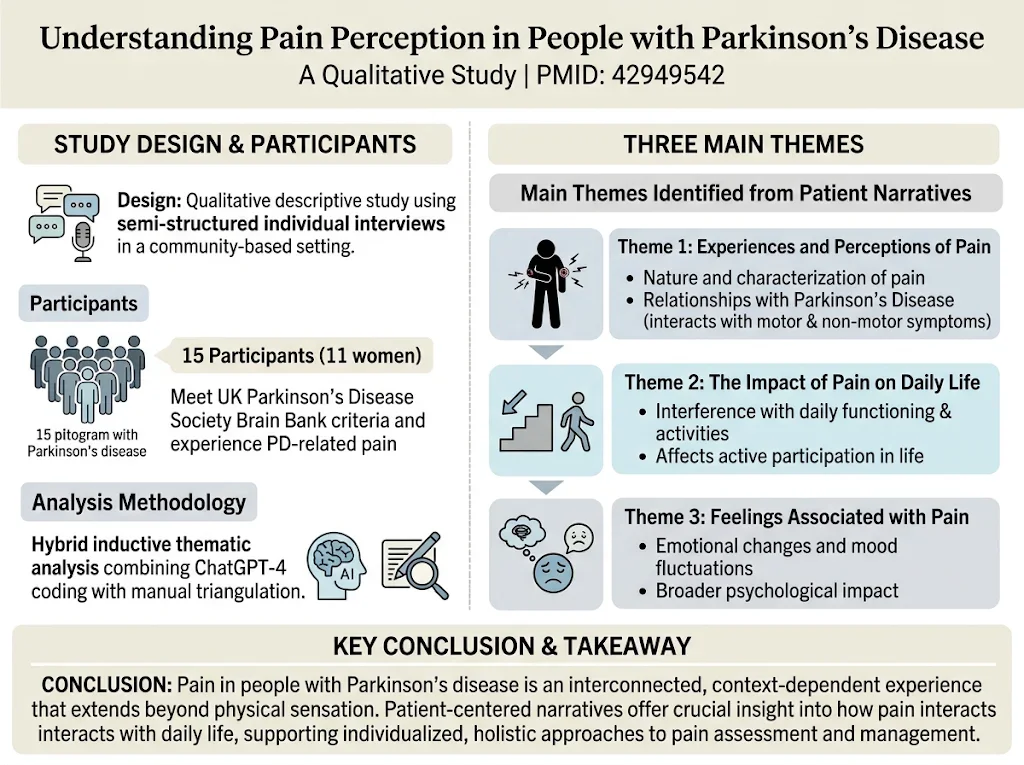
This study employed a qualitative descriptive design using semi-structured interviews to explore the lived experiences of pain among people diagnosed with Parkinson’s disease according to the United Kingdom Parkinson’s Disease Society Brain Bank criteria. Fifteen participants (11 women) who reported Parkinson’s disease-related pain, classified via the Parkinson’s Disease Pain Classification System, were recruited from community settings.
Interviews were conducted individually with open-ended questions probing the nature, characteristics, psychological effects, and impact of pain on daily life. The researchers applied an inductive thematic analysis, blending artificial intelligence-assisted coding through ChatGPT-4 with manual triangulation to ensure analytic rigor and comprehensive theme development.
Key Findings
Thematic analysis identified three overarching themes that frame the complex patient experience of pain in Parkinson’s disease:
- Experiences and Perceptions of Pain: Participants described pain in diverse ways, including aching, burning, stabbing, and stiffness sensations. They frequently linked pain to motor fluctuations, rigidity, or specific body regions but also acknowledged that some pain was difficult to localize or explain. Several participants noted variability in pain intensity and triggers, reflecting fluctuating PD symptoms.
- Impact of Pain on Daily Life: Pain was reported to significantly interfere with activities of daily living, mobility, sleep quality, and social participation. Many described pain as a barrier to exercise, which is critical for PD management, thereby potentially exacerbating disability. Participants expressed frustration that pain limited their independence and diminished enjoyment in routine or valued activities.
- Feelings Associated with Pain: Beyond the sensory dimension, pain elicited a range of emotional responses including anxiety, sadness, and feelings of helplessness. Some participants linked pain with mood changes or increased emotional distress, highlighting the interrelation of pain and psychological well-being. Chronic pain was perceived as emotionally exhausting and contributed to feelings of isolation.
These themes illustrate that pain in Parkinson’s disease is an interconnected and context-dependent experience, extending beyond physical symptoms to affect psychological and social domains.
Expert Commentary
This study enriches the understanding of pain in PD from the patient perspective, emphasizing the necessity of comprehensive pain assessment tools that address sensory, emotional, and functional dimensions. The use of AI-assisted thematic analysis demonstrates innovative methodological approaches for qualitative health research, enhancing data coding efficiency while preserving interpretive depth through manual triangulation.
Limitations include the small, predominantly female sample, which may restrict generalizability, and potential recall bias inherent in interviews. Nonetheless, the findings align with prior quantitative and qualitative literature emphasizing heterogeneous pain presentations and complex biopsychosocial influences in PD.
From a clinical standpoint, these insights advocate for individualized pain management strategies that integrate pharmacologic treatments targeting dopaminergic and non-dopaminergic pathways with interdisciplinary non-pharmacologic interventions such as physical therapy, psychological support, and patient education focused on coping strategies.
Conclusion
Pain in Parkinson’s disease represents a multidimensional experience intricately linked to both motor and non-motor disease manifestations. Patients’ narratives underscore the profound impact of pain on daily function, emotional health, and overall quality of life, advocating for holistic, patient-centered assessment and management approaches. Future research should validate comprehensive pain assessment instruments and test individualized multimodal interventions to alleviate pain and improve well-being in PD.
Enhancing clinician awareness of the complex nature of pain in PD and fostering shared decision-making with patients can optimize therapeutic outcomes and quality of life.
Funding and ClinicalTrials.gov
No specific funding information was provided. This qualitative study did not involve clinical interventions registered on clinicaltrials.gov.
References
- Beiske AG, Loge JH, Rønningen A, Svensson E. Pain in Parkinson’s disease: prevalence and characteristics. Pain. 2009;141(1-2):173–177. doi:10.1016/j.pain.2008.10.010
- Defazio G, Abbruzzese G, Conte A, et al. Pain as a Nonmotor Symptom of Parkinson’s Disease. Mov Disord Clin Pract. 2017;4(5):704-711. doi:10.1002/mdc3.12511
- Gibb WRG, Lees AJ. The relevance of the Lewy body to the pathogenesis of idiopathic Parkinson’s disease. J Neurol Neurosurg Psychiatry. 1988;51(6):745-752. doi:10.1136/jnnp.51.6.745
- Palermo TM, Toliver-Sokol M, Canning C. Management of chronic pain in Parkinson’s disease: A clinical review. Expert Opin Pharmacother. 2017;18(8):859-867. doi:10.1080/14656566.2017.1280403
Specialty calculators
For clinical reference; use professional judgment.