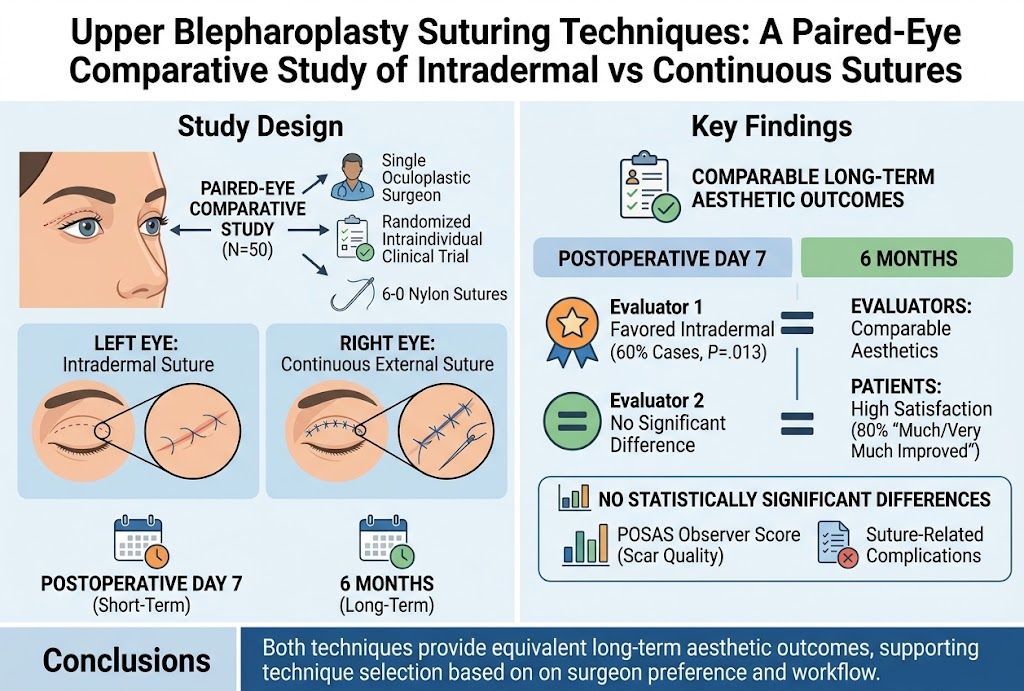
Highlight
– A randomized intraindividual study compared intradermal and continuous external suturing for upper eyelid blepharoplasty skin closure.
– Early postoperative assessments suggested modest aesthetic benefits for intradermal suturing at day 7.
– At 6 months, both suturing methods yielded comparable long-term scar quality and high patient satisfaction.
– No significant complications attributable to either technique were observed, supporting surgeon discretion in suture choice.
Study Background
Upper blepharoplasty is a frequently performed oculoplastic procedure aimed at rejuvenating the eyelids by removing excess skin and soft tissue. A critical goal in blepharoplasty is achieving optimal scar aesthetics to ensure patient satisfaction and minimize visible signs of surgery. Although nylon 6-0 is a standard suture material, debate persists regarding the ideal suturing technique to optimize wound healing and scar formation. Intradermal sutures, placed within the dermal layer, theoretically avoid suture track marks and may reduce early inflammatory responses, whereas continuous external sutures allow efficient closure but may pose a risk for more visible scars or track marks. Clarifying whether suturing technique impacts long-term aesthetic outcomes is essential to guide surgical practice and patient counseling.
Study Design
This prospective, randomized, intraindividual clinical trial involved 50 patients undergoing bilateral upper blepharoplasty at a university-affiliated tertiary center. All procedures were performed by a single experienced oculoplastic surgeon to reduce technique variability. Each patient’s eyelids were randomized such that one eyelid received an intradermal 6-0 nylon suture closure, while the contralateral eyelid was closed with a continuous external running 6-0 nylon suture. Evaluations included standardized photographic assessments at postoperative day 7 and at 6 months reviewed by two blinded oculoplastic surgeons using established scar assessment tools. Patients also completed the Global Aesthetic Improvement Scale to capture subjective satisfaction. Scar quality was quantitatively assessed using the Observer component of the Patient and Observer Scar Assessment Scale (POSAS Observer), a validated instrument rating parameters such as vascularity, pigmentation, thickness, and surface irregularity.
Key Findings
At the early postoperative assessment (day 7), one of the blinded evaluators favored intradermal sutures in 60% of cases, achieving statistical significance (P = .013), while the second evaluator did not note a statistically significant difference between the two techniques. This suggests a potential modest early aesthetic advantage for intradermal sutures, possibly due to less visible suture marks or inflammation immediately after surgery.
By 6 months postoperative, both suturing methods demonstrated comparable aesthetic outcomes across all parameters evaluated by blinded observers. The POSAS Observer scores, which quantitatively examine scar characteristics, did not show significant differences between intradermal and continuous external sutures at either time point, confirming equivalency in observed scar quality long term.
Patient-reported outcomes aligned with clinical assessments, with 80% of patients rating their results as “much improved” or “very much improved,” indicating high satisfaction independent of suturing technique. No suture-related complications such as infection, granuloma formation, or dehiscence attributable to suturing method occurred. A single unilateral incidence of wound dehiscence was reported but was not linked to either suturing strategy specifically.
These findings collectively indicate that while intradermal sutures may confer a slight early aesthetic edge, both techniques ensure excellent and comparable scar maturation and patient satisfaction over time.
Expert Commentary
The study benefits from a robust intraindividual randomized design, minimizing confounders such as patient-specific healing variability. The standardized photographic documentation and blinded evaluator assessments strengthen the validity of findings. However, subtle differences in early postoperative appearance favored only one evaluator’s subjective perception, highlighting challenges in scar assessment reliability and the multifactorial nature of wound healing.
From a clinical perspective, these data suggest flexibility in suture technique choice, allowing surgeons to select based on personal comfort, operative efficiency, and workflow without compromising long-term scar aesthetics. Given that scar outcomes at six months are primary for cosmetic satisfaction, patient counseling can emphasize this equivalency to alleviate concerns about technique-related scarring.
Future research could explore patient skin types, ethnic variations in scarring, or the impact of adjunctive modalities such as topical scar therapies post-blepharoplasty. Additionally, longer-term follow-up beyond six months might be useful to detect any late scar maturation differences.
Conclusion
In conclusion, this paired-eye randomized study demonstrates that intradermal and continuous external suturing techniques provide equivalent long-term aesthetic outcomes for skin closure in upper blepharoplasty. While intradermal sutures may have modest benefits in the immediate postoperative period, final scar quality at six months is similar between techniques. High patient satisfaction and low complication rates reinforce the safety and efficacy of both methods. Thus, choice of suturing technique can be guided by surgeon preference and practical considerations without compromising cosmetic results, facilitating individualized patient care in oculoplastic surgery.
Funding and ClinicalTrials.gov
The publication did not specify funding sources or clinical trial registration. Future detailed reporting on trial registration and funding transparency would be beneficial.
References
1. Soares R, Limongi RM, Allen RC, Bernardini F, Isaac DLC, de Ávila MP. Upper Blepharoplasty Suturing Techniques: A Paired-Eye Comparative Study of Intradermal vs Continuous Sutures. Aesthetic surgery journal. 2026 Aug 18;46(9):1037-1045. doi:10.1093/asj/sjaa123. PMID: 42118953.
2. Dower DS, DelRosso JQ. Scar Management and Surgical Techniques to Minimize Scar Formation. Dermatol Clin. 2015 Oct;33(4):555-70. doi:10.1016/j.det.2015.06.005.
3. Baumann LS. How to Improve Postoperative Scarring and Patient Satisfaction After Blepharoplasty. Facial Plast Surg Clin North Am. 2019 Feb;27(1):87-95.
4. van der Velden U, et al. The Patient and Observer Scar Assessment Scale: A Reproducibility Study. Plast Reconstr Surg. 2016;138(1):50e-57e. doi:10.1097/PRS.0000000000002339.