Highlight
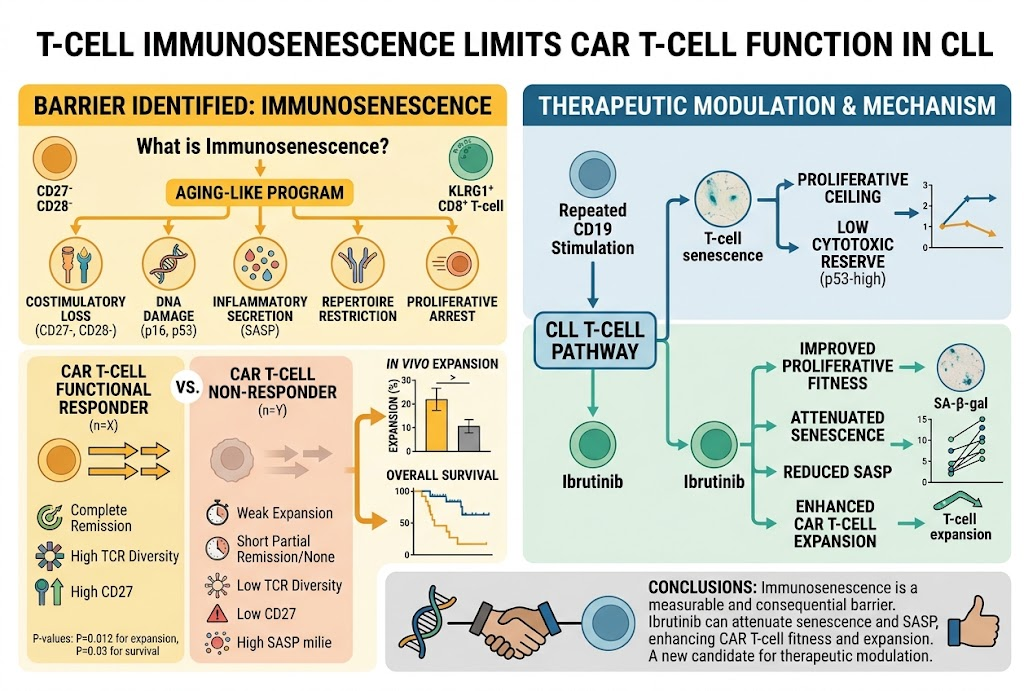
- Autologous T-cell immunosenescence significantly limits the expansion, persistence, and cytotoxic function of CD19 CAR T-cells in chronic lymphocytic leukemia (CLL).
- Senescence-associated secretory phenotype (SASP) programs and CD8 T-cell phenotypes (CD27⁻CD28⁻, KLRG1⁺) correlate with poor CAR T-cell responses and inferior survival.
- Ibrutinib shows promise in improving CAR T-cell proliferative fitness and reversing senescence-associated features ex vivo and in preclinical models.
Study Background
Chronic lymphocytic leukemia (CLL) is a malignancy characterized by clonal expansion of mature B lymphocytes. CD19-directed chimeric antigen receptor (CAR) T-cell therapy represents a revolutionary advance, offering the potential for durable remissions in patients with relapsed or refractory disease. However, the therapeutic efficacy of autologous CAR T-cells depends heavily on the quality and functional fitness of the patient’s T-cells, which serve as the raw material for CAR T-cell manufacturing.
Despite successes, many CLL patients exhibit suboptimal responses or treatment failures attributed traditionally to T-cell exhaustion. This paradigm, centered on dysfunctional T-cells losing cytokine production and proliferative capacity, has been challenged by findings indicating that many CLL T-cells remain capable of inflammatory cytokine secretion despite impaired cytotoxic function. The concept of immunosenescence — an aging-like T-cell state marked by loss of costimulatory molecules, DNA damage, restrictive T-cell receptor (TCR) repertoires, pro-inflammatory secretory profiles, and proliferation arrest — may better explain this functional impairment.
Understanding immunosenescence in CLL is critical to improving CAR T-cell outcomes and identifying new therapeutic avenues.
Study Design
In this comprehensive investigational study, researchers analyzed CD19 CAR T-cell products (CTL019) derived from patients with CLL. The design involved:
– Stratifying CAR T-cell products from responders (complete or partial with transformed disease) versus nonresponders or patients with short partial responses.
– Characterizing immunosenescence and senescence-associated secretory phenotype (SASP) gene expression programs before and during CAR T-cell manufacturing.
– Performing serum proteomic analyses to detect circulating inflammatory milieus associated with SASP.
– Employing flow cytometry and TCR repertoire profiling at apheresis to identify senescent CD8 T-cell phenotypes and diversity.
– Conducting in vitro assays with research-grade CAR T-cells from treatment-naïve CLL samples to evaluate senescence markers (e.g., SA-β-gal, p16, p53), transcriptomic profiles, and proliferative capacity under repeated CD19 stimulation.
– Testing the effects of ibrutinib exposure on reversing immunosenescence features and enhancing CAR T-cell expansion in an ibrutinib-resistant CLL model.
Key Findings
The study yielded pivotal insights:
Immunosenescence and Treatment Response
Nonresponders and short partial responders’ CAR T-cell products exhibited significantly elevated immunosenescence and SASP programs relative to functional responders. These senescence signatures were present preinfusion and intensified during T-cell manufacturing, clearly linked to poor in vivo expansion of CAR T-cells and worse overall survival outcomes.
Peripheral T-Cell Phenotypes and Repertoire
At leukapheresis, nonresponding patients harbored increased proportions of CD8 T-cells lacking costimulatory markers CD27 and CD28 and expressing the senescence marker KLRG1. The resulting CAR T-cell products showed diminished CD27 expression and restricted TCR diversity, consistent with senescence-driven repertoire narrowing.
Senescence Markers and Functional Exhaustion in CAR T-Cells
Research-manufactured CAR T-cells from treatment-naïve CLL showed hallmark senescence features including SA-β-gal positivity, p16 and p53 upregulation, DNA damage accumulation, depletion of less-differentiated T-cell states, and transcriptomic patterns enriched for senescence pathways. Upon repeated antigen stimulation, these CAR T-cells reached a proliferative plateau, and products with high p53 expression lost cytotoxic reserves, indicating functional exhaustion.
Circulating SASP and Inflammatory Milieu
Serum proteomic analysis revealed a SASP-like inflammatory profile in nonresponders, suggestive of systemic contribution to immune dysregulation.
Ibrutinib Modulates Immunosenescence
Ibrutinib, a Bruton’s tyrosine kinase inhibitor commonly used in CLL treatment, improved CAR T-cell proliferative fitness in paired patient samples and direct-exposure assays. It attenuated senescence markers and SASP-related secretions. In an ibrutinib-resistant CLL mouse model, ibrutinib enhanced CAR T-cell expansion, providing a mechanistic rationale for combining or sequencing ibrutinib with CAR T-cell therapy.
Expert Commentary
This seminal study elucidates immunosenescence as a concrete, measurable limiting factor in CAR T-cell efficacy for CLL, moving beyond the classical exhaustion paradigm. By defining senescence-associated molecular and phenotypic features linked to poor clinical responses, it opens avenues for pre-treatment patient stratification and optimization of CAR T-cell manufacturing protocols.
Notably, the reversal of senescence features by ibrutinib highlights a promising pharmacologic intervention to restore T-cell fitness. This supports emerging clinical trial efforts combining kinase inhibitors with cellular therapies to improve outcomes.
Limitations include the predominantly correlative nature of clinical observations and the challenge of translating ex vivo findings fully into clinical practice. Further studies are warranted to validate biomarkers predictive of response and to optimize timing and dosing regimens for senescence-modulating agents.
Conclusion
T-cell immunosenescence substantially limits CD19 CAR T-cell therapeutic efficacy in chronic lymphocytic leukemia. The presence of senescence and SASP programs, phenotypic alterations in peripheral T-cells, and restricted TCR diversity underpin impaired CAR T-cell expansion and cytotoxicity. Pharmacological modulation with agents like ibrutinib can partially reverse these deleterious effects, enhancing CAR T-cell fitness.
These findings underscore the need to integrate immunosenescence assessment into CAR T-cell therapy paradigms for CLL and lay groundwork for combination strategies to improve clinical outcomes. Addressing immunosenescence will be critical in realizing the full potential of CAR T-cell therapies in this challenging hematological malignancy.
Funding and ClinicalTrials.gov
The study was supported by multiple academic and governmental grants detailed in the original publication. No direct clinical trial registration is cited in this report.
References
Noll JH, Dersh D, Li JY, et al. T-cell immunosenescence limits CD19 CAR T-cell function in chronic lymphocytic leukemia. Blood. 2026 Aug 24; PMID:42636161. https://pubmed.ncbi.nlm.nih.gov/42636161/
Additional literature relevant to immunosenescence, CAR T-cell therapy, and CLL biology was consulted to provide context and interpret findings comprehensively.