Highlight
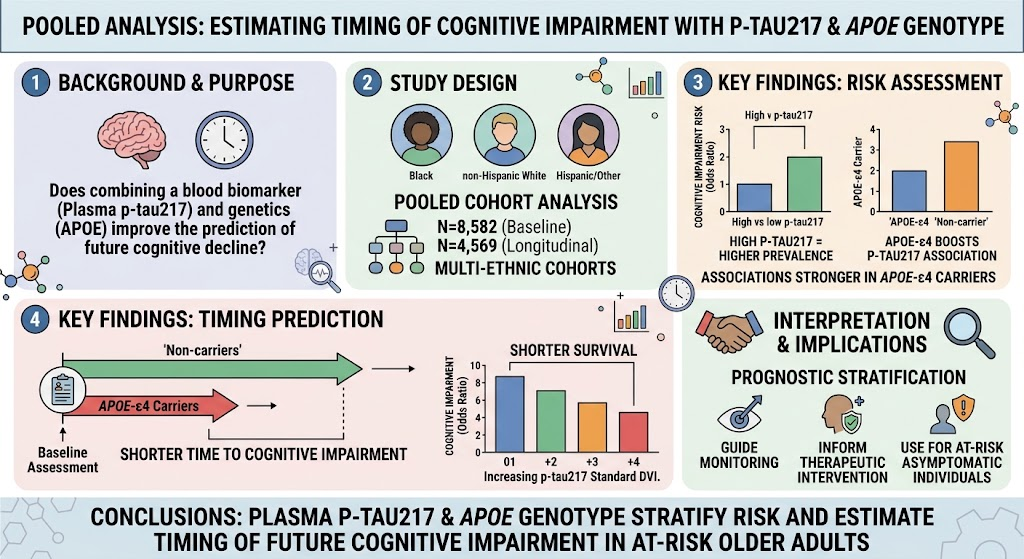
Plasma phosphorylated tau 217 (p-tau217) concentrations are significantly associated with both prevalent and incident cognitive impairment across racially and ethnically diverse older adults. The APOE-ε4 genotype modifies this relationship, with carriers exhibiting higher risk and shorter time to cognitive impairment for equivalent p-tau217 levels. Biomarker and genetic profiling combined can improve risk stratification and timing prediction for cognitive decline ahead of clinical symptoms.
Study Background
Alzheimer’s disease (AD) is the most common cause of dementia and imposes a substantial public health burden worldwide, exacerbated by an aging global population. Early identification of individuals at risk for cognitive impairment is critical to enable timely monitoring and therapeutic intervention before irreversible neuronal damage occurs. Plasma biomarkers, such as phosphorylated tau at threonine 217 (p-tau217), have emerged as accessible measures reflecting AD neuropathology in vivo. However, variability in clinical progression despite comparable biomarker levels suggests genetic factors, notably the APOE genotype, influence individual risk and timing of cognitive decline. The APOE-ε4 allele is a well-established genetic risk factor for AD, affecting amyloid deposition, tau pathology, and neurodegeneration dynamics. This study aimed to clarify how APOE genotype interacts with plasma p-tau217 concentrations to predict cognitive impairment onset within a racially and ethnically diverse population.
Study Design
This research employed a pooled analysis of participant-level data from seven prospective, multi-ethnic cohorts recruited across academic and community settings in Canada, the Dominican Republic, and the USA, spanning data collection from 1992 to 2025. The study population included 8,582 individuals (mean age 70 years, 65.9% female) comprising Black (16.1%), non-Hispanic White (47.3%), Hispanic, and other ethnicities (36.7%). Eligible participants had plasma p-tau217 measurements, APOE genotyping, clinical cognitive status assessments, and complete covariate data. The primary outcome was cognitive impairment, defined as either mild cognitive impairment or dementia.
Baseline analyses examined cross-sectional associations between p-tau217 levels and cognitive impairment status in the entire cohort, stratified and tested for interactions by APOE-ε4 carrier status. Longitudinal analyses focused on 4,569 individuals cognitively unimpaired at baseline with at least one follow-up visit, assessing incident cognitive impairment and time to event. Logistic regression and Cox proportional hazard models estimated associations controlling for demographic and clinical confounders. Additional survival analyses and random survival forests evaluated discrimination performance and timing of impairment onset.
Key Findings
At baseline, higher plasma p-tau217 concentrations were robustly associated with prevalent cognitive impairment (odds ratio [OR] 1.77; 95% CI, 1.42–2.20 per standard deviation increase), with a substantially stronger association in APOE-ε4 carriers (OR 2.25; 95% CI, 1.52–3.34) compared to non-carriers (OR 1.52; 95% CI, 1.35–1.72). This indicates that for identical elevations in plasma p-tau217, APOE-ε4 carriers had higher odds of existing cognitive impairment.
In the longitudinal analysis, higher baseline p-tau217 predicted incident cognitive impairment with a hazard ratio (HR) of 1.41 (95% CI, 1.22–1.64) per 1-SD increase. The risk was again stronger among APOE-ε4 carriers (HR 1.76; 95% CI, 1.36–2.26) relative to non-carriers (HR 1.26; 95% CI, 1.12–1.42). Notably, each 1-SD increment in p-tau217 corresponded to a 24% reduction in cognitive-impairment-free survival time among APOE-ε4 carriers, compared to a 13% reduction among non-carriers. This suggests accelerated progression to symptomatic impairment in APOE-ε4 carriers with elevated p-tau217.
Differences in survival without cognitive impairment by plasma p-tau217 concentration became evident approximately 3-4 years following biomarker measurement and before symptom onset, underscoring the prognostic window that p-tau217 and APOE genotype assessment provide for early intervention.
Expert Commentary
This study strengthens the evidence supporting plasma p-tau217 as a sensitive biomarker for AD neuropathology that, when combined with APOE genotype, enables refined prognostication of cognitive decline. The incorporation of genetic context is crucial because the APOE-ε4 allele influences amyloid and tau pathobiology and modulates clinical phenotypic expression. The results highlight the heterogeneity in clinical trajectories among individuals with similar biomarker levels, emphasizing personalized risk assessment.
Importantly, the inclusion of diverse racial and ethnic groups enhances generalizability and addresses disparities in biomarker research traditionally based on predominantly White cohorts. However, one should consider potential cohort heterogeneity and residual confounding. The use of standardized p-tau217 assays and harmonized cognitive assessments across cohorts bolsters validity. Future studies should explore integrating additional genetic variants and plasma biomarkers to further improve prognostic precision.
Conclusion
The combined assessment of plasma phosphorylated tau 217 concentration and APOE genotype offers a powerful approach to stratify risk and estimate timing of cognitive impairment in at-risk but asymptomatic adults. These findings support biomarker-informed strategies to identify individuals for close monitoring or early therapeutic intervention aimed at altering disease trajectories before overt cognitive decline. Wider clinical implementation of plasma p-tau217 testing alongside genetic profiling could transform Alzheimer’s disease risk management and foster personalized preventive care.
Funding and ClinicalTrials.gov
This study was funded by the National Institutes of Health. Data were pooled from multiple prospective cohorts; individual trial registrations are available in corresponding original cohort publications.
References
- Xu Y, Gunasekaran TI, Gu Y, et al. Plasma phosphorylated tau 217 concentrations, APOE genotype, and timing of cognitive impairment in individuals across diverse racial and ethnic groups: a pooled analysis of prospective cohort studies. Lancet Neurol. 2026 Sep 9. PMID: 42716078.
- Fagan AM, Shaw LM, Xiong C, et al. Comparison of plasma and cerebrospinal fluid biomarkers in Alzheimer’s disease: Utility of plasma p-tau217. Nat Rev Neurol. 2021;17(8):484-494.
- Reitz C. Genetic and epidemiologic landscape of Alzheimer’s disease. Clin Psychiatr Neurosci. 2019;73(2):55-71.