Highlight
- Development of a novel CRS Severity Index (CRS-SI) integrating patient-reported symptom phenotypes with objective imaging to predict outcomes after endoscopic sinus surgery (ESS).
- The four-level CRS-SI stratifies patients across a wide gradient (29%-81%) for likelihood of clinically meaningful symptomatic improvement measured by SNOT-22.
- The CRS-SI outperforms imaging grading alone and remains consistent across CRS phenotypes and multiple postoperative time points.
- Potential utility in preoperative counseling and clinical trial patient stratification if externally validated.
Study Background and Disease Burden
Chronic rhinosinusitis (CRS) affects a significant proportion of the population causing considerable morbidity linked to nasal congestion, facial pressure, and reduced quality of life. Endoscopic sinus surgery (ESS) is a well-established intervention aimed at improving sinus drainage and resolving symptoms when medical management is inadequate. However, about one-third of patients fail to achieve a clinically meaningful improvement postoperatively, underscoring the need for better preoperative prognostication. Existing tools focus on isolated domains such as symptom severity or CT imaging scores but lack integration into a composite predictive measure. This gap complicates surgical counseling and may hinder tailored treatment decisions and clinical trial design.Study Design
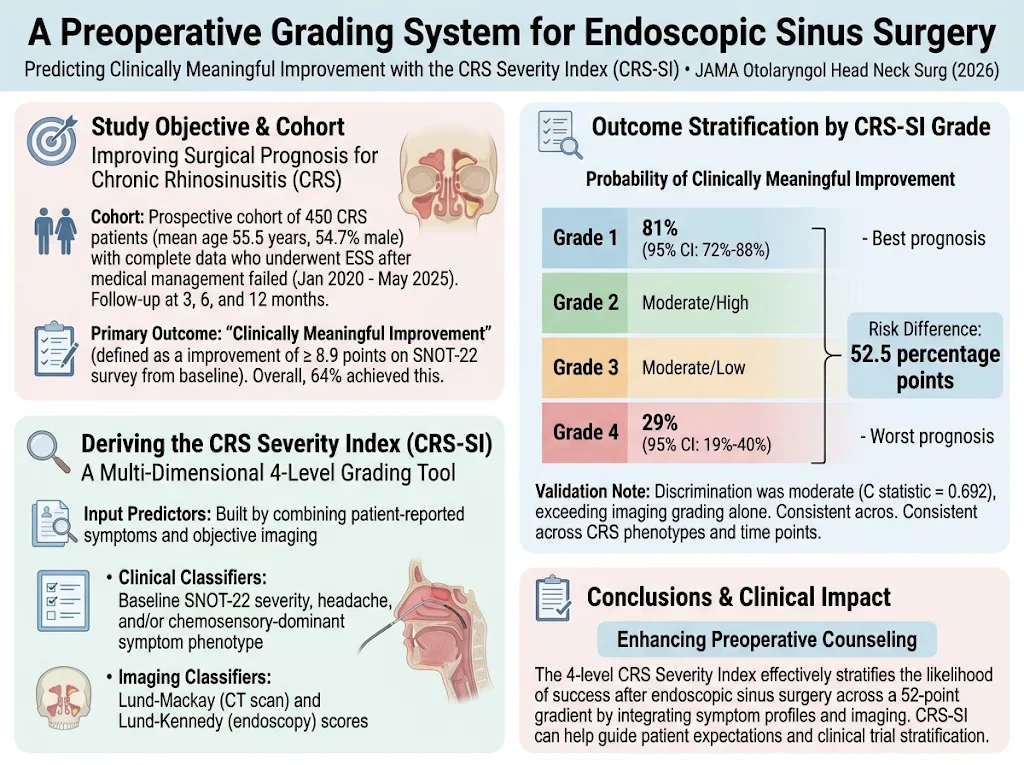
This research was conducted as a prospective cohort study enrolling consecutive patients aged 16 to 95 years diagnosed with CRS refractory to medical therapy who underwent ESS at academic tertiary care rhinology clinics from January 2020 to May 2025. Baseline clinical assessment included the 22-item Sino-Nasal Outcome Test (SNOT-22), a validated patient-reported outcome measure capturing symptom burden. Symptom phenotypes were derived from multiple correspondence analysis of symptom profiles, with specific attention to the presence of headache and chemosensory-dominant symptoms. Objective imaging grading employed the Lund-Mackay and Lund-Kennedy scoring systems from computed tomography and nasal endoscopy, respectively, alongside frontal opacification assessments. Outcomes were longitudinally evaluated at 3, 6, and 12 months post-ESS. The primary endpoint was a clinically meaningful improvement defined as a minimum 8.9-point reduction in SNOT-22 score from baseline. Seven candidate predictors were evaluated and categorized as clinical (baseline SNOT-22 score, latent symptom phenotype dimensions, presence of nasal polyps) and imaging measures (Lund-Mackay score, Lund-Kennedy score, frontal sinus opacification). The CRS-SI was derived using sequential sequestration and conjunctive consolidation methodology to formulate an ordinal staging predicting symptomatic improvement.Key Findings
Out of 488 eligible patients, 450 with complete baseline clinical and imaging data and at least one postoperative SNOT-22 follow-up constituted the analytic cohort. The mean age was 55.5 years, with a slight male predominance (54.7%). At follow-up, 64% experienced clinically meaningful improvement. Six of seven candidate predictors met predefined bivariate screening criteria. The sequential sequestration process selected baseline SNOT-22 severity and headache/chemosensory symptom phenotype as clinical classifiers. The Lund-Mackay and Lund-Kennedy scores were retained as imaging classifiers. The four-level CRS-SI stratified patients into grades reflecting decreasing likelihood of improvement: grade 1 had an 81% chance of improvement, grade 4 only 29%, yielding a risk difference of 52.5 percentage points (95% CI, 39.3–65.7%). The model demonstrated moderate discrimination with a C statistic of 0.692 (95% CI, 0.643–0.740), surpassing the predictive value of imaging alone. Bootstrap calibration confirmed good model fit (calibration slope 1.00, 95% CI, 0.77–1.31). This prognostic gradient was robust across different CRS phenotypes, including polyp status, and consistent at all postoperative time points evaluated.Expert Commentary
This study addresses a critical unmet need in CRS management by integrating multidimensional patient data to forecast surgical benefits more accurately. Incorporating patient-reported symptom phenotypes, especially those dominated by headache and chemosensory complaints, alongside objective imaging offers a nuanced approach reflecting both disease burden and anatomical severity. The CRS-SI’s moderate discrimination is clinically meaningful given the complexity of CRS and variability in patient responses. While imaging scores have utility, the enhanced predictive capacity of a combined index supports a precision medicine approach. This tool can better inform surgeon-patient discussions, setting realistic expectations. Limitations include the single academic setting and need for external validation in diverse populations and private practice. Also, further work may explore integrating biochemical or genetic markers to refine prognostication.Conclusion
The CRS Severity Index represents a promising composite preoperative grading system that quantifies the probability of clinically meaningful improvement following ESS by combining symptom phenotyping and objective imaging scores. Its ability to stratify patients over a broad risk spectrum has implications for personalized surgical planning and could improve clinical trial enrolment through better risk-based stratification. Future research should focus on external validation, incorporation of additional biomarkers, and assessment of CRS-SI impact on clinical outcomes and healthcare resource utilization.Funding and ClinicalTrials.gov
Details regarding study funding are not explicitly provided in the abstract. The prospective study was likely supported by institutional resources at participating tertiary care rhinology clinics. The clinical trial registration number, if applicable, is not mentioned and should be referenced in the full published article.References
Williams E, Minesinger K, Guevara G, Casiano RR, Palacio A, Levine CG. A Preoperative Grading System for Endoscopic Sinus Surgery. JAMA Otolaryngol Head Neck Surg. 2026 Nov 12. PMID: 43018980. https://pubmed.ncbi.nlm.nih.gov/43018980/ Additional pertinent literature includes validation studies of the SNOT-22 instrument, Lund-Mackay and Lund-Kennedy scoring systems, and literature on CRS phenotypes and their outcomes after ESS.Specialty calculators
For clinical reference; use professional judgment.