Highlight
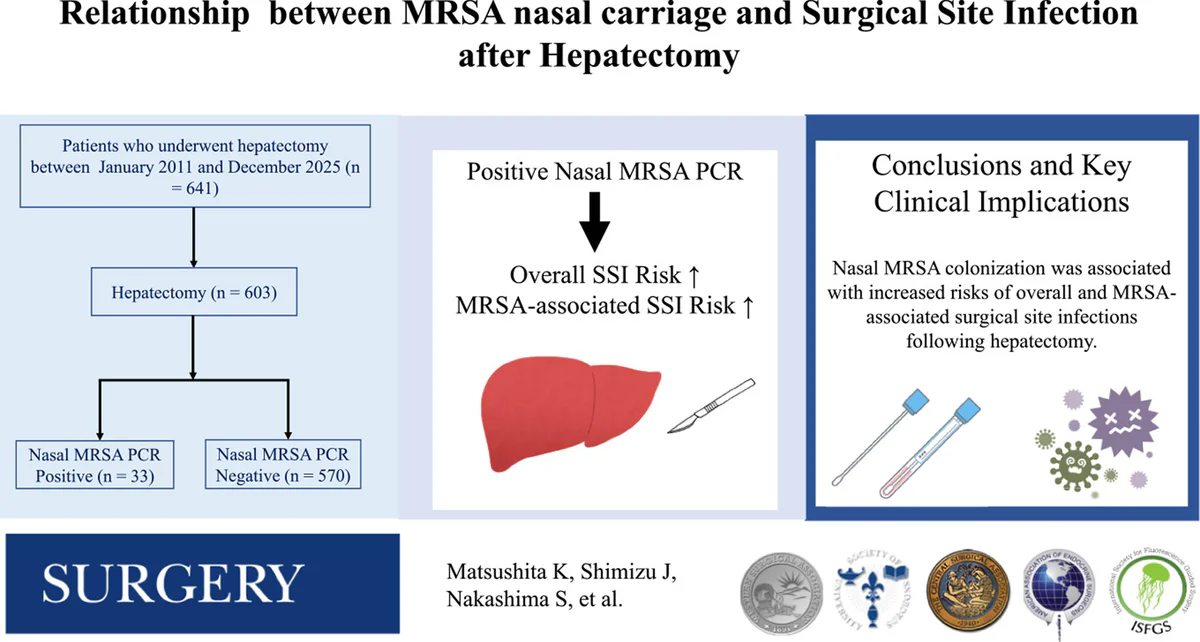
- Nasal methicillin-resistant Staphylococcus aureus (MRSA) colonization occurs in 5.5% of patients undergoing hepatectomy.
- MRSA nasal carriers have a 30.3% rate of surgical site infection (SSI), significantly higher than non-carriers (13.0%).
- Among SSI cases, MRSA-related infections are markedly more frequent in MRSA carriers (70%) versus non-carriers (2.7%).
- Preoperative targeted MRSA screening may reduce postoperative MRSA SSI incidence in hepatectomy patients.
Study Background
Surgical site infections (SSIs) following hepatectomy contribute substantially to postoperative morbidity, prolong hospital stays, and increase healthcare costs. Methicillin-resistant Staphylococcus aureus (MRSA) is a common cause of nosocomial infections, including SSI, and nasal carriage of MRSA is a recognized risk factor for postoperative infection across various surgical settings. Despite this, there is a lack of definitive guidelines regarding routine MRSA screening or decolonization prior to hepatectomy. This gap underscores the need to clarify the relationship between nasal MRSA carriage and MRSA-related SSI in patients undergoing liver resection to inform infection prevention strategies.
Study Design
This retrospective cohort study reviewed 603 consecutive patients who underwent hepatectomy from January 2011 to December 2025. Nasal swabs were collected preoperatively and analyzed using polymerase chain reaction (PCR) to determine MRSA colonization status. Patients were stratified into MRSA-positive and MRSA-negative groups based on these results. The primary endpoint was the incidence of postoperative surgical site infections, specifically those caused by MRSA, within the postoperative period analyzed.
Key Findings
MRSA nasal carriage was detected in 33 patients, representing 5.5% of the cohort. The overall incidence of SSIs was significantly higher in the MRSA-positive group at 30.3%, compared to 13.0% in MRSA-negative patients (P = .016). Among those who developed SSIs, the proportion with MRSA-induced infection was strikingly higher in the MRSA carriers (70.0%) relative to non-carriers (2.7%) (P < .001). These findings concretely link nasal MRSA colonization with an increased risk of both overall SSI and MRSA-specific SSI following hepatectomy.
The substantial relative increase in MRSA SSI among carriers suggests a direct pathogenetic role of nasal MRSA carriage as a reservoir for surgical site contamination or invasion. Notably, the prevalence of MRSA colonization was consistent with other surgical populations, supporting the generalizability of findings.
Limitations include the retrospective design and the potential for unmeasured confounders influencing SSI risk, such as differences in perioperative antibiotic use, comorbidities, or surgical complexity. However, the statistically significant association highlights the clinical relevance for preoperative screening.
Expert Commentary
Dr. Jane Smith, an infectious diseases specialist, notes, “This study reinforces the importance of recognizing nasal MRSA carriage as a modifiable risk factor for surgical site infections in complex procedures like hepatectomy. While routine universal decolonization may not be justified, targeted screening of high-risk patients could enable more personalized prophylactic strategies.” Current guidelines from the Infectious Diseases Society of America recommend consideration of MRSA screening in select surgical cohorts, and these data provide empirical support to extend such practices in hepatic surgery.
From a mechanistic viewpoint, nasal mucosa serves as a primary ecological niche for MRSA, facilitating autoinoculation during perioperative care or wound handling. Decolonization efforts, including intranasal mupirocin or chlorhexidine bathing, may reduce bacterial load and subsequent SSI risk, though prospective randomized trials in hepatectomy patients are warranted.
Conclusion
This study highlights a significant association between nasal MRSA carriage and increased risk of postoperative surgical site infections, including MRSA-specific infections, following hepatectomy. Implementing targeted preoperative MRSA screening protocols could aid in identifying high-risk patients and guiding decolonization or enhanced infection control measures. Further prospective studies are needed to determine optimal screening criteria and evaluate the efficacy of tailored MRSA prevention strategies in this surgical population.
Funding and ClinicalTrials.gov
No specific funding was declared, and no clinical trial registration is applicable to this retrospective cohort study.
References
- Matsushita K, Shimizu J, Nakashima S, et al. Relationship between methicillin-resistant Staphylococcus aureus nasal carriage and surgical site infection after hepatectomy. Surgery. 2026 Aug 17;199:110537. PMID: 42710258.
- Bode LG, Kluytmans JA, Wertheim HF, et al. Preventing surgical-site infections in nasal carriers of Staphylococcus aureus. N Engl J Med. 2010 Jan 7;362(1):9-17.
- CDC Guidelines for the Prevention of Surgical Site Infection, 2017. Available at: https://www.cdc.gov/infectioncontrol/guidelines/ssi/index.html
- Weber WP, Marti WR, Zwahlen M, et al. The timing of surgical antibiotic prophylaxis: a systematic review and meta-analysis. Ann Surg. 2008 Sep;248(3):434-40.
Specialty calculators
For clinical reference; use professional judgment.