Highlight
- High-dose intravitreal topotecan (100 g) provides robust control of refractory or recurrent intraocular retinoblastoma, including vitreous and subretinal seeds.
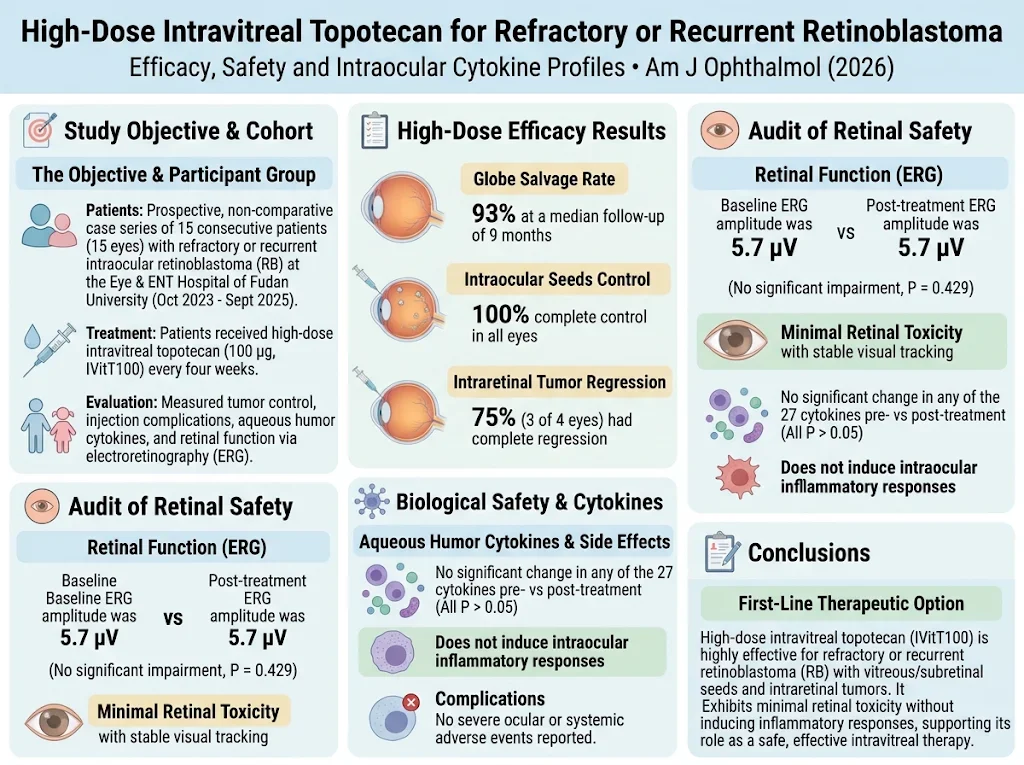
- This regiment achieves a 93% globe salvage rate, with complete intraocular seed control and effective intraretinal tumor regression.
- Retinal function measured by electroretinography remains stable post-treatment, indicating minimal retinal toxicity.
- Aqueous humor cytokine profiles show no significant inflammatory response associated with this treatment, supporting its ocular safety.
Study Background
Retinoblastoma (RB) is the most common intraocular malignancy in children worldwide. Despite advances in multimodal therapy, management of refractory or recurrent intraocular disease remains challenging, particularly with vitreous and subretinal seeding, which are resistant to conventional systemic and local therapies. Globe salvage is a critical therapeutic goal to preserve vision and quality of life, especially as enucleation carries significant morbidity. Intravitreal chemotherapy has emerged as a targeted approach to overcome chemotherapy resistance and improve local tumor control. Topotecan, a topoisomerase I inhibitor with proven antineoplastic efficacy, has been explored intravitreally but concerns regarding ocular toxicity and inflammatory side effects have limited its broader use. This study by Lin et al. investigates the efficacy, safety, and intraocular cytokine dynamics following high-dose intravitreal topotecan administration for refractory or recurrent retinoblastoma.Study Design
This prospective, non-comparative case series enrolled 15 consecutive patients with refractory or recurrent intraocular retinoblastoma from October 2023 to September 2025 at the Eye & ENT Hospital of Fudan University. Each patient received high-dose intravitreal topotecan (100 g, IVitT100) injections every four weeks. Clinical assessments including detailed ophthalmic examination, tumor characterization, and intraocular seed status were recorded pre- and post-treatment. Electroretinography (ERG) was conducted to evaluate retinal function, while aqueous humor samples were analyzed for 27 cytokines to assess inflammatory responses. The primary endpoints were tumor and seed control, globe salvage rates, and safety outcomes documented during a median 9-month follow-up after the final injection.Key Findings
High-dose intravitreal topotecan demonstrated excellent efficacy in this challenging cohort: all eyes (100%) achieved complete control of vitreous and subretinal seeds. Intraretinal tumor regression was observed in 75% (3 of 4) of evaluable eyes. Globe salvage was achieved in 93% (14 of 15) of treated eyes over a median 9-month follow-up (interquartile range 6-14 months). Importantly, ERG measurements showed no statistically significant decline in retinal function post-treatment (baseline median amplitude 5.7 V vs. post-treatment 5.7 V; P=0.429), indicating minimal retinal toxicity. This is clinically relevant as limiting retinal damage is essential in preserving visual potential. Regarding ocular safety, no severe injection-related complications such as endophthalmitis, retinal detachment, or ocular hemorrhage were observed. Systemic adverse events related to chemotherapy were also absent, consistent with localized intravitreal therapy minimizing systemic exposure. Analysis of aqueous humor cytokine profiles revealed no significant changes in any of the 27 measured cytokines before versus after treatment (all P > 0.05), suggesting that high-dose intravitreal topotecan does not provoke inflammatory or immune-mediated ocular responses. This contrasts favorably with some other intravitreal chemotherapeutics known to induce local inflammation.Expert Commentary
This study provides compelling evidence that high-dose intravitreal topotecan is a safe and efficacious option for recurrent or refractory intraocular retinoblastoma, including tumors with vitreous and subretinal seeds that are often highly refractory to treatment. The high globe salvage rate and preservation of retinal function are remarkable, given the resistant nature of these tumors. The absence of cytokine elevation post-treatment suggests that topotecan avoids provoking a deleterious inflammatory milieu in the eye, which may contribute to its favorable safety profile. These findings are concordant with prior pharmacokinetic and toxicity studies implicating topotecan as an ocular chemotherapeutic with a wide therapeutic window. Limitations include the small sample size and single-center design, which may limit generalizability. The relatively short follow-up (median 9 months) necessitates longer-term data to confirm durability of tumor control and monitor late toxicities. Future studies might include comparative trials against intravitreal melphalan or other agents, incorporation of pharmacodynamic biomarkers, and evaluation of combination approaches to optimize outcomes further.Conclusion
High-dose intravitreal topotecan offers a potent and safe therapeutic strategy for managing refractory or recurrent retinoblastoma, achieving high rates of seed and tumor control with minimal retinal toxicity or inflammatory complications. Given the critical need for effective globe-sparing treatments in advanced intraocular RB, IVitT100 represents a promising first-line intravitreal option that warrants broader clinical adoption and further validation in larger cohorts.Funding and ClinicalTrials.gov
This prospective study was conducted at the Eye & ENT Hospital of Fudan University; specific funding sources were not detailed in the report. ClinicalTrials.gov registration number was not provided in the publication.References
Lin X, Zheng Z, Chen H, Qian J, Liu Q, Ma R, Xue K. High-Dose Intravitreal Topotecan for Refractory or Recurrent Retinoblastoma: Efficacy, Safety and Intraocular Cytokine Profiles. American Journal of Ophthalmology. 2026 Nov 10; PMID: 43009085. Additional relevant literature for context: 1. Francis JH, et al. Intravitreal chemotherapy for vitreous seeding in retinoblastoma: Efficacy and toxicity. Ophthalmology. 2020;127(1):74-84. 2. Munier FL, et al. Intravitreal chemotherapy for vitreous seeding in retinoblastoma: Pharmacokinetics and safety. Ophthalmology. 2012;119(10):2168-2174. 3. Shields CL, Shields JA. Retinoblastoma management: Advances in focal treatments. Curr Opin Ophthalmol. 2011;22(3):203-208.Specialty calculators
For clinical reference; use professional judgment.