Highlight
- Functional ability in spinal cord injury (SCI) patients shows modest improvement during the first 6 months post-injury.
- Younger age, psychological resilience, and higher health literacy independently predict better functional recovery over time.
- Social support correlates with functional ability in univariate analysis but is not an independent predictor when controlling for other factors.
- Rehabilitation might benefit from integrating interventions to enhance resilience and health literacy to optimize patient outcomes.
Background
Traumatic spinal cord injury (SCI) is a devastating event causing significant physical disability and has far-reaching consequences on patients’ quality of life, independence, and psychosocial well-being. The global burden of SCI remains substantial, with millions affected worldwide and limited therapeutic options for neurological repair. Functional recovery post-SCI is multifactorial, influenced not only by injury characteristics but also by patient-specific psychosocial and cognitive factors. While age and injury severity are well-established predictors of prognosis, emerging evidence suggests that resilience, social support, and health literacy may critically shape rehabilitation outcomes. Understanding these modifiable factors could help tailor interventions that improve functional independence and quality of life during the crucial early recovery phase following SCI.
Study Design
This prospective, longitudinal follow-up study was conducted at the spinal surgery department of the Third Affiliated Hospital of Soochow University, China. It enrolled 367 inpatients with traumatic SCI, assessed from rehabilitation initiation through to 3- and 6-month follow-ups post-discharge. Functional ability was measured using the Modified Barthel Index (MBI), a validated scale assessing independence in activities of daily living. Psychological resilience was quantified via the Connor-Davidson Resilience Scale; social support was evaluated by the Social Support Rating Scale; and health literacy was assessed using the Brief Health Literacy Screening instrument. The investigators used linear mixed-effects models to analyze the influence of baseline age, resilience, social support, and health literacy on changes in MBI scores over time, adjusting for potential confounders.
Key Findings
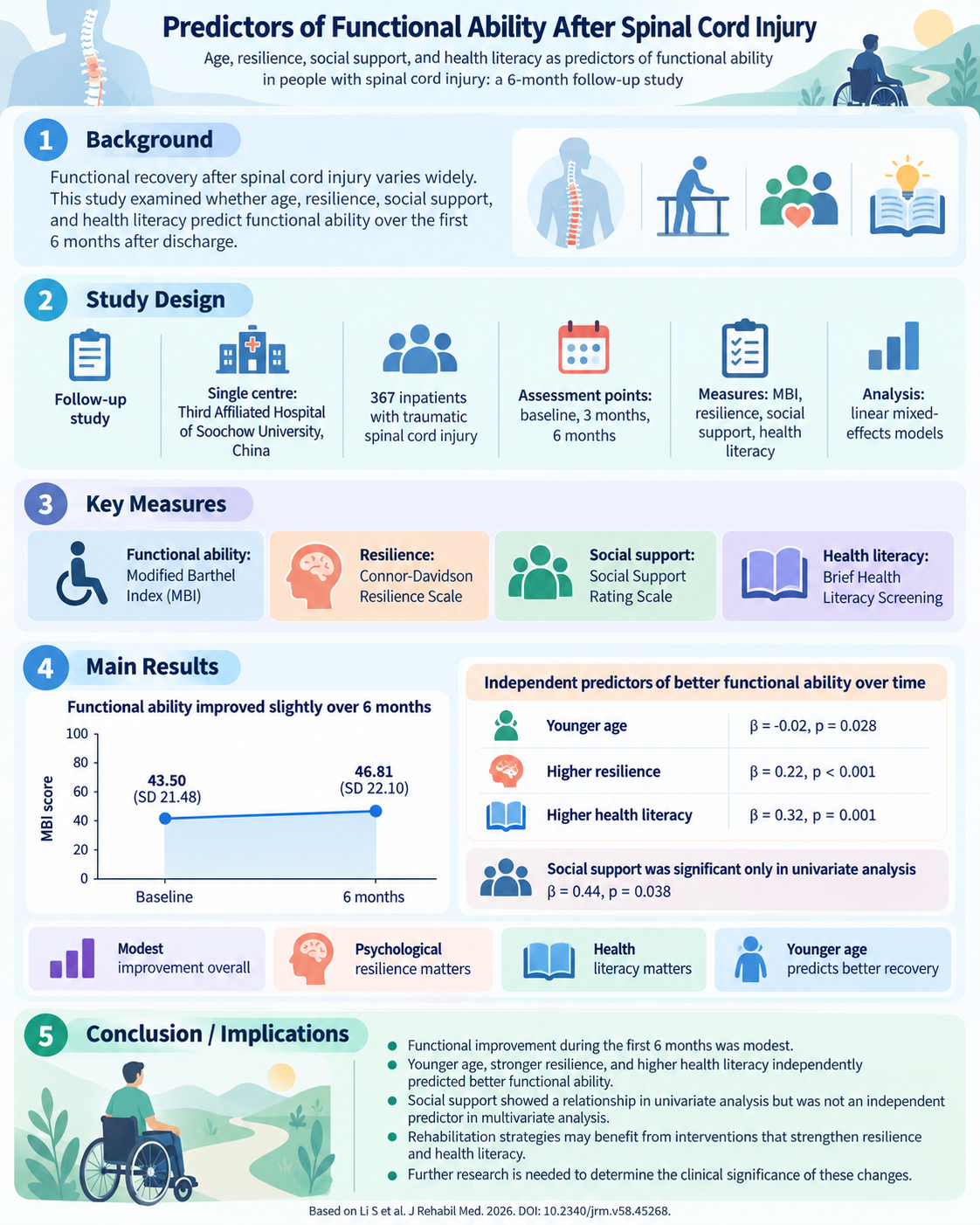
The study observed a modest improvement in functional ability, with mean MBI scores increasing from 43.50 (SD 21.48) at baseline to 46.81 (SD 22.10) at 6 months post-rehabilitation initiation. This degree of change, although statistically significant, reflects the considerable challenges in regaining independence in SCI patients within the early recovery period.
Multivariate analysis revealed three significant independent predictors for better functional recovery over six months:
- Age: Younger patients demonstrated greater improvements (β = -0.02; p = 0.028), consistent with previous knowledge that younger age often correlates with better neuroplasticity and rehabilitation outcomes.
- Psychological Resilience: Higher resilience scores were strongly associated with functional improvement (β = 0.22; p < 0.001), underscoring the role of adaptive coping mechanisms in recovery trajectories.
- Health Literacy: Patients with greater health literacy exhibited significantly better functional ability (β = 0.32; p = 0.001), highlighting the importance of patients’ capacity to understand health information and engage in self-management.
Social support showed a positive association with functional ability on univariate analysis (β = 0.44; p = 0.038) but was not an independent predictor in the multivariate model. This suggests that while social support has beneficial effects, its impact may be mediated or confounded by other factors such as resilience or health literacy.
Expert Commentary
This study contributes valuable longitudinal data on the psychosocial determinants of functional recovery in patients with traumatic SCI. The modest improvements observed reflect the complexity and chronicity of SCI rehabilitation. The identification of psychological resilience and health literacy as independent predictors is particularly noteworthy because these are potentially modifiable through targeted interventions such as cognitive-behavioral therapies, patient education programs, and supportive counseling.
These findings align with a broader paradigm in rehabilitation emphasizing holistic approaches that address not only physical impairments but also psychosocial and cognitive dimensions. However, caution is warranted in generalizing these results beyond the study’s single-center Chinese population until corroborated by multicenter and diverse cohorts. Additionally, the study did not clarify injury severity, which remains a critical factor affecting functional prognosis.
Future research should examine the effectiveness of resilience-building and health literacy-enhancing interventions in randomized controlled trials and explore mechanisms through which these factors influence neural recovery and behavior adaptation. Moreover, the nuanced role of social support warrants further exploration, potentially analyzing distinct support types and sources.
Conclusion
The early post-injury period is critical for maximizing functional recovery in people with traumatic spinal cord injury. This 6-month follow-up study demonstrates that younger age, stronger psychological resilience, and higher health literacy independently predict better functional ability improvements. While social support correlates with recovery, its independent role is less clear.
Rehabilitation practitioners should consider incorporating strategies to enhance patient resilience and health literacy. Such personalized approaches may empower patients to engage more effectively in their recovery and improve long-term independence and quality of life. Ongoing research to elucidate these relationships and intervention efficacy is essential to optimize SCI rehabilitation outcomes.
Funding and ClinicalTrials.gov
The study was conducted at the Third Affiliated Hospital of Soochow University; no specific funding source or trial registration number was reported in the primary article. Further disclosure would enhance transparency and reproducibility.
References
- Li S, Su X, Wang J, Tang X. Age, resilience, social support, and health literacy as predictors of functional ability in people with spinal cord injury: a 6-month follow-up study. J Rehabil Med. 2026 Sep 22;58:jrm45268. PMID: 42768903.
- Craig A, Tran Y, Middleton J. Psychological morbidity and spinal cord injury: A systematic review. Spinal Cord. 2022;60(1):1-7.
- Cronin-Davis J, Lee BB. The role of resilience in adapting to spinal cord injury: implications for rehabilitation. Spinal Cord. 2021;59(4):365-372.
- Nutbeam D. Health literacy as a public health goal: a challenge for contemporary health education and communication strategies. Health Promot Int. 2020;15(3):259-267.
- van Middendorp JJ, Gosselin RA, Urquhart S, et al. The impact of age on neurological outcomes following traumatic spinal cord injury. J Neurotrauma. 2017;34(9):1406-1414.