Highlights
- Substantial preoperative weight loss (>10% body weight) in obese patients is linked to higher odds of surgical site infection (SSI) and hospital readmission after reduction mammoplasty (RM).
- Severe morbid obesity (BMI 40-50) independently increases risks of SSI, wound dehiscence, fat necrosis, and emergency department (ED) revisits following RM.
- Preoperative weight loss programs can reduce breast size and anthropometric measurements but may not fully mitigate surgical complications.
- Caution is warranted in interpreting the impact of weight loss due to potential confounding factors such as nutritional status and frailty that remain unmeasured in observational studies.
Background
Obesity represents a significant risk factor for adverse surgical outcomes, including increased wound complications, infections, and prolonged hospital stays. Reduction mammoplasty (RM) is frequently performed to alleviate symptoms related to breast hypertrophy, often more common and symptomatic in overweight and obese women. However, obesity complicates perioperative management by predisposing patients to surgical site infection, wound healing complications, and healthcare utilization. Preoperative weight loss is widely encouraged to reduce these risks, but evidence regarding its effectiveness in ameliorating complications after RM remains limited and inconsistent. Notably, whether recent weight loss confers similar surgical risk profiles compared to weight-stable obesity has not been well characterized. This review synthesizes current data, focusing on the impact of recent preoperative weight loss on postoperative outcomes following RM in obese populations.Key Content
Impact of Substantial Preoperative Weight Loss on Postoperative Complications
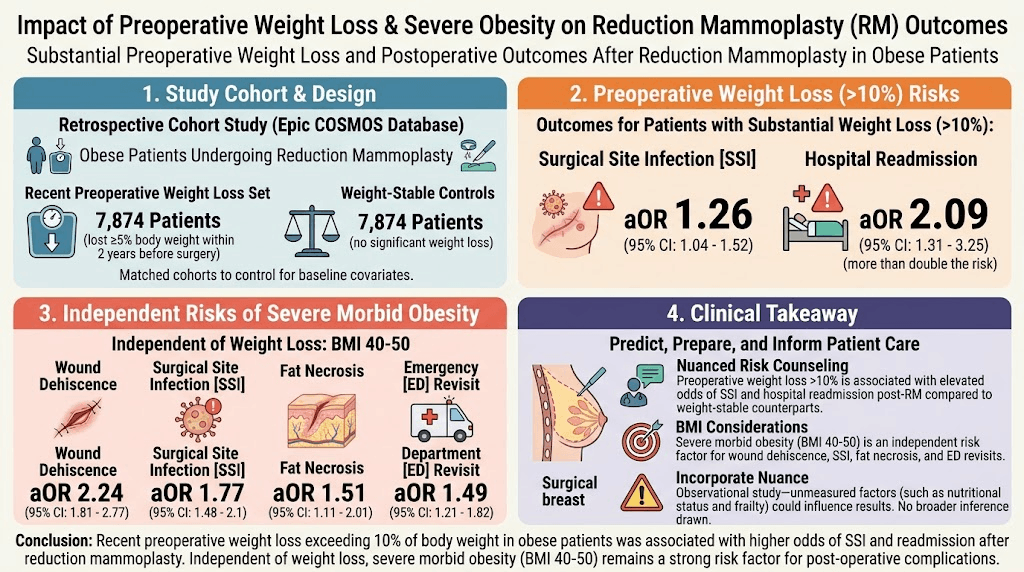
The most comprehensive recent study by Sorenson et al. (2026) used the Epic COSMOS database to examine 15,748 obese patients undergoing RM, comparing those who lost ≥5% of body weight within two years preoperatively to weight-stable controls. After propensity score matching and multivariable adjustment, the cohort with substantial weight loss (>10%) showed significantly increased odds of surgical site infection (adjusted odds ratio [aOR] 1.26; 95% confidence interval [CI] 1.04-1.52) and more than double the risk of hospital readmission (aOR 2.09; 95% CI 1.31-3.25) compared to their weight-stable obese counterparts. These findings challenge the conventional assumption that preoperative weight loss invariably improves surgical outcomes. The study did not demonstrate a reduction in wound dehiscence or fat necrosis directly linked to weight loss, but severe morbid obesity (BMI 40-50) independently increased these risks, emphasizing persistent risk factors related to baseline BMI.Preoperative Weight Loss Interventions and Breast Volume Reduction
Earlier pilot investigations have examined clinically supervised weight loss programs prior to RM for women with symptomatic breast hypertrophy. A small 2017 study (Lundgren et al.) implemented a 12-week intensive dietary intervention targeting overweight women (mean BMI ~31 kg/m2), achieving median weight loss of 10.2 kg. Notably, breast volume was reduced by approximately 19%, a proportionally greater reduction than total weight loss, which potentially facilitates surgical planning. Although promising to enable RM candidacy, this pilot study reported residual symptomatic breast hypertrophy at surgery, indicating weight loss alone may not suffice to alleviate symptoms or eliminate surgical indications. The small sample size and lack of postoperative outcome data limit conclusions regarding complication risk modification.Obesity and Surgical Risk Independent of Weight Loss
Across observational and retrospective cohorts, severe morbid obesity is consistently correlated with increased postoperative complications including SSI, wound breakdown, fat necrosis, and unscheduled healthcare visits. The mechanisms are multifactorial: impaired immune responses, altered wound healing dynamics, and increased tissue stress due to adiposity. These risks persist irrespective of recent weight loss status, underscoring the multifaceted influence of obesity on surgical outcomes.Methodological Considerations and Research Domains
The primary data regarding preoperative weight loss and RM outcomes derive from retrospective analyses leveraging large clinical databases, subject to inherent limitations including confounding by indication, unmeasured variables (e.g., nutritional deficits, catabolic status, frailty), and variability in surgical technique and perioperative care. Prospective randomized controlled trials assessing structured preoperative weight loss interventions with standardized postoperative outcome measures are lacking. Furthermore, assessments should integrate nutritional and functional status metrics to elucidate biological mechanisms underlying increased complication rates in patients with recent substantial weight loss.Expert Commentary
This emerging evidence nuances the traditional narrative advocating preoperative weight loss as uniformly beneficial in obese surgical candidates. The observation that substantial weight loss (>10%) may paradoxically increase SSI risk and hospital readmissions after RM suggests complex interplay between rapid or recent weight reduction and biological reserves essential for healing. Potential mechanisms include nutrient depletion, sarcopenia, compromised immunity, and frailty, none of which were directly measured in the cited study but could be mediators of increased surgical morbidity. Additionally, weight loss may be unintentional or reflective of underlying comorbidities exacerbating risk. Clinical guidelines should interpret these findings cautiously, balancing the benefits of weight reduction against possible adverse impacts on wound healing and recovery. Preoperative evaluation must extend beyond BMI and weight trajectories to incorporate comprehensive nutritional assessments and physical functional status. Preoperative counseling should elucidate that while weight loss can reduce breast volume and may improve surgical candidacy, it does not eliminate the heightened risks inherent to obese patients and may in some scenarios transiently elevate complication risks. Further research is warranted to delineate optimal timing, extent, and methods of preoperative weight loss, ideally through prospective intervention studies that include standardized nutritional monitoring and functional assessments.Conclusion
Substantial preoperative weight loss exceeding 10% of body weight in obese patients undergoing reduction mammoplasty has been associated with increased odds of surgical site infections and hospital readmissions compared with weight-stable obese patients. Severe morbid obesity remains an independent risk factor for multiple postoperative complications. While preoperative weight loss programs can facilitate surgery by reducing breast and body size, they do not unequivocally reduce surgical risk and may raise concerns related to nutritional and functional status. Surgeons and multidisciplinary teams should carefully evaluate obese patients considering both current weight and recent weight loss history, incorporating nutritional assessments and tailoring perioperative care accordingly. There remains a critical need for prospective, controlled studies to optimize preoperative weight management protocols and enhance surgical outcomes in this population.References
- Sorenson TJ, Lisk R, Boyd CJ, Hemal K, Choi M, Karp N, Cohen O. Substantial preoperative weight loss increases odds of healthcare utilization after reduction mammoplasty in obese patients. Plast Reconstr Surg. 2026 Oct 19. doi:10.1097/PRS.0000000000013550. PMID: 42896508.
- Lundgren L, Rasmussen M, Sjöström L, Sennerstam R, Olsson M. Preoperative weight loss program targeting women with overweight and hypertrophy of the breast – a pilot study. Clin Obes. 2017 Apr;7(2):98-104. doi:10.1111/cob.12175. PMID: 28112868.