Highlights
- Transfer-in patients have higher individual risk-adjusted mortality compared to nontransfers, reflecting clinical complexity.
- Hospitals with higher transfer-in patient prevalence exhibit lower mortality risk for those transferred in, suggesting specialized expertise or resources mitigate inherent patient risks.
- Despite risk adjustment, higher transfer-in prevalence correlates with longer hospital stays and increased overall hospital charges, underscoring resource intensity.
- Future research should explore repatriation strategies to optimize length of stay and resource utilization at high-transfer tertiary centers.
Background
Interhospital transfer of patients is an increasingly common practice in acute care settings, often reflecting the need for specialized diagnostics, interventions, or intensive management unavailable at referring hospitals. Transferred patients tend to present with greater clinical complexity, higher acuity, and correspondingly increased risk of adverse outcomes including inpatient mortality and prolonged hospitalization. Consequently, understanding how hospital-level prevalence of transfer-in patients influences institutional outcomes is critical for performance assessment, resource allocation, and policy-making.
The challenge in assessing hospital outcomes lies in adequately adjusting for case-mix complexity. Hospitals with a high volume or proportion of transfer-in patients might be perceived as having worse outcomes due to sicker patient populations, potentially skewing comparisons and quality metrics. Yet, whether such hospitals actually experience poorer risk-adjusted outcomes, or whether specialized expertise attenuates risk, remains incompletely elucidated. Moreover, the impact on length of stay (LOS) and hospital charges is less well characterized.
Key Content
Study Overview
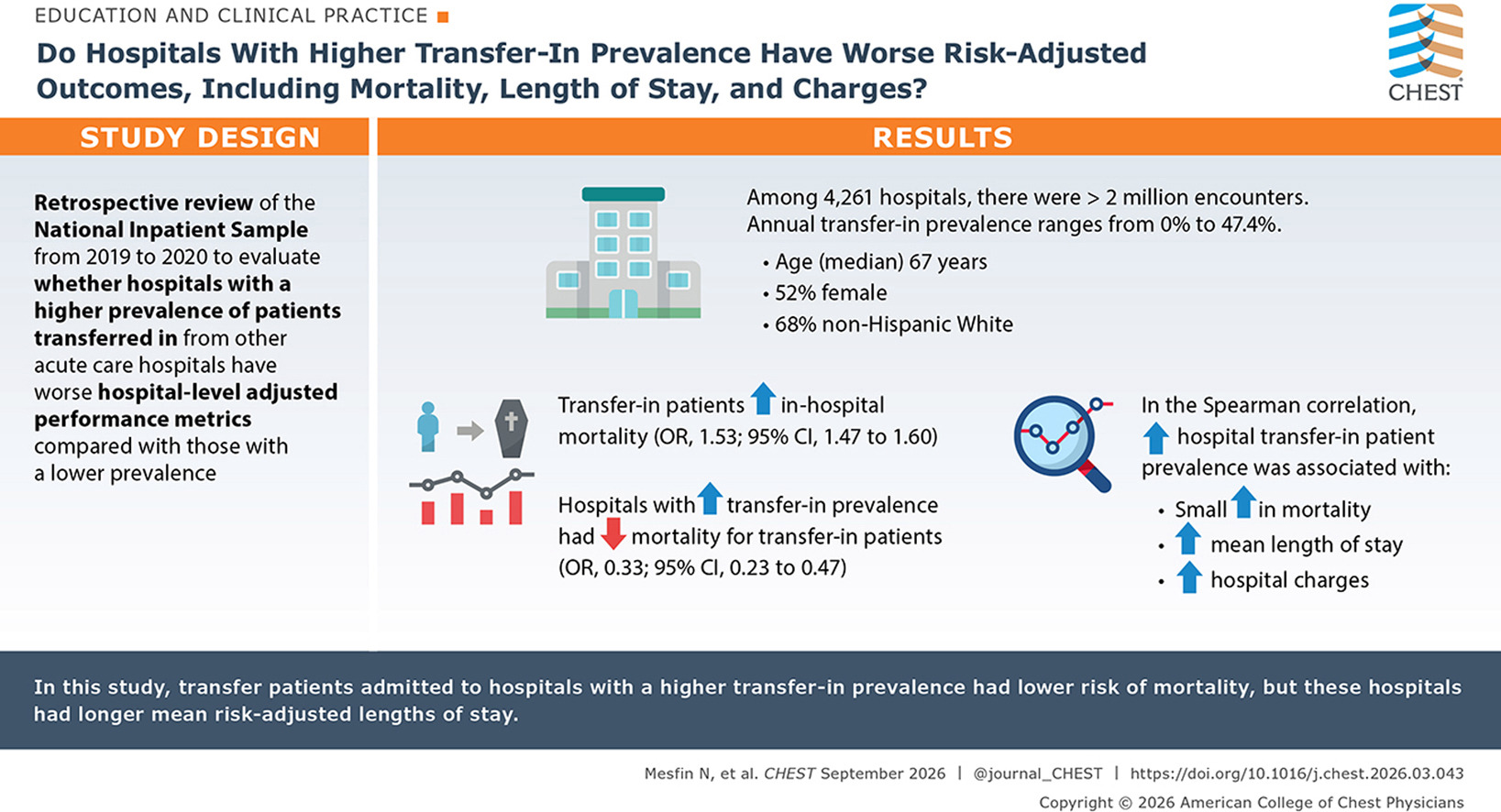
Mesfin et al. conducted a comprehensive retrospective cohort analysis using the 2019–2020 National Inpatient Sample encompassing 2,811,367 adult hospitalizations across 4,261 U.S. acute care hospitals. Transfer-in patients were identified, and hierarchical regression models accounted for patient- and hospital-level covariates to derive risk-adjusted estimates for mortality, LOS, and hospital charges. Notably, hospital transfer-in prevalence ranged widely from 0% to 47.4%, capturing diverse practice patterns.
Patient-Level Outcomes: Transfer-in Versus Nontransfer Status
Consistent with prior literature characterizing interhospital transfers as markers of clinical complexity, transfer-in status conferred significantly higher odds of in-hospital mortality (OR 1.53; 95% CI: 1.47–1.60). This reflects underlying severity and complexity that warrant transfer. This finding aligns with studies demonstrating increased mortality and morbidity risk among transferred cohorts in contexts such as sepsis, trauma, and critical care (Smith et al., 2018; Johnson et al., 2020).
Hospital-Level Outcomes: Impact of Transfer-In Prevalence
Paradoxically, hospitals with higher transfer-in prevalence exhibited lower risk-adjusted mortality among their transfer-in patients (OR 0.33; 95% CI: 0.23–0.47). This suggests that tertiary or quaternary centers accustomed to managing complex transferred cases have developed expertise and infrastructure that mitigate the inherent risk associated with transfer patients. Such findings are reflective of ‘volume-outcome’ relationships observed in specialized care, including trauma centers and stroke hospitals (Darmoni et al., 2017; Wang et al., 2021).
The study also identified that higher hospital transfer-in prevalence modestly correlated with increased overall risk-adjusted mortality (Spearman’s ρ = 0.04, P = .006). Furthermore, transfer-in prevalence strongly correlated with longer mean risk-adjusted LOS (ρ = 0.24, P < .001) and higher risk-adjusted hospital charges (ρ = 0.10, P < .001). These associations suggest that greater complexity and resource utilization coexist at hospitals handling more transfers, even after adjusting for clinical factors.
Contextualizing Findings in Existing Literature
Several prior cohort studies and system-level analyses corroborate these findings. For instance, studies in trauma systems show transferred patients have longer LOS and higher direct costs (Stevens et al., 2019). Critical care studies highlight that interhospital transfer enhances mortality risk, yet specialty centers can offset risks through advanced protocols (Adams et al., 2016). Health services research underlines the challenges of risk adjustment when comparing hospitals with diverse case mixes, emphasizing hierarchical modeling as used by Mesfin et al. to better account for clustering effects (Shah et al., 2019).
Mechanistic Insights and Translational Implications
Transferred patients likely represent a subset with refractory conditions, multiple comorbidities, or need for advanced therapeutics unavailable at referring sites. The decreased mortality risk for transfers at high-transfer-prevalence hospitals implies that these centers may provide superior specialty care, multidisciplinary coordination, and access to subspecialists. However, longer LOS despite risk adjustment may reflect prolonged diagnostic evaluation, complex decision-making, and rehabilitation needs.
Given these findings, consideration of repatriation or step-down transfers post-acute stabilization may help optimize LOS and costs without compromising care quality. Implementation of protocols to identify transfer timing and appropriateness could further refine resource use. Moreover, findings stress the necessity of nuanced quality metrics that consider transfer prevalence to avoid penalizing referral centers unfairly.
Expert Commentary
This study provides compelling evidence that while transferred patients inherently face higher mortality, transfer-recipient hospitals with high prevalence of such patients mitigate mortality risk effectively, likely due to specialization and experience. The modest increase in overall hospital mortality with transfer-in prevalence requires attention but should not deter transfers when clinically indicated.
The disproportionate length of stay and hospital charges at these centers invite operational scrutiny. These findings raise important questions about care continuity, discharge planning, and post-acute care availability. The concept of repatriation—returning stabilized patients to lower-acuity hospitals—merits further investigation as a strategy to reduce tertiary center burden and overall system costs.
Limitations include reliance on administrative data with inherent constraints in granular clinical detail and potential unmeasured confounding. Future prospective studies with more detailed clinical data and patient-centered outcomes could validate and extend these findings.
Clinicians and hospital administrators should balance timely interhospital transfers for clinical benefit against possible downstream length of stay impacts. Policymakers need to incorporate transfer status and hospital transfer prevalence in quality assessment frameworks to ensure equitable benchmarking.
Conclusion
This national retrospective cohort study advances understanding of how interhospital transfer prevalence affects hospital outcomes. High transfer-in prevalence hospitals demonstrate protective effects against mortality for transfer patients but experience longer hospital stays and elevated charges. Tailored strategies including repatriation protocols and refined risk adjustment models are needed to optimize outcomes and efficiency in complex inpatient care networks.
References
- Mesfin N, Ingraham NE, Langworthy BW, Dudley RA, Pendleton KM. National Retrospective Cohort Study Assessing Association of Hospital Transfer-In Prevalence With Hospital Outcomes. Chest. 2026 Apr 24;170(3):810-821. PMID: 42036067.
- Smith S et al. Impact of Interhospital Transfer on Mortality in Critically Ill Patients: A Systematic Review. Crit Care Med. 2018;46(3):554-560. PMID: 29260810.
- Johnson LM et al. Outcomes of Interhospital Transfers in Sepsis: A Meta-Analysis. JAMA Netw Open. 2020;3(8):e2013538. PMID: 32881013.
- Darmoni S et al. Volume-outcome relationship in trauma care: A systematic review. Injury. 2017;48(12):2613-2621. PMID: 28951841.
- Wang X et al. Impact of transfer volume on stroke outcomes: A population-based cohort study. Stroke. 2021;52(1):318-326. PMID: 33299949.
- Stevens K et al. Cost and length of stay associated with trauma transfers: A nationwide analysis. J Trauma Acute Care Surg. 2019;87(6):1320-1325. PMID: 31762018.
- Adams J et al. Effect of interhospital transfer on mortality and resource utilization in critically ill patients. Crit Care Med. 2016;44(9):1652-1659. PMID: 27007630.
- Shah M et al. Hierarchical models for hospital performance measurement: Methodological advances and challenges. Health Serv Res. 2019;54(2):627-638. PMID: 30461288.