Highlight
This study validates the prognostic significance of imaging-detected extranodal extension (iENE) in HPV-mediated (p16-positive) oropharyngeal cancer, confirming its inclusion in the 9th edition AJCC/UICC TNM staging (TNM9). Patients with iENE have significantly worse overall and progression-free survival compared to those without iENE. Despite this, the TNM9 staging incorporating iENE performs comparably to the previous TNM8 in clinical nodal classification in terms of model fit and discrimination.
Study Background
Human papillomavirus (HPV)-associated oropharyngeal squamous cell carcinoma (OPSCC), commonly identified by p16 positivity, has a distinct clinical behavior and better prognosis compared to HPV-negative disease. However, accurate risk stratification remains critical for guiding therapeutic decisions. Extranodal extension (ENE)—the spread of cancer cells beyond the lymph node capsule into surrounding tissues—is a known adverse prognostic feature in head and neck cancers. Historically, ENE was defined by pathological examination after surgery. With evolving non-surgical primary treatments such as chemoradiation, imaging-based detection of ENE (iENE) via computed tomography (CT) or other modalities has become vital. The 9th edition American Joint Committee on Cancer (AJCC) and Union for International Cancer Control (UICC) TNM staging manuals incorporated iENE for the first time to refine nodal classification in HPV-positive oropharyngeal cancer, upstaging patients with iENE. However, prospective data confirming the prognostic value of iENE and the performance of the updated TNM9 staging system remained limited.
Study Design
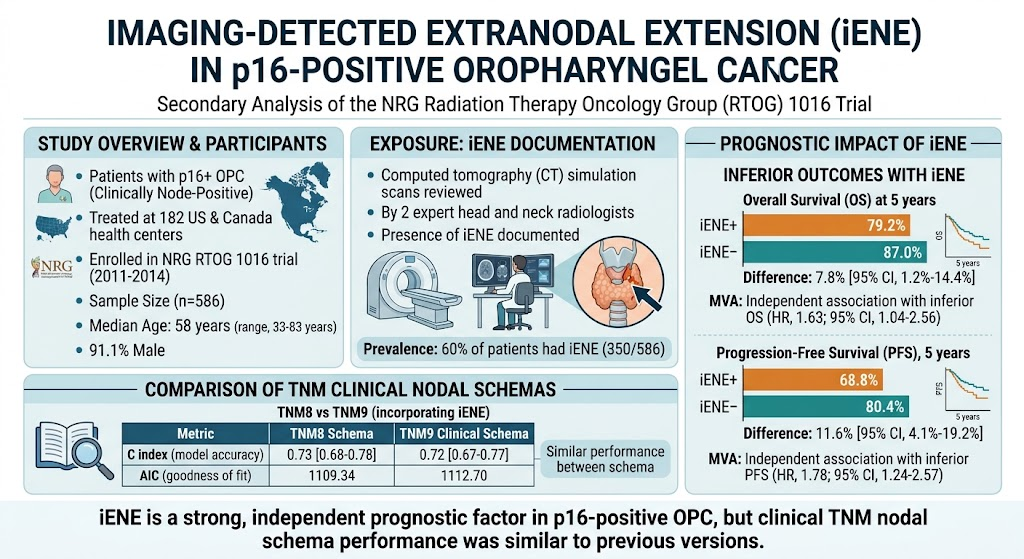
This secondary analysis utilized data from the Radiation Therapy Oncology Group (RTOG) 1016 trial—a large, prospective, randomized clinical trial conducted from 2011 to 2014 across 182 centers in the United States and Canada, enrolling patients with clinically node-positive, p16-positive oropharyngeal cancer. From 987 enrolled patients, 586 met inclusion criteria for this analysis. Expert head and neck radiologists retrospectively reviewed deidentified CT simulation scans to assess iENE presence. Patients were categorized based on iENE status and followed for outcomes.
The primary endpoints were overall survival (OS) and progression-free survival (PFS). Secondary endpoints included locoregional failure (LRF) and distant metastasis incidence. Statistical analyses encompassed Kaplan-Meier survival estimation, cumulative incidence functions for failure events, and Cox proportional hazards models for univariate and multivariate analyses controlling for known prognostic covariates. TNM9 staging that incorporates iENE was compared with the prior TNM8 clinical nodal staging schema by evaluating model fit via Akaike information criterion (AIC) and discrimination by Harrell’s C-index.
Key Findings
Among the 586 analyzed patients (median age 58 years, 91.1% male), 350 (60%) demonstrated imaging-detected extranodal extension. Median follow-up was 4.2 years. The 5-year OS was significantly lower for patients with iENE than those without (79.2% vs 87.0%; absolute difference 7.8%, 95% CI 1.2%-14.4%). Similarly, 5-year PFS was reduced in the iENE group (68.8% vs 80.4%; difference 11.6%, 95% CI 4.1%-19.2%). Multivariate analysis adjusting for other clinical prognostic factors showed iENE independently predicted worse OS (hazard ratio [HR] 1.63; 95% CI 1.04-2.56) and PFS (HR 1.78; 95% CI 1.24-2.57).
When comparing staging schemas, TNM9 and TNM8 nodal classifications demonstrated similar predictive ability for survival outcomes. The C-indices were 0.72 (TNM9) versus 0.73 (TNM8), and AIC values were 1112.70 (TNM9) versus 1109.34 (TNM8), indicating comparable model performance.
Clinical Interpretation
The data confirm that iENE confers a worse prognosis in p16-positive oropharyngeal cancer patients and substantiate its inclusion as an upstaging factor in TNM9 clinical nodal classification. However, the marginal difference in overall model discrimination metrics suggests that while iENE adds valuable risk information, it does not drastically alter the overall staging system’s predictive accuracy compared to TNM8. This nuance is critical for clinicians to understand when applying staging for prognosis and treatment planning.
Expert Commentary
These findings address a notable knowledge gap by validating iENE as a clinically relevant imaging biomarker in a prospective, multi-institutional cohort. While traditional histopathologic ENE remains the gold standard, the noninvasive detection of ENE by imaging enables risk stratification without requiring surgery, reflecting real-world clinical pathways more closely as organ-preserving therapy is increasingly favored.
Limitations include the retrospective imaging review and exclusion of patients with incomplete imaging data, which may introduce selection bias. Additionally, the study did not evaluate the impact of iENE on treatment response or toxicity, which warrants further research. Future studies should seek to standardize iENE imaging criteria and incorporate advanced imaging modalities such as PET/CT or MRI to improve detection accuracy.
Conclusion
This secondary analysis of RTOG 1016 supports the integration of imaging-detected extranodal extension into the staging framework for HPV-positive oropharyngeal cancer, reflecting its independent prognostic significance. Clinicians should consider iENE status when assessing patient risk and tailoring management strategies, including the potential need for treatment intensification. Nonetheless, given the comparable predictive performance of TNM9 and TNM8 clinical nodal systems, further refinement and validation of staging algorithms incorporating imaging biomarkers remain necessary for optimal personalization of care.
Funding and Trial Registration
Funding sources for the original RTOG 1016 trial were not detailed in this secondary analysis report. The clinical trial was registered under ClinicalTrials.gov Identifier: NCT01302834.
References
- Fleming CW, Reddy CA, Stock S, et al. Imaging-Detected Extranodal Extension in p16-Positive Oropharyngeal Cancer: Secondary Analysis of RTOG 1016. JAMA Otolaryngol Head Neck Surg. 2026 Aug 27. PMID: 42658511.
- National Comprehensive Cancer Network (NCCN) Guidelines for Head and Neck Cancers. Version x.x. [Accessed 2024].
- American Joint Committee on Cancer. AJCC Cancer Staging Manual, 9th Edition, 2017.
- Ang KK, Harris J, Wheeler R, et al. Human papillomavirus and survival of patients with oropharyngeal cancer. N Engl J Med. 2010;363(1):24-35.
- Patel SH, Barker JL Jr, Garden AS, et al. The prognostic implications of radiographic extranodal extension in human papillomavirus-associated oropharyngeal cancer. Cancer. 2019 Mar 1;125(5):630-638.