Highlights
- Randomized clinical trials (RCTs) demonstrate that virtual reality (VR)-based digital defocus vision training (DDVT) modestly reduces axial elongation and spherical equivalent progression in myopic children.
- VR technologies integrating defocus stimuli may improve accommodative function and choroidal thickness dynamics, which are implicated in myopia control mechanisms.
- The non-invasive, home-based nature of VR-DDVT improves user compliance and safety, though longer-term clinical significance of myopia control remains to be established.
- Adjunctive use of DDVT with single-vision spectacles (SVS) may provide a promising complementary strategy to existing myopia management approaches.
Background
Myopia is a growing global public health concern, disproportionately affecting children and adolescents, especially in East Asia, where prevalence rates exceed 80% in some populations. Progressive axial elongation underpinning myopia development is a major risk factor for vision-threatening complications, including retinal detachment, myopic maculopathy, glaucoma, and cataracts. Emerging evidence suggests that optical interventions leveraging peripheral defocus and accommodative stimuli can retard myopic progression. Digital defocus vision training (DDVT) delivered through virtual reality (VR) platforms represents a novel, home-friendly approach for myopia control, potentially manipulating visual signals to induce beneficial retinal defocus and strengthen accommodative responses. Yet, robust randomized evidence quantifying efficacy and safety remains limited.
Key Content
Chronological and Clinical Trial Evidence on VR-Based Myopia Control
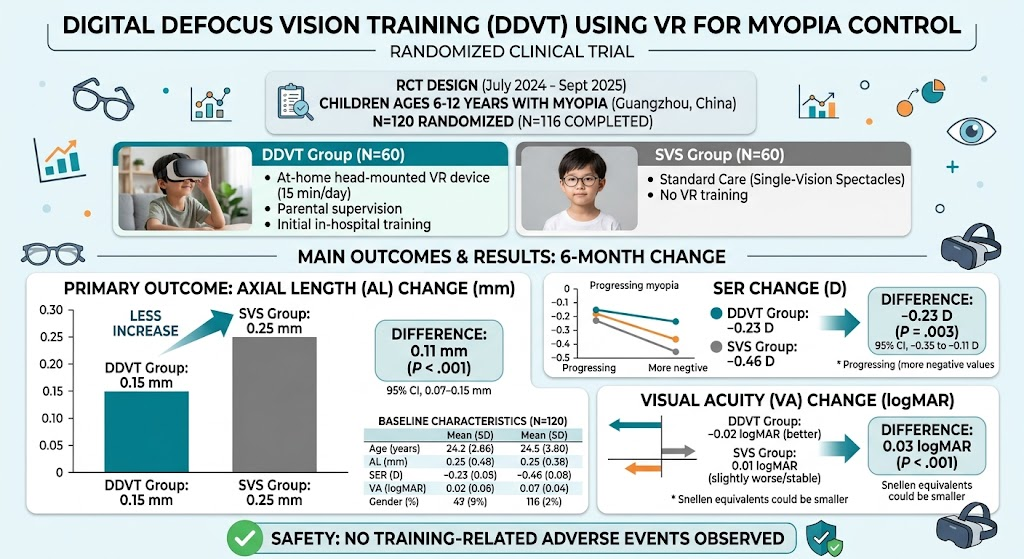
- Zhong et al., 2026 (JAMA Ophthalmology): This randomized clinical trial (NCT07042022) investigated VR-based DDVT combined with single-vision spectacles (SVS) versus SVS alone in 120 myopic children aged 6 to 12 years over 6 months. The DDVT group performed 15-minute daily training at home using a head-mounted VR device simulating defocus stimuli. Results showed a statistically significant but modest reduction in axial elongation (0.15 mm vs. 0.25 mm; mean difference 0.11 mm, P<.001) and spherical equivalent refractive (SER) progression (-0.23 D vs. -0.46 D, P =.003). Visual acuity improved slightly in the DDVT group without adverse events, underscoring safety and feasibility. However, the clinical relevance of these short-term effects requires longer follow-up.
- Wang et al., 2024 (BMC Ophthalmology): In a randomized controlled trial of 65 low-myopic children aged 8 to 13 years, VR visual training (VRVT) administered 20 minutes daily under supervision showed a smaller axial length increase at 3 months compared with controls using only SVS (0.063 mm vs. 0.129 mm; P = 0.037). Additionally, macular choroidal thickness (mCT) increased significantly in the VRVT group, suggesting beneficial retinal structural changes. Although the sample size and follow-up duration were more limited, these results align with those of Zhong et al. and highlight early anatomical correlates.
- Tan et al., 2025 (Photodiagnosis and Photodynamic Therapy): A small sample study evaluated the immediate effects of augmented reality (AR) visual training on choroidal thickness and accommodative facility in 20 children. A single AR training session decreased choroidal thickness transiently while significantly improving accommodative facility (P = 0.004), which is biologically plausible as accommodative function may influence myopia progression. This supports mechanistic rationale for VR/DDVT interventions stimulating accommodative responses to induce myopic defocus and retinal signaling imbalance that may slow axial elongation.
Mechanistic Insights and Translational Implications
Digital defocus training platforms leverage the principle that imposing peripheral myopic defocus or stimulating accommodation may counteraxially regulate axial elongation through retinal and choroidal signaling pathways. VR devices can simulate complex defocus patterns in a controlled, repeatable manner while engaging children in interactive home-based programs, potentially improving compliance versus clinic-based interventions.
Evidence indicates that accommodative function enhancement and choroidal thickness modulation may mediate the effects of DDVT/VRVT on slowing myopic progression. Short-term physiological changes in these ocular parameters after training suggest a potent digital therapeutics avenue, warranting integration with optical correction strategies.
Safety and User Acceptability
Across studies, including Zhong et al. and Wang et al., VR-based defocus training showed excellent safety profiles with no serious adverse events. Mild VR-induced vertigo occurred infrequently (6.7% in Wang et al.), affirming tolerability. Home-based use under parental supervision is advantageous for adherence and scalability in pediatric populations.
Comparison with Other Myopia Control Modalities
While orthokeratology, atropine eye drops, and multifocal lenses remain mainstays of myopia control, digital defocus training adds a non-pharmacological, non-invasive adjunct or alternative. Its modest effect sizes in axial length reduction are comparable to low-dose atropine in short-term studies but need validation for sustained efficacy. Combining VR-DDVT with traditional optical corrections (e.g., SVS) suggests a synergistic potential requiring exploration in larger, longer trials.
Expert Commentary
The emerging evidence on VR-DDVT represents an exciting frontier in pediatric myopia control integrating technological innovation with visual physiology. Zhong et al.’s randomized trial confirms early efficacy signals, demonstrating a modest but statistically significant slowing of axial elongation and SER progression compared with SVS alone. The key strengths include rigorous randomization, high retention, objective outcomes (axial length measurement), and safety monitoring.
However, the clinical importance of the reported mean 0.11 mm axial length reduction over 6 months needs contextualization against established myopia control thresholds. Longitudinal data extending to 1 year or beyond are essential to validate durability and influence on vision-threatening complications.
Mechanistically, short-term improvements in accommodative facility and choroidal thickness observed post-training support biological plausibility for VR-DDVT’s efficacy. Notably, underlying retinal and scleral remodeling pathways remain areas for translational research.
Current guidelines for myopia management prioritize evidence-based interventions like low-dose atropine and optical strategies. VR-DDVT could complement these, especially where pharmacologic or contact lens options are less feasible or accepted.
Several challenges remain, including standardization of training protocols (duration, intensity, defocus parameters), user adherence in varied real-world settings, and evaluation across different myopic severities and ethnicities. Additionally, integrating VR-DDVT within broader pediatric eye care workflows and assessing cost-effectiveness are critical.
Conclusion
Digital defocus vision training using virtual reality platforms constitutes a promising novel approach for myopia control in children. Randomized clinical trials have provided preliminary evidence of modest slowing in axial elongation and refractive progression over 3 to 6 months, with good safety and user acceptance. Mechanistic studies corroborate effects on accommodative function and choroidal morphology, underpinning the therapeutic rationale.
These findings encourage further large-scale, long-term studies to establish clinical efficacy benchmarks, optimal training regimens, and integration strategies with established myopia control methods. Given the rising global myopia burden, VR-based DDVT could represent an important addition to multidisciplinary, patient-centered pediatric eye care.
References
- Zhong J, Liu Y, Peng T, Ma J, Huang Z, Yang X, Li SM, Yuan J. Digital Defocus Vision Training Using Virtual Reality for Myopia Control: A Randomized Clinical Trial. JAMA Ophthalmol. 2026 Aug 27. PMID: 42658516. https://pubmed.ncbi.nlm.nih.gov/42658516/
- Wang L, Xu K, Wang Y, et al. Effect of virtual reality-based visual training for myopia control in children: a randomized controlled trial. BMC Ophthalmol. 2024 Sep 16;24(1):358. PMID: 39278928. https://pubmed.ncbi.nlm.nih.gov/39278928/
- Tan J, Li W, Chen S, et al. Immediate impact of augmented reality visual training on choroidal thickness and accommodative function: A small sample study. Photodiagnosis Photodyn Ther. 2025 Oct;55:104756. PMID: 40782879. https://pubmed.ncbi.nlm.nih.gov/40782879/