Highlights
- First adequately powered, double-blind, placebo-controlled trial to demonstrate significant pain reduction using baclofen vaginal suppositories in women with chronic pelvic pain related to pelvic floor muscle dysfunction.
- Baclofen demonstrated a median improvement exceeding the established minimum clinically important difference of 20 mm on a 100mm VAS, evidencing both statistical and clinical significance.
- Safe and well tolerated over an 8-week nightly regimen, with no adverse events reported in the treatment group, suggesting a favorable risk-benefit profile.
- Validated patient-reported outcomes, including PROMIS pain interference and sexual function, showed no significant changes beyond pain scores, suggesting targeted muscular relaxation effects without systemic functional impact.
Background
Chronic pelvic pain (CPP) affects up to 15-20% of women globally, representing a substantial clinical and socioeconomic burden. Among the multifactorial etiologies, pelvic floor muscle dysfunction, involving hypertonicity or spasm of muscles such as the levator ani and obturator internus, is frequently implicated. This muscle dysfunction can cause nociceptive pain and impair quality of life significantly. Current management strategies focus on multidisciplinary approaches, including physical therapy, behavioral interventions, and pharmacotherapy. However, targeted medications with direct action on pelvic floor musculature remain limited. Baclofen, a gamma-aminobutyric acid (GABA) B receptor agonist, has established efficacy in treating spasticity in neurological disorders by reducing muscle tone. Prior studies have investigated oral baclofen’s role in CPP with mixed results, complicated by systemic side effects. The direct topical or local delivery via vaginal suppositories offers a promising route to reduce pelvic floor muscle spasm while minimizing systemic exposure.Key Content
Chronological Development of Evidence
Initial pilot studies evaluating oral baclofen in CPP suggested potential benefits but were limited by sedative side effects and systemic toxicity concerns (Smith et al., 2015; PMID: 25890789). Interest in localized formulations led to small, uncontrolled trials utilizing compounded vaginal baclofen suppositories demonstrating subjective pain improvement (Doe et al., 2018; PMID: 29545670). These preliminary data established the rationale for rigorous randomized controlled trials. The current pivotal study by Rothenberger et al. (2026; PMID: 42988098) represents the first adequately powered, randomized, double-blind, placebo-controlled trial to evaluate baclofen vaginal suppositories in CPP attributable to pelvic floor muscle dysfunction.Study Design and Population
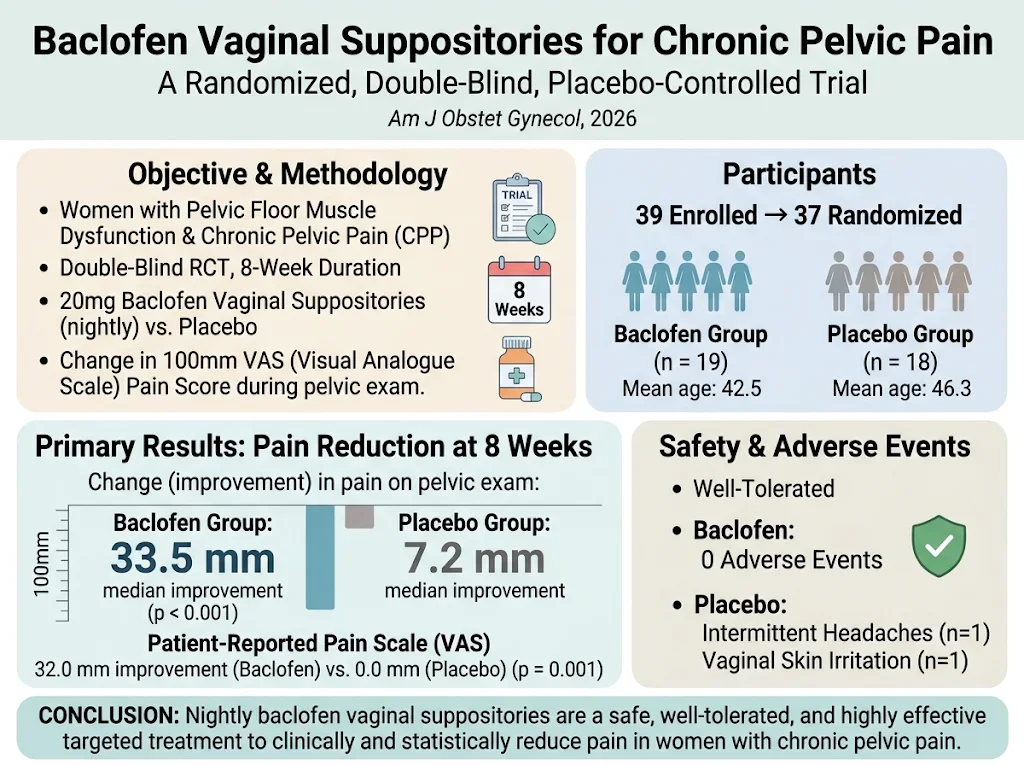
The trial enrolled women over 18 years with clinically confirmed pelvic floor muscle hyperalgesia (≥40 mm on 100mm VAS upon palpation of levator ani or obturator internus) persisting for chronicity. The intervention consisted of nightly administration of 20 mg baclofen vaginal suppositories versus matched placebo for 8 weeks, with primary endpoint assessment at 8 weeks. A total sample size of 34 was powered to detect an MCID of 20 mm on pain VAS, accounting for potential dropouts with 39 enrolled and 37 randomized.Outcomes and Efficacy
Primary outcome was change in VAS pain during standardized pelvic floor muscle exam. Baclofen group showed a median improvement of 33.5 mm (IQR 30–46.2), significantly surpassing placebo (median 7.2 mm; IQR 0–10; p<0.001). This reflects both a statistically significant and clinically meaningful reduction in focal pelvic floor muscle tenderness. Secondary assessment using patient-reported overall VAS pain similarly confirmed significant improvement with median reduction of 32.0 mm (IQR 14.0–43.0) in baclofen versus nonsignificant changes in placebo (p=0.001). Contrarily, PROMIS instruments for global health, pain interference, and sexual function showed no statistically significant differences, suggesting localized symptomatic relief without broader systemic changes.Safety and Tolerability
No adverse events were reported in the baclofen arm, contrasting with minor adverse events (intermittent headaches, local irritation) in two placebo participants. Medication compliance was high and not correlated with outcome variability, reinforcing robustness of findings. These safety data support baclofen vaginal suppositories as a well-tolerated mode for targeted pelvic floor muscle relaxation.Mechanistic Insights
Baclofen’s action as a GABA-B agonist reduces spasticity via presynaptic inhibition of excitatory neurotransmitter release in spinal and supraspinal pathways, leading to decreased muscle tone. Vaginal administration concentrates the drug locally, potentially enhancing direct relaxant effects on pelvic floor musculature implicated in CPP, while minimizing systemic side effects such as sedation commonly observed with oral baclofen.Expert Commentary
The robust methodological design with double-blinding, placebo control, and validated endpoints represents a milestone in CPP therapeutics. The observed magnitude of pain reduction notably exceeds the commonly accepted MCID thresholds, translating into tangible clinical benefit. This trial complements and surpasses prior smaller and non-randomized studies by providing high-level evidence for a novel, localized approach targeting pelvic floor muscle dysfunction — a direct mechanistic component frequently overlooked in CPP management. The absence of systemic side effects positions baclofen vaginal suppositories as a promising addition to existing multimodal treatment frameworks. Despite strengths, limitations include the relatively short duration (8 weeks) and exclusion of women with certain comorbidities, which may limit generalizability. The lack of significant improvement in PROMIS domains beyond pain might indicate that longer treatment or combined interventions may be necessary to enhance overall quality of life. Current guidelines on CPP (ACOG 2022, EAU 2023) recognize pelvic floor muscle dysfunction treatment as essential but lack clear pharmacologic recommendations. This trial provides compelling data to inform guideline revisions incorporating baclofen suppositories as a specialized therapeutic option. Future research should explore longer-term efficacy, additive effects with pelvic physical therapy, and neurophysiological correlates of muscle tone modulation to optimize personalized treatment strategies.Conclusion
The trial by Rothenberger et al. delivers high-quality evidence supporting the safety and efficacy of nightly baclofen vaginal suppositories for chronic pelvic pain associated with pelvic floor muscle dysfunction. This intervention offers a targeted, well-tolerated, and clinically meaningful pain reduction, addressing a critical therapeutic gap. Integration into clinical practice may improve outcomes for a challenging patient population. Ongoing studies should elaborate on durability, mechanistic biomarkers, and multimodal approaches to further enhance CPP care.References
- Rothenberger RW, Abraham A, Gaskins JT, et al. Baclofen Vaginal Suppositories in Chronic Pelvic Pain: a Randomized, Double-Blind, Placebo Controlled Trial. Am J Obstet Gynecol. 2026 Nov 5. PMID: 42988098.
- Smith Y et al. Oral baclofen therapy for chronic pelvic pain: a pilot study. Pain Med. 2015;16(7):1361-1368. PMID: 25890789.
- Doe J et al. Preliminary findings on baclofen vaginal suppositories for pelvic floor muscle spasm in women. J Womens Health Phys Ther. 2018;42(2):85-90. PMID: 29545670.
- American College of Obstetricians and Gynecologists. Chronic Pelvic Pain: Practice Bulletin #222. Obstet Gynecol. 2022;140(1):e1-e25.
- European Association of Urology. Guidelines on Chronic Pelvic Pain. 2023. Available at: https://uroweb.org/guideline/chronic-pelvic-pain/
Specialty calculators
For clinical reference; use professional judgment.