Highlights
- Long-term tyrosine kinase inhibitor (TKI) therapy in chronic myeloid leukemia (CML) patients is associated with higher rates of poor general health, functional impairment, activity limitation, and frailty compared to non-cancer controls.
- TKI-treated CML patients and blood or marrow transplantation (BMT) survivors exhibit comparable degrees of impaired health domains, though TKIs may lead to greater activity limitations.
- Emerging evidence supports the safety and benefit of patient-guided TKI dose reductions and intermittent dosing schedules to mitigate adverse health effects without compromising molecular response.
- Financial toxicity and endocrine dysfunction represent additional key dimensions affecting health-related quality of life (HRQoL) in long-term TKI-treated CML survivors.
Background
Chronic myeloid leukemia (CML) transformed from a fatal disease to a chronic condition following the introduction of tyrosine kinase inhibitors (TKIs). TKIs such as imatinib have significantly decreased CML-related mortality, enabling many patients to achieve near-normal life expectancy. However, as CML patients transition to long-term survivors, the long-term impact of TKI therapy on health status, functional capacity, and quality of life (QoL) is an evolving concern. Blood or marrow transplantation (BMT), once a mainstay therapy, is associated with known late effects including frailty and functional impairments. The seminal study by Bhatia et al. (2026) compared health impairments in TKI-treated patients who never underwent BMT, BMT survivors without TKI exposure, and non-cancer controls to delineate the comparative burden and guide risk mitigation strategies. This review synthesizes these findings and integrates corroborating literature on TKI dose optimization, treatment-free remission, and QoL outcomes.
Key Content
Comparative Health Status Impairments: TKI-Treated Patients Versus BMT Survivors and Non-Cancer Controls
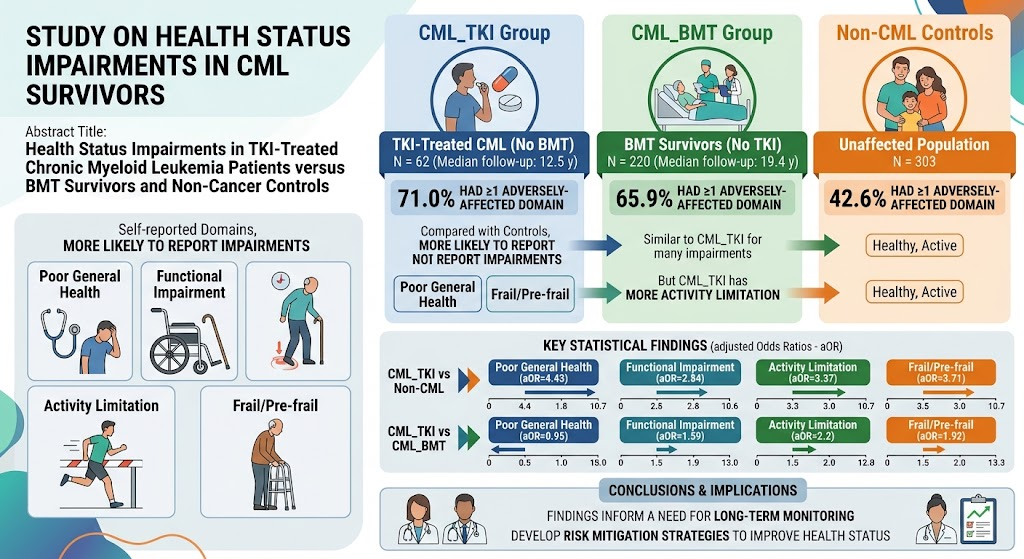
The prospective cohort examined by Bhatia et al. included 62 CML patients treated solely with TKIs (median follow-up 12.5 years), 220 CML patients treated with BMT but no TKI exposure (median follow-up 19.4 years), and 303 age-matched non-CML controls. Self-reported domains included general health, functional status, activity limitations, and pre-frailty/frailty.
Results revealed that 71.0% of the CML_TKI group reported at least one impaired domain—significantly greater than 42.6% in non-CML controls and marginally more than the 65.9% in CML_BMT survivors. Adjusted odds ratios (aOR) showed that compared with controls, the CML_TKI group had markedly increased odds for poor general health (aOR 4.43), functional impairment (aOR 2.84), activity limitation (aOR 3.37), and frailty/pre-frailty (aOR 3.71). When compared with the CML_BMT cohort, the CML_TKI group exhibited equivalent poor general health and functional impairment prevalence, but higher activity limitations (aOR 2.2).
These findings highlight that while TKIs circumvent transplantation-related morbidity, they are not devoid of chronic health status consequences. The persistence of frailty and functional impairment underscores the complexity of survivorship care in the TKI era.
Long-Term Quality of Life and Functional Outcomes in TKI Therapy
Numerous studies have evaluated HRQoL and functional outcomes in patients receiving long-term TKI therapy. A cross-sectional study from the Kurdistan region (2024) involving 161 adult CML patients showed that despite generally preserved QoL, impairments exist in emotional functioning and symptom burden. Female sex, older age, and comorbidities were associated with worse functional scores and increased symptomatology.
Similarly, pediatric and young adult CML patients on prolonged TKI therapy demonstrated endocrine dysfunctions such as short stature, vitamin D deficiency, and subclinical hypothyroidism (Front Oncol, 2025), which could indirectly compromise physical well-being and activity.
Strategies to Optimize TKI Therapy and Minimize Toxicity
Recent prospective trials have explored dose de-escalation and intermittent TKI regimens aiming to reduce cumulative toxicity while maintaining molecular control. The OPTkIMA trial (Clin Lymphoma Myeloma Leuk, 2024) in elderly patients demonstrated that progressive TKI de-escalation maintains major molecular response (MR3.0) and improves HRQoL metrics.
The RODEO study (Haematologica, 2026) employed patient-guided dose reduction with shared decision-making and observed low intervention failure rates at 6 months, alongside improvements in symptom burden and HRQoL.
Additionally, the Chinese multicenter trial (EJHaem, 2022) showed that TKI dose de-escalation yields high 12-month molecular recurrence-free survival (88.3%), with better emotional functioning and reduced fatigue and pain compared to treatment discontinuation.
The cumulative evidence supports individualized TKI dosing strategies to balance efficacy and long-term health impacts, potentially mitigating the elevated functional impairments reported.
Financial Toxicity and Psychosocial Considerations
Financial toxicity (FT), driven by prolonged TKI costs, importantly modulates health outcomes in CML survivors. A structural equation model study (Support Care Cancer, 2025) linked FT with worse psychoneurological symptoms, decreased HRQoL, and increased distress. Risk factors included racial minority status, low income, and non-private insurance.
These findings indicate that psychosocial dimensions and financial burden should be integrated into survivorship care plans.
Adherence and Symptom Monitoring for Improved Outcomes
Medication adherence underpins sustained molecular response and improved QoL. A randomized controlled trial in Malaysia (Support Care Cancer, 2020) implementing medication management services showed superior adherence and clinical outcomes at 6 months. Patient-reported symptom monitoring via digital platforms (Cancer, 2024) also enhanced early molecular response.
Expert Commentary
The study by Bhatia et al. breaks ground by directly comparing health impairments in TKI-treated CML survivors with BMT survivors and non-cancer controls, revealing substantive health and functional decrements even with non-transplant approaches. The comparable burden of frailty and impairment observed suggests that TKI toxicity profiles warrant equivalent clinical vigilance as BMT late effects.
Mechanistically, prolonged TKI exposure may contribute to mitochondrial dysfunction, vascular alterations, and endocrine sequelae, leading to activity limitation and frailty. The heterogeneity among TKI agents and patient factors further complicate the risk-benefit assessment.
The emergence of patient-guided de-escalation and intermittent dosing regimens offers promising avenues to mitigate adverse health outcomes while preserving disease control. However, these strategies require robust molecular monitoring and shared decision-making.
Financial toxicity remains an underappreciated adverse effect impacting patient-reported outcomes and adherence, mandating systemic interventions including insurance support and targeted education.
Guidelines increasingly advocate for holistic survivorship care integrating physical rehabilitation, endocrinology evaluation, psychosocial support, and financial counseling for long-term TKI-treated patients.
Conclusion
Tyrosine kinase inhibitor therapy has revolutionized the prognosis of chronic phase CML, yet long-term survivors on TKIs endure significant impairments in health status, functional ability, and frailty comparable to BMT survivors. These findings emphasize the critical need for multidisciplinary survivorship monitoring and tailored risk mitigation interventions aiming to optimize quality of life and functional independence.
Emerging evidence supports dose reduction and intermittent dosing as feasible, safe approaches to reduce toxicity burden without compromising molecular remission.
Future research should focus on longitudinal evaluation of health outcomes, elucidation of underlying biological mechanisms of TKI-related impairments, and development of comprehensive survivorship models that integrate medical, psychosocial, and financial dimensions.
References
- Bhatia S, Meng Q, Hageman L, et al. Health status impairments in tyrosine kinase inhibitor-treated chronic myeloid leukemia patients versus blood or marrow transplant survivors and non-cancer controls. Leukemia. 2026 Aug 21. PMID: 42629391.
- Meng Q, Bhatia S, et al. Interim analysis of a multicenter study on patient-guided dose reduction of tyrosine kinase inhibitors in chronic myeloid leukemia: the RODEO study. Haematologica. 2026 Mar;111(3):918-926. PMID: 41035410.
- OPTkIMA Study Group. The Italian Multicentric Randomized OPTkIMA Trial on fixed vs progressive intermittent TKI therapy in elderly CML patients. Clin Lymphoma Myeloma Leuk. 2024 May;24(5):323-331. PMID: 38369436.
- Wang Q, et al. De-escalation or discontinuation of tyrosine kinase inhibitor in patients with chronic myeloid leukemia: A prospective trial in China. EJHaem. 2022 Sep;3(4):1220-1230. PMID: 36467815.
- Kumar V, et al. Long-term endocrine outcomes and quality of life in pediatric and young chronic myeloid leukemia patients on tyrosine kinase inhibitor therapy: a prospective study from India. Front Oncol. 2025 Jul 8;15:1598104. PMID: 40697385.
- Chung S, et al. Risk factors, behaviors, and adverse health outcomes of financial toxicity in adult chronic myeloid leukemia survivors. Support Care Cancer. 2025 Jun;33(7):542. PMID: 40471334.
- Kong W, et al. Health-related quality of life in chronic myeloid leukemia patients receiving long-term therapy with different tyrosine kinase inhibitors in Kurdistan region. Georgian Med News. 2024 Sep;(354):173-180. PMID: 39580847.
- Tan SH, et al. Efficacy of a medication management service in improving adherence to tyrosine kinase inhibitors and clinical outcomes in chronic myeloid leukemia: a randomized controlled trial. Support Care Cancer. 2020 Jul;28(7):3237-3247. PMID: 31734798.
- Kokra D, et al. Molecular response and quality of life in chronic myeloid leukemia patients treated with bosutinib or imatinib: the BFORE trial. Ann Hematol. 2020 Jun;99(6):1241-1249. PMID: 32307568.
- Yermakova A, et al. Withdrawal syndrome after tyrosine kinase inhibitor discontinuation in CML: RU-SKI study. Clin Lymphoma Myeloma Leuk. 2020 May;20(5):267-271. PMID: 32146103.