Highlight
1. Urinary volatile organic compounds (VOCs) represent novel metabolic biomarkers that can non-invasively differentiate acute tubular necrosis (ATN) from acute graft rejection following kidney transplantation.
2. Gas chromatography-mass spectrometry (GC-MS) analysis of urinary VOC profiles shows distinct patterns between ATN and acute rejection with high statistical significance.
3. Specific VOCs are significantly upregulated or downregulated in ATN versus acute rejection, underscoring metabolomic differences in these transplant-related pathologies.
4. This approach could reduce reliance on invasive transplant biopsies, improving diagnostic speed and patient management.
Study Background
Kidney transplantation remains the optimal therapeutic intervention for patients with end-stage renal disease, offering improved survival and quality of life. However, early post-transplant complications such as acute tubular necrosis (ATN) and acute graft rejection pose significant challenges, both of which can present with impaired graft function but require fundamentally different management strategies. ATN, commonly due to ischemia-reperfusion injury, typically follows a self-limited course with supportive care, whereas acute rejection necessitates prompt immunosuppressive treatment to preserve graft viability.
Currently, differentiation between ATN and acute rejection relies predominantly on histologic assessment via invasive transplant biopsy. Biopsies are resource-intensive, carry risk of bleeding and graft injury, and may be limited by sampling errors or interobserver variability. Hence, there is a critical unmet need for reliable, non-invasive biomarkers that can facilitate early and accurate diagnostic discrimination to guide clinical decision-making.
Volatile organic compounds are small gaseous metabolites produced through various cellular metabolic pathways and excreted in bodily fluids such as urine. Changes in tissue metabolism during pathologic processes, including ischemia and immune-mediated injury, alter VOC profiles. Metabolomic technologies such as gas chromatography-mass spectrometry (GC-MS) allow sensitive detection and characterization of VOCs, providing a promising platform for biomarker discovery in kidney transplant assessment.
Study Design
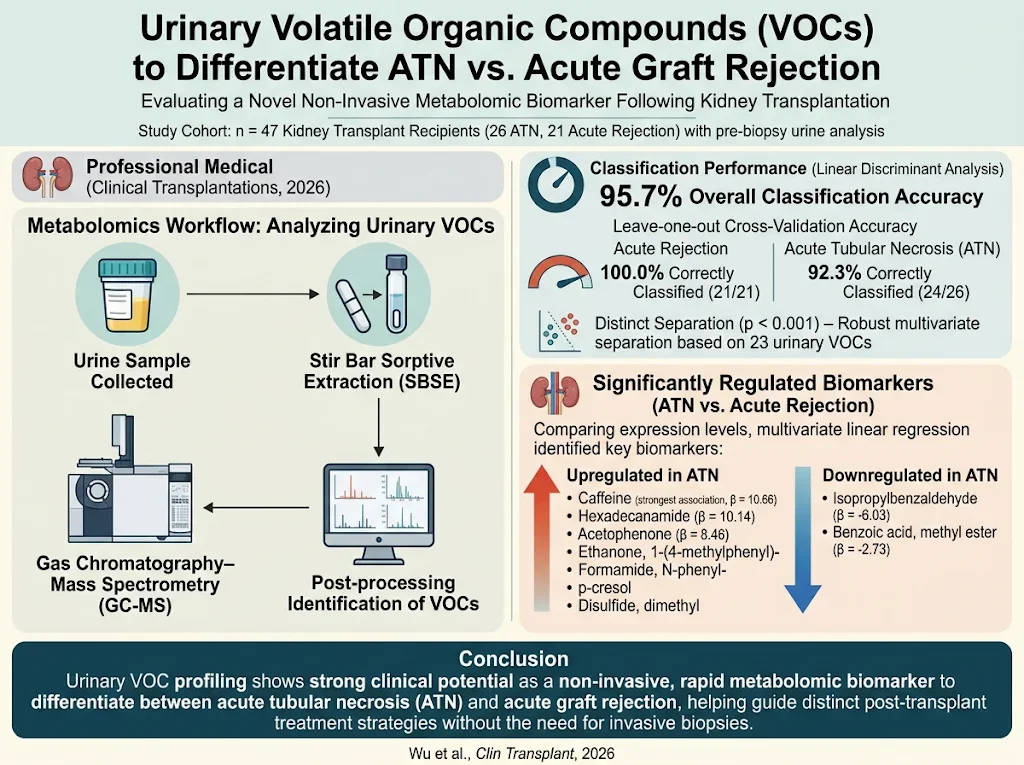
The investigative study enrolled 47 kidney transplant recipients aged between 18 and 75 years, all biopsy-proven cases diagnosed with either acute tubular necrosis or acute graft rejection. Urine samples were collected from patients prior to undergoing transplant biopsy to ensure unbiased assessment of metabolomic profiles.
The urine processing protocol involved centrifugation and collection of the supernatant, which was stored at -80°C until further analysis. Samples were thawed overnight at 4°C before being subjected to stir bar sorptive extraction (SBSE), a preconcentration technique optimizing VOC isolation from complex biological matrices.
Subsequently, samples underwent GC-MS analysis to separate VOCs based on volatility and polarity characteristics, with mass-to-charge ratios and fragmentation patterns enabling precise identification and quantification of individual compounds. Statistical analysis including linear discriminant analysis (LDA) and multivariate linear regression was applied to discern VOC pattern differences between ATN and acute rejection groups.
Key Findings
The study cohort included 26 patients with ATN and 21 with acute rejection. Distinct separation between groups based on urinary VOC profiles was demonstrated, with linear discriminant analysis achieving statistically significant discrimination (p < 0.001) using a panel of 23 VOCs.
Further multivariate regression identified 7 VOCs significantly upregulated in ATN patients compared with those undergoing acute rejection, while 2 VOCs were significantly downregulated in ATN relative to rejection (p < 0.001). These differential VOC expressions reflect underlying pathophysiological divergences between ischemic tubular injury and immune-mediated graft damage.
The identification of these relevant VOCs provides critical insights into altered metabolic pathways in each condition. For instance, VOC changes may reflect oxidative stress metabolites, lipid peroxidation products, or shifts in amino acid metabolism specific to either tubular necrosis or immunologic insult.
While individual VOCs were associated with each condition, the combined VOC signature enhanced diagnostic performance, supporting the concept of a composite metabolomic biomarker panel to aid clinical decision-making.
No adverse effects were associated with urine collection or analytical procedures, making this diagnostic approach inherently safe and feasible for routine longitudinal monitoring in transplant recipients.
Expert Commentary
This study represents a significant advance in transplant nephrology by integrating metabolomics into clinical diagnostics. Dr. Saad and colleagues provide compelling evidence that urinary VOC profiling can distinguish ATN from acute rejection non-invasively, a critical differentiation that currently relies on biopsy.
Although promising, these findings require validation in larger, multicenter cohorts to assess reproducibility, influence of confounders such as infection or concomitant medications, and performance in early versus late post-transplant periods. Furthermore, the logistical aspects of implementing GC-MS-based VOC profiling in routine clinical workflows, including turnaround time, cost, and technical expertise, merit consideration.
Biologically, the differential VOC profiles reflect distinct metabolic reprogramming during ischemic injury versus alloimmune activation, consistent with existing knowledge of transplant pathophysiology. The highlighted VOCs may serve as candidates for mechanistic studies and potential therapeutic targeting.
Limitations include relatively small sample size, lack of longitudinal data correlating VOC dynamics with clinical outcomes, and the influence of recipient comorbidities, which warrant further research.
Conclusion
The study by Wu et al. introduces urinary VOC profiling by GC-MS as a promising non-invasive metabolomic tool to differentiate acute tubular necrosis from acute graft rejection following kidney transplantation. This approach could transform transplant care by reducing reliance on invasive biopsies, facilitating early diagnosis, and guiding tailored therapeutic interventions.
Future research should focus on validating these biomarkers in diverse populations, integrating metabolomic data with other omics and clinical parameters, and developing rapid point-of-care assays to translate this novel diagnostic strategy into clinical practice. Ultimately, leveraging urinary VOCs holds potential to improve graft survival and patient outcomes through precision medicine in transplant nephrology.
Funding and Trial Registration
The original study was published in Clinical Transplantation (2026) and was conducted under institutional ethical approvals. Specific funding sources were not detailed in the abstract. No clinical trial registration number was provided.
References
Wu HHL, Possell M, Peng W, Parthiban NK, Pollock CA, Saad S. Evaluating Urinary Volatile Organic Compounds as a Novel Metabolomic Biomarker to Differentiate Between Acute Tubular Necrosis and Acute Graft Rejection Following Kidney Transplantation. Clin Transplant. 2026 Nov;40(11). PMID: 43043679.
Knoll GA. Kidney transplantation in 2021: recent advances and remaining challenges. Nat Rev Nephrol. 2022 Jan;18(1):1-2. doi:10.1038/s41581-021-00520-4.
Pavkovic M, et al. The role of metabolomics in kidney transplantation. Metabolites. 2021 Mar;11(3):177. doi:10.3390/metabo11030177.
Specialty calculators
For clinical reference; use professional judgment.