Highlight
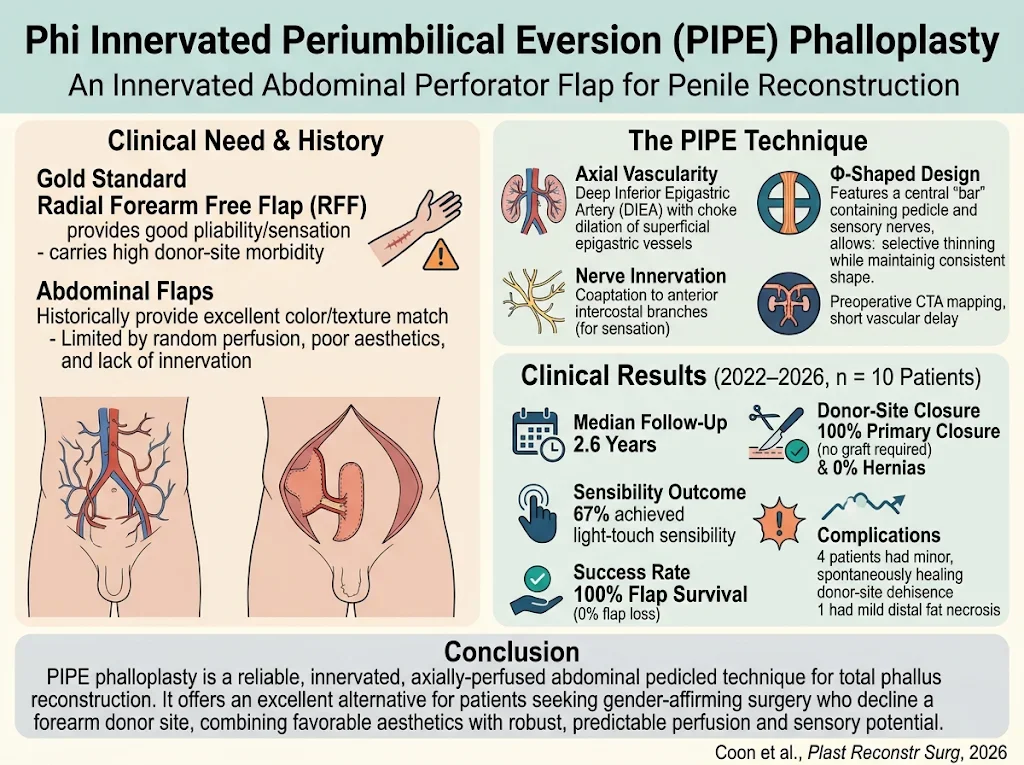
- The PIPE phalloplasty introduces a pedicled, innervated flap based on the deep inferior epigastric artery for penile reconstruction.
- It offers predictable perfusion, consistent shape, and favorable aesthetic outcomes with minimal donor-site morbidity.
- Two-thirds of patients achieved light-touch sensory recovery, highlighting effective nerve coaptation.
- PIPE phalloplasty represents a valuable alternative to the radial forearm free flap, especially for patients seeking to avoid forearm donor-site complications.
Study Background
Penile reconstruction remains a critical component of gender-affirming surgery and reconstruction following trauma or oncologic resection. The radial forearm free flap (RFF) has long been considered the gold standard for total phallic reconstruction, mainly due to its favorable characteristics including thin, pliable tissue suitable for tubularization and a robust potential for sensory innervation through microsurgical nerve coaptation. However, significant donor-site morbidity such as visible scarring and functional compromise limits patient acceptance. Historically, abdominal-based phalloplasty techniques, broadly falling under the Gillies-style flap category, exhibit advantages including improved tissue color, texture, and bulk. Despite these, their clinical uptake has been limited by non-axial, random-pattern perfusion which risks ischemia and distal necrosis; unsatisfactory dorsal scarring; and limited neural integration that impairs sensory restoration. Bridging this gap, the development of an abdominal-based pedicled flap with axial vascularity and sensory reinnervation potential holds promise to enhance clinical outcomes and patient satisfaction.Study Design
This novel method termed Phi Innervated Periumbilical Eversion (PIPE) Phalloplasty utilizes the deep inferior epigastric artery (DIEA) system for axial perfusion and anterior intercostal nerve branches for sensory innervation. The flap design is Φ-shaped, designed with a central bar containing the pedicle and sensory nerves to preserve blood supply during selective thinning and facilitate consistent cylindrical phallic morphology. Key components of the procedure include: – Preoperative computed tomography angiography (CTA) mapping to visualize vascular anatomy. – A short vascular delay period to promote choke vessel dilation, enhancing vascular inflow from superficial epigastric vessels to the flap tip. – Microsurgical nerve coaptation connecting sensory nerves from the flap to recipient sites aiming to restore sensibility. From 2022 to 2026, a consecutive series of 10 patients underwent PIPE phalloplasty with a median follow-up of 2.6 years to evaluate surgical outcomes, flap viability, sensory recovery, and donor-site complications.Key Findings
The PIPE phalloplasty demonstrated favorable outcomes in this cohort: – Flap Viability and Complications: There were no cases of total or partial flap loss, denoting reliable perfusion. Minor complications included donor-site dehiscence in four patients which resolved with conservative management and one instance of mild distal fat necrosis. Notably, no donor-site hernias occurred, and all donor regions were closed primarily. – Sensory Recovery: Sensory reinnervation was successful in 67% (6/9 evaluable patients) who developed light-touch sensation at a median follow-up of 2.6 years. This finding is consistent with effective nerve coaptation and suggests the preservation and regeneration of critical sensory pathways within the flap. – Aesthetic and Functional Outcomes: The axial vascular design enabled consistent cylindrical phallus shape and an advantageous abdominal skin color and texture match. The flap design circumvented the dorsal scar burden typically observed with other abdominal flaps, improving cosmesis. – Patient Selection: The technique offers a particularly valuable alternative for transmasculine patients or others seeking phallic reconstruction who decline RFF due to potential donor-site issues.Expert Commentary
The PIPE phalloplasty represents a significant technical advance by integrating axial vascularity and targeted nerve reinnervation within an abdominal donor site, a combination that has eluded traditional Gillies-style flaps. The preoperative CTA and vascular delay procedures are critical innovations enabling the establishment of an axial pedicle to the distal flap tip, which historically limited abdominal flap viability. Moreover, the selective thinning guided by the Φ-shaped design allows optimization of flap bulk while preserving perfusion and nerve integrity. Despite promising early outcomes, notable limitations remain. The sample size to date is modest, and longer-term functional data including tactile, erogenous sensation, and erectile prosthesis integration remain to be established. Furthermore, patients with higher BMI or prior abdominal surgeries might not be ideal candidates given vascular and tissue variability. Comparatively, while the RFF remains unmatched in sensory potential and thinner pliability, its donor-site morbidity often deters patients. The PIPE flap offers a compelling balance by utilizing more concealed donor sites with reduced morbidity. Further multi-center, prospective studies with standardized sensory and functional outcome measures will be critical to validate efficacy and safety broadly. Integration with prosthetic implantation approaches may further enhance patient satisfaction and quality of life.Conclusion
The Phi Innervated Periumbilical Eversion (PIPE) Phalloplasty is an innovative, axially perfused, innervated abdominal flap technique advancing the armamentarium for total phallus reconstruction. It addresses critical drawbacks of existing abdominal flaps by reliably preserving vascular and sensory nerves, enabling consistent cylindrical shape, and improved aesthetics. With low donor-site morbidity and promising sensory results, PIPE phalloplasty emerges as an attractive alternative particularly for those declining radial forearm donor sites. Ongoing research should focus on long-term sensory outcomes, functional results, and integration with penile prosthetics to fully establish its clinical role in gender-affirming and reconstructive urology.Specialty calculators
For clinical reference; use professional judgment.