Highlight
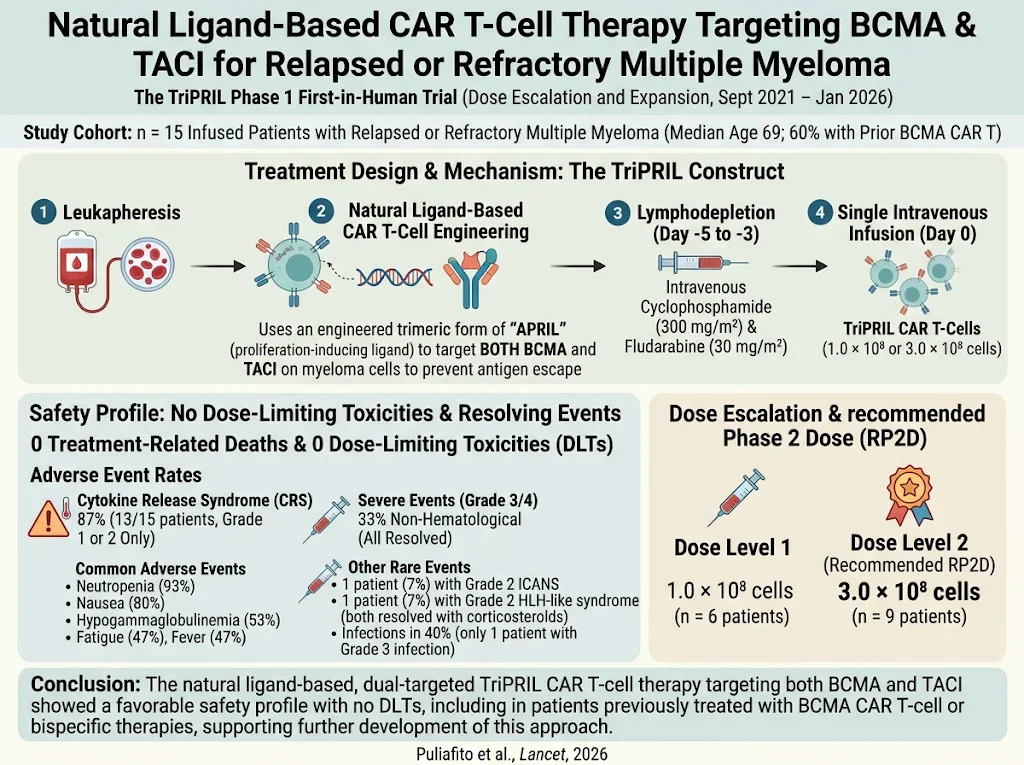
This phase 1 study introduces TriPRIL, a first-in-human CAR T-cell therapy designed to simultaneously target two myeloma antigens—BCMA and TACI—using a natural ligand-based approach via engineered APRIL trimer. The dual targeting strategy aims to curb antigen escape, a common resistance mechanism. TriPRIL displayed a favorable safety profile and evidence of efficacy in heavily pretreated relapsed or refractory multiple myeloma patients, including those with prior BCMA-directed therapies.
Study Background and Disease Burden
Multiple myeloma (MM) remains a largely incurable plasma cell malignancy characterized by clonal proliferation of abnormal plasma cells in the bone marrow. Despite advances in therapeutic options—including proteasome inhibitors, immunomodulatory drugs, monoclonal antibodies, and CAR T-cell therapies—patients frequently ultimately relapse and develop refractory disease, posing a significant unmet clinical need.
BCMA-targeted CAR T-cell therapies have revolutionized the treatment landscape for relapsed or refractory MM but are limited by the emergence of antigen loss or downregulation, leading to disease relapse. Transmembrane Activator and CAML Interactor (TACI) is another receptor expressed on MM cells that shares the natural ligand APRIL with BCMA. Combining these targets may mitigate resistance through antigen escape, potentially improving durability of responses.
Study Design
This was a first-in-human, open-label, phase 1 trial conducted at Massachusetts General Hospital, evaluating safety, tolerability, and preliminary efficacy of TriPRIL CAR T cells in patients with relapsed or refractory MM refractory to at least three prior lines of therapy or triple-class refractory. Patients with prior exposure to BCMA-targeted CAR T or bispecific T-cell engager therapies were eligible.
Following leukapheresis, patients underwent a lymphodepletion regimen with intravenous cyclophosphamide and fludarabine over three days. Subsequently, a single TriPRIL CAR T-cell infusion was administered at escalating doses: 1.0 × 10⁸ or 3.0 × 10⁸ CAR T cells. The primary endpoint assessed safety (adverse events and dose-limiting toxicities), with secondary endpoints including disease response and tolerability over a 24-month follow-up period.
Key Findings
Between September 2021 and January 2026, 16 patients underwent leukapheresis and 15 received TriPRIL infusion. The median age was 69 years, with a majority female population (67%). Notably, 60% had prior BCMA-directed CAR T-cell treatments, and 27% had previous bispecific T-cell engager therapy.
No dose-limiting toxicities were observed at either tested dose, and the recommended phase 2 dose was established at 3.0 × 10⁸ CAR T cells. Common adverse events included neutropenia (93%), nausea (80%), hypogammaglobulinaemia (53%), fatigue (47%), and fever (47%). Grade 3 or higher nonhematological toxicities occurred in 33% but all resolved. Cytokine release syndrome (CRS) was mostly mild (grade 1 or 2) and occurred in 87% of patients. One patient each experienced grade 2 neurotoxicity and immune effector cell-associated hemophagocytic lymphohistiocytosis-like syndrome; both resolved with corticosteroid treatment.
Infectious complications were observed in 40% of patients, including one grade 3 infection. There were no treatment-related deaths. Importantly, these safety findings were reported despite a heavily pretreated population, including prior advanced immunotherapies.
Although the focus of this phase 1 trial was safety, early signals of anti-myeloma activity were encouraging, particularly for patients whose disease had progressed after BCMA-targeted treatments. Detailed response data remains forthcoming as the study continues beyond initial analysis.
Expert Commentary
The TriPRIL trial represents a significant innovation in CAR T-cell therapy for multiple myeloma by employing a dual-target strategy through a natural ligand, APRIL, to simultaneously engage BCMA and TACI. This approach strategically addresses the challenge of antigen escape, a predominant relapse mechanism after single-target CAR T-cell therapy.
Dr. Michel Sadelain, a well-recognized authority in CAR T-cell therapeutics, noted that “Dual targeting via natural ligands could redefine durability and resistance management in MM CAR therapies.” Nonetheless, the relatively small sample size and the non-randomized design limit definitive efficacy conclusions.
Further studies should explore comparative efficacy, long-term durability, and expansion to less heavily treated patients. Mechanistically, the use of APRIL as a natural ligand might reduce off-tumor toxicity and enhance CAR T-cell functionality, but confirmation in larger cohorts remains essential.
Conclusion
TriPRIL exemplifies a promising dual-targeted, natural ligand-based CAR T-cell therapy that is safe and tolerable in a heavily pretreated relapsed or refractory multiple myeloma population, including patients with prior BCMA-directed treatments. Its favorable safety profile and potential to mitigate antigen escape set the stage for further phase 2 evaluation to establish clinical efficacy and impact on long-term disease control.
Funding and Clinical Trial Information
This research was funded by Mass General Brigham and the V Foundation. The trial is registered at ClinicalTrials.gov under identifier NCT05020444 and remains ongoing.
References
- Puliafito BR, et al. Natural ligand-based CAR T-cell therapy targeting BCMA and TACI for relapsed or refractory multiple myeloma (TriPRIL): a non-randomised, phase 1, first-in-human trial. Lancet. 2026 Nov 17; PMID: 43044617.
- Munshi NC, et al. Idecabtagene vicleucel in relapsed and refractory multiple myeloma. N Engl J Med. 2021;384(8):705-716.
- Raje N, et al. Anti-BCMA CAR T-cell therapy in relapsed or refractory multiple myeloma. N Engl J Med. 2019;380(18):1726-1737.
Specialty calculators
For clinical reference; use professional judgment.