Highlight
- The PATIO trial compared prediction-aided tapering versus conventional disease activity-guided dose optimisation (DGDO) in RA patients on biologics.
- Prediction-aided tapering did not reduce flare rates or biologic usage over 18 months compared to DGDO alone.
- Flare incidence, disease activity trajectories, patient-reported outcomes, and infection rates were similar between groups.
- Nonadherence to tapering advice was common, primarily continuing tapering despite recommendations to stop or escalate therapy.
Study Background
Rheumatoid arthritis (RA) is a chronic inflammatory autoimmune disease characterized by joint inflammation and progressive damage. Treatment with biological disease-modifying antirheumatic drugs (bDMARDs) has revolutionized RA management by achieving sustained low disease activity or remission in many patients. However, long-term use of biologics is associated with significant costs, potential side effects, and patient burden. Consequently, tapering biologic doses in patients with stable controlled disease is an important strategy to minimize exposure while maintaining disease control.
Currently, tapering decisions are guided primarily by clinical disease activity measures, leading to trial-and-error adjustments that can precipitate disease flares. Recently, prediction models estimating the individual risk of flare have been developed, aiming to personalize tapering decisions and minimize flare risk. Nonetheless, the clinical utility of integrating such prediction models into routine tapering protocols remains uncertain.
Study Design
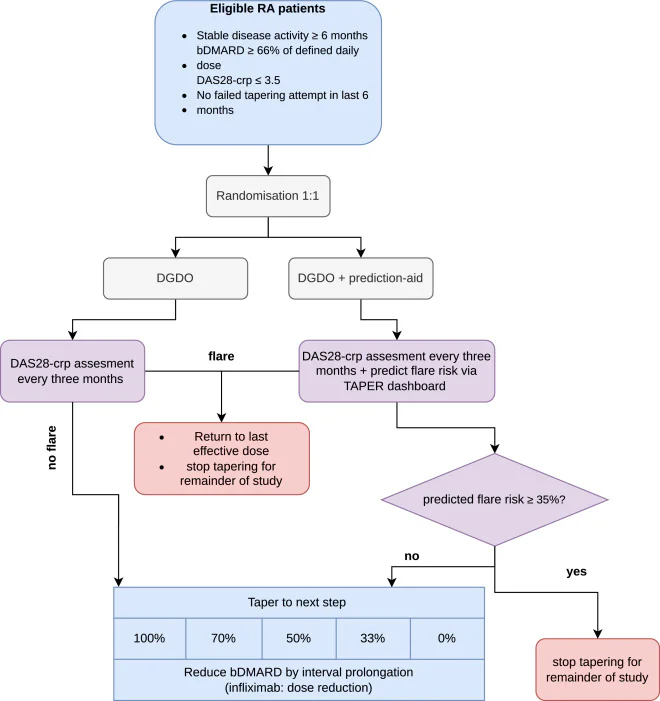
The Prediction-Aided Tapering in Rheumatoid Arthritis patients treated with biOlogicals (PATIO) trial was a pragmatic, multicenter, open-label, randomized controlled superiority trial conducted across multiple centers. The study enrolled 162 RA patients who were receiving stable bDMARD therapy and had sustained low disease activity, rendering them eligible for tapering. Participants were randomized in a 1:1 ratio to two groups:
- DGDO alone: Tapering guided solely by disease activity-based dose optimisation.
- Prediction-aided DGDO: Tapering combining DGDO with a previously validated dynamic prediction model that estimated flare risk every three months to support clinical decision-making.
Patients were followed for 18 months. The primary endpoint was the mean number of flares per patient during follow-up. Secondary endpoints included incidence of any flare, major flares lasting longer than 12 weeks, longitudinal DAS28-CRP scores, mean bDMARD dose fraction, infection rates, and patient-reported outcomes. Adherence to tapering recommendations was also assessed.
Key Findings
Of the 162 randomized patients (81 per group), the mean flare count per patient over 18 months was 1.00 (95% CI, 0.73–1.27) in the prediction-aided group versus 0.73 (95% CI, 0.51–0.95) in the DGDO-only group. The rate ratio was 1.32 (95% CI, 0.90–1.95), indicating no statistically significant reduction in flares with prediction-aided tapering. The proportion of patients experiencing any flare was higher in the prediction-aided group (57%) than in the DGDO group (44%). Similarly, major flares occurred in 22% versus 15% respectively.
Disease activity trajectories assessed by DAS28-CRP were comparable throughout follow-up between the two groups. The reduction in mean bDMARD dose fraction was similar, indicating that the prediction model did not enable greater dose reduction. Patient-reported outcomes, including measures of function and quality of life, did not differ significantly between strategies. Infection rates, an important safety measure in immunosuppressed patients, were also similar.
Interestingly, nonadherence to tapering advice was observed in 23% of visits. Of these deviations, 72% were instances where tapering continued against advice to stop or escalate medication, highlighting complexities in clinical decision-making and patient or physician preference influencing treatment adjustments.
Expert Commentary
The PATIO trial provides important clinical insights into the feasibility and effectiveness of integrating a dynamic flare risk prediction model into bDMARD tapering protocols. Despite the intuitive appeal of personalized risk prediction, the model used in this study did not improve clinical outcomes, flare rates, or biologic dose reduction compared to conventional DGDO strategies.
This lack of benefit may stem from several factors. First, the predictive accuracy of the model, although previously validated, may not have been sufficiently robust or discriminative in this pragmatic setting. Prediction models require rigorous external validation and refinement to ensure clinical reliability. Second, adherence challenges demonstrate that human factors and clinical judgment still play a major role in treatment decisions, potentially diluting the impact of decision-support tools.
Importantly, flare occurrence remains a complex and multifactorial phenomenon. Incorporating additional biomarkers, imaging, or genetic factors may enhance future model performance. Moreover, patient engagement and shared decision-making are critical in tapering and managing RA, emphasizing that prediction tools should augment, rather than replace, clinical expertise.
These findings align with current guideline recommendations that endorse highly individualized tapering approaches using clinical judgement, while recognizing the need for further research to optimize prediction models before widespread clinical adoption.
Conclusion
The PATIO randomized controlled trial demonstrated that prediction-aided tapering of biological DMARDs in RA patients with stable disease did not reduce flare frequency or medication use compared to conventional disease activity-guided dose optimization alone. These results underscore the necessity for sufficiently accurate and prospectively validated prediction models prior to implementation in clinical practice.
Moving forward, refinement of predictive algorithms with enhanced biomarkers and integration within patient-centered care frameworks is essential. Until then, tapering remains a carefully balanced clinical decision requiring vigilant monitoring.
Funding and Registration
The trial was supported by multiple academic and grant institutions, as detailed in the primary publication. The clinical trial registration information is available within the original Published report (PMID: 43045565).
References
- Fadaei S, den Broeder AA, Herman A, et al. Prediction-aided tapering in rheumatoid arthritis patients treated with biOlogicals (PATIO): a randomised controlled trial. Ann Rheum Dis. 2026; PMID: 43045565.
- Smolen JS, Landewé R, Bijlsma J, et al. EULAR recommendations for the management of rheumatoid arthritis with synthetic and biological disease-modifying antirheumatic drugs: 2019 update. Ann Rheum Dis. 2020;79(6):685-699.
- van der Maas A, Lie E, Christensen R, et al. Dose reduction and discontinuation of bDMARDs in RA after achieving remission or low disease activity: systematic review. Arthritis Care Res. 2017;69(12):1747-1756.
Specialty calculators
For clinical reference; use professional judgment.