Highlights
- Initiation of GLP-1 receptor agonists (GLP-1 RAs) is associated with significantly lower all-cause mortality and major adverse cardiovascular events (MACEs) compared with sodium-glucose cotransporter-2 (SGLT2) inhibitors in adults with serious mental illness (SMI).
- Cardiometabolic benefits of GLP-1 RAs, particularly semaglutide and tirzepatide, manifest early (within 1 year) and persist up to 10 years across schizophrenia, bipolar disorder, and major depressive disorder subgroups.
- Randomized clinical trials show adjunctive semaglutide improves glycemic control and reduces weight in schizophrenia spectrum disorders on antipsychotics, supporting early cardiometabolic intervention in SMI.
- GLP-1 RAs are a promising strategy to address cardiovascular disease burden, a leading mortality cause in SMI, warranting prospective randomized trials for definitive evidence.
Background
Serious mental illnesses (SMI)—notably bipolar disorder, major depressive disorder, and schizophrenia—carry a markedly elevated risk of premature mortality, predominantly due to cardiovascular disease (CVD). The intersection of psychiatric illness with metabolic comorbidities such as obesity, insulin resistance, and type 2 diabetes contributes to this excess cardiovascular burden. Despite advances in psychiatric care, strategies to mitigate cardiovascular risk and mortality in SMI remain insufficiently addressed, representing an urgent clinical priority.
Glucagon-like peptide-1 receptor agonists (GLP-1 RAs), originally developed for type 2 diabetes mellitus (T2DM), have demonstrated cardiometabolic benefits beyond glycemic control, including weight loss, reduction in major adverse cardiovascular events (MACEs), and kidney protection. Their safety and efficacy profile in general populations with diabetes has driven interest in their application within psychiatric populations, who are uniquely vulnerable to cardiometabolic disease owing to antipsychotic medication effects and lifestyle factors. In parallel, sodium-glucose cotransporter-2 (SGLT2) inhibitors also confer cardiovascular and renal protection in T2DM, serving as an important active comparator in comparative effectiveness studies.
This review synthesizes emerging evidence from large-scale observational data and randomized clinical trials evaluating GLP-1 RAs’ impact on mortality and cardiovascular outcomes in individuals with SMI, highlighting mechanistic insights and translational potential.
Key Content
Large-Scale Observational Comparative Effectiveness: GLP-1 RAs Versus SGLT2 Inhibitors in SMI
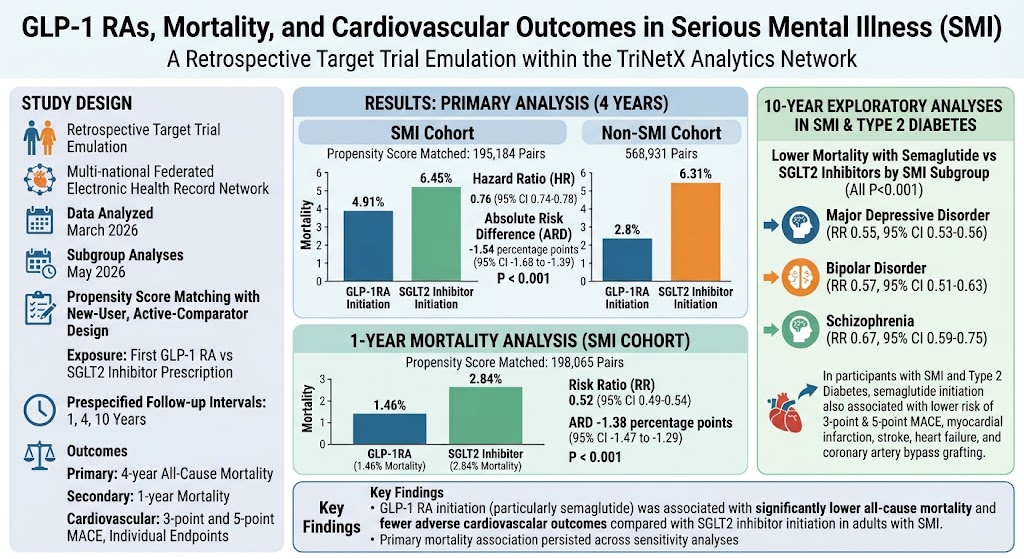
The landmark study by McIntyre et al. (2026) utilized the TriNetX Analytics Network to emulate a retrospective target trial comparing first recorded initiation of GLP-1 RAs to SGLT2 inhibitors in over 1.5 million adults, including 195,184 with documented SMI. Propensity score matching balanced confounders between therapy groups and stratified analyses by SMI status as well as comorbid type 2 diabetes.
Key findings at 4-year follow-up included:
- Mortality was significantly lower in GLP-1 RA initiators with SMI versus SGLT2 initiators (4.91% vs 6.45%; HR 0.76, 95% CI 0.74-0.78, P<.001), yielding an absolute risk reduction (ARD) of 1.54 percentage points.
- Among SMI participants with type 2 diabetes, semaglutide initiation reduced risk of 3- and 5-point MACEs, myocardial infarction, stroke, heart failure, and coronary artery bypass grafting relative to SGLT2 inhibitors.
- Mortality benefits of GLP-1 RAs emerged within one year and were consistent across SMI subgroups: major depressive disorder, bipolar disorder, and schizophrenia, persisting through 10-year exploratory analyses (RR 0.55 to 0.67, all P<.001).
- Notably, the benefits were primarily driven by semaglutide and tirzepatide among GLP-1 RA agents.
Sensitivity analyses accounted for diabetes status, baseline cardiovascular and renal comorbidities, and treatment crossover, all reaffirming the robustness of the observed associations.
Randomized Clinical Trial Evidence for GLP-1 RAs in Psychiatric Populations
Complementing observational findings, a randomized clinical trial by McIntyre et al. (2026) evaluated adjunctive semaglutide (1 mg weekly) versus placebo over 26 weeks in individuals with schizophrenia spectrum disorders treated with clozapine or olanzapine exhibiting early glycemic abnormalities (HbA1c 5.4%-7.4%). This well-powered, double-blind trial conducted in Denmark confirmed that semaglutide significantly:
- Reduced HbA1c by 0.25% compared to placebo (P<.001), with 43% achieving low-risk HbA1c (<5.4%) versus 3% in placebo.
- Induced mean weight loss of 9.2 kg and significant reductions in waist circumference and fat mass.
- Maintained stable lipid profiles, blood pressure, liver function, and psychiatric symptoms.
Adverse events were predominantly mild, transient gastrointestinal symptoms; importantly, no increased psychiatric adverse events were observed. These findings support early cardiometabolic risk modification with GLP-1 RAs in SMI populations, particularly those on second-generation antipsychotics with diabetogenic potential.
GLP-1 RAs and Inflammation in Substance Use Disorders
Additional studies examining GLP-1 RAs in related psychiatric comorbidities highlight the complex link between metabolic dysfunction and inflammation. A randomized placebo-controlled study of exenatide in alcohol use disorder patients found elevated inflammatory biomarkers compared to controls but no significant biomarker modulation with exenatide treatment, suggesting GLP-1 RAs’ cardiometabolic benefits may be primarily metabolic rather than anti-inflammatory in this setting (Klein et al., 2025).
Mechanisms Underlying Cardiovascular Benefits
The cardioprotective effects of GLP-1 RAs derive from multiple mechanisms including improved insulin sensitivity, weight reduction, anti-atherosclerotic effects, lowered blood pressure, and possibly improved endothelial function. In psychiatric populations, these effects may counteract the metabolic adverse effects of psychotropic medications and mitigate systemic inflammatory burden contributing to atherosclerosis. Importantly, GLP-1 receptors are expressed in cardiovascular and central nervous system tissues, suggesting direct and indirect pathways for cardiovascular risk modulation.
Expert Commentary
This growing body of evidence repositions GLP-1 RAs as promising agents in addressing the critical cardiovascular mortality gap in SMI. The retrospective target trial by McIntyre et al. establishes a compelling real-world comparative effectiveness advantage of GLP-1 RAs over SGLT2 inhibitors in reducing mortality and cardiovascular events in this vulnerable population, with the strongest effect sizes observed in those with comorbid diabetes. The corroborating randomized data affirm safety and efficacy of GLP-1 RAs in improving glycemic control and reducing adiposity in schizophrenia spectrum disorders without psychiatric destabilization.
Current clinical guidelines for cardiovascular risk management in SMI primarily emphasize lifestyle optimization and standard pharmacotherapies; however, the prevalence of metabolic comorbidities and pharmacological risk factors necessitates novel interventions. While SGLT2 inhibitors remain important, GLP-1 RAs may provide superior cardiovascular protection, particularly semaglutide and tirzepatide, offering a dual benefit of weight management and cardiovascular risk reduction.
Nevertheless, caution is warranted given the observational design of the primary study and potential residual confounding. The heterogeneity of mental illness subtypes and psychiatric medication regimens complicate generalizability. Furthermore, the absence of clear biomarker impact on inflammation in alcohol use disorder suggests that pleiotropic mechanisms of GLP-1 RAs remain to be fully elucidated.
Prospective, randomized controlled trials focusing on long-term cardiovascular outcomes, mortality, and mechanistic biomarkers in diverse SMI populations are necessary to refine clinical recommendations. Optimal timing for initiation, agent selection, and integration with psychiatric treatment paradigms require further study.
Conclusion
Evidence synthesized from recent large-scale observational studies and randomized controlled trials points to a promising role for GLP-1 receptor agonists in reducing mortality and cardiovascular events in patients with serious mental illness. These benefits are pronounced in patients with comorbid type 2 diabetes and appear early after treatment initiation. Semaglutide and tirzepatide demonstrate particular efficacy in improving glycemic control, weight parameters, and long-term cardiovascular outcomes without compromising psychiatric stability. This emerging therapeutic approach addresses a critical unmet need, potentially transforming cardiovascular risk management in psychiatry. Ongoing and future prospective trials are awaited to establish definitive evidence and inform clinical guidelines.
References
- McIntyre RS, Zhang-James Y, Kwan ATH. Glucagon-Like Peptide 1 Receptor Agonists, Mortality, and Cardiovascular Outcomes in Serious Mental Illness. JAMA Psychiatry. 2026 Aug 26. PMID: 42647034.
- McIntyre RS, et al. Semaglutide and Early-Stage Metabolic Abnormalities in Individuals With Schizophrenia Spectrum Disorders: A Randomized Clinical Trial. JAMA Psychiatry. 2026 Feb 1;83(2):128-138. PMID: 41335431.
- Klein AB, et al. Effect of the GLP-1 receptor agonist exenatide on pro-inflammatory and metabolic biomarkers in individuals with alcohol use disorder: Post hoc results from a randomized, double-blinded, placebo-controlled clinical trial. Alcohol Clin Exp Res. 2025 Aug;49(8):1659-1666. PMID: 40630018.