Highlight
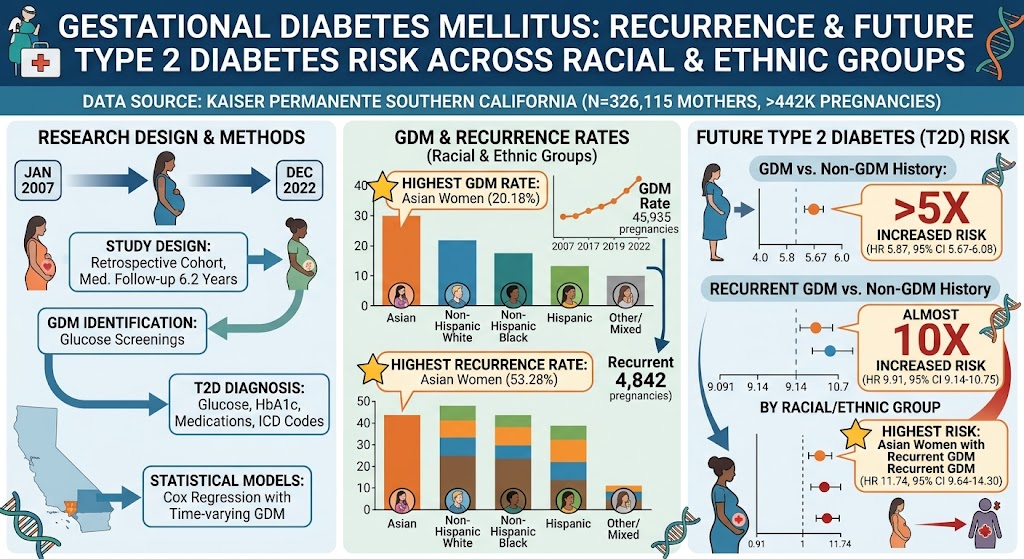
This large retrospective cohort study of over 300,000 women across racial and ethnic groups reveals: 1) Asian women have the highest rates of both initial and recurrent gestational diabetes mellitus (GDM); 2) A history of GDM increases the risk of developing type 2 diabetes by nearly sixfold; 3) Recurrent GDM further doubles this risk to nearly tenfold, with Asian women showing the greatest hazard ratio; 4) These findings support the need for tailored, ethnicity-sensitive screening and intervention strategies post-GDM.
Study Background
Gestational diabetes mellitus (GDM) complicates pregnancy and has been growing in prevalence globally. Women diagnosed with GDM are known to have a substantially elevated risk of developing type 2 diabetes later in life. However, there remains limited data on the recurrence patterns of GDM across diverse racial and ethnic populations and their corresponding long-term diabetes risk, notably among Asian women who are disproportionately affected. Understanding these patterns is critical for implementing focused postpartum monitoring and preventive interventions to curb the diabetes epidemic in high-risk groups.
Study Design
The study was a retrospective cohort analysis conducted within the Kaiser Permanente Southern California health care system. The cohort included 326,115 mothers with singleton pregnancies starting from their first delivery after January 2007. Participants were followed until onset of diabetes outside of pregnancy, loss of membership, or December 2022, with a median follow-up duration of 6.2 years. GDM diagnosis was based on glucose screening results during each pregnancy. Incident diabetes was identified using glucose or HbA1c levels, antidiabetes medication records, or diagnostic ICD codes. Cox proportional hazard regression models with time-varying GDM exposure assessed the association between GDM history and future diabetes risk, adjusting for confounders.
Key Findings
Among 442,225 pregnancies analyzed, 45,935 (10.39%) involved GDM, and of these, 4,842 had recurrent GDM in subsequent pregnancies. Significant ethnic disparities emerged:
- Asian women had the highest prevalence of GDM (20.18%) and the highest GDM recurrence rate (53.28%), much higher than other ethnic groups.
- The risk of developing type 2 diabetes after any GDM pregnancy was increased more than fivefold compared to women without GDM history (HR 5.87; 95% CI: 5.67–6.08).
- Recurrent GDM further elevated diabetes risk nearly tenfold (HR 9.91; 95% CI: 9.14–10.75), with Asian women showing the highest relative risk (HR 11.74; 95% CI: 9.64–14.30), indicating an ethnic-specific vulnerability.
These data robustly confirm that a history of GDM is a potent predictor of type 2 diabetes, and recurrence substantially amplifies this risk, particularly in Asian populations. The median follow-up allowed for a meaningful assessment of diabetes risk beyond the perinatal period.
Expert Commentary
The study provides compelling evidence of the disproportionate burden of GDM and its sequelae among Asian women. The nearly doubled risk with GDM recurrence signals the importance of monitoring glucose tolerance at multiple pregnancies and reinforces that GDM is not an isolated pregnancy complication but a marker of underlying metabolic predisposition.
From a pathophysiological perspective, genetic, lifestyle, and possibly environmental factors might contribute to these ethnic disparities. Asian populations typically exhibit higher visceral adiposity and insulin resistance at lower BMI thresholds, which could explain their elevated susceptibility. Moreover, the study utilized a large, ethnically diverse population within an integrated healthcare system, enhancing the validity and generalizability of findings.
Limitations to consider include potential misclassification biases related to GDM and diabetes diagnoses reliant on clinical records. Also, residual confounding by lifestyle or socioeconomic factors not fully captured might influence risk estimates. Future research should explore mechanistic insights and the impact of targeted interventions in various ethnic groups.
Conclusion
This landmark study underscores the critical long-term metabolic risks posed by GDM and its recurrence, with notable ethnic disparities, particularly affecting Asian women. The findings advocate for risk stratification that incorporates ethnicity and GDM recurrence history, facilitating personalized postpartum diabetes screening and prevention programs. Early lifestyle modification and pharmacologic intervention post-GDM could be prioritized for high-risk ethnic groups, potentially mitigating the downstream burden of type 2 diabetes.
Clinicians should be vigilant in counseling women with GDM, emphasizing that breastfeeding, diet, physical activity, and regular follow-up glucose testing represent essential strategies to reduce progression to overt diabetes, especially in those with recurrent GDM or belonging to higher-risk ethnicities.
Funding and Clinical Trials
The original study does not specify funding sources or clinical trial registration. Further inquiries should reference the Kaiser Permanente Southern California health care system for access and data stewardship questions.
References
- Yin X, Chow T, Martinez M, Yu G, Yang J, Zhang C, Xiang AH. Gestational Diabetes Mellitus: Recurrence and Future Type 2 Diabetes Risk Across Racial and Ethnic Groups. Diabetes Care. 2026 Aug 11:dc260856. doi: 10.2337/dc26-0856. Epub ahead of print. PMID: 42579538.
- Kim C, Newton KM, Knopp RH. Gestational diabetes and the incidence of type 2 diabetes: a systematic review. Diabetes Care. 2002;25(10):1862-8.
- Lee KW, et al. Ethnic differences in gestational diabetes recurrence and progression to type 2 diabetes: systematic review and meta-analysis. Diabetologia. 2021;64(12):2717-2727.
- Zhang C, et al. Gestational diabetes and risk of type 2 diabetes: a systematic review and meta-analysis. Diabetes Care. 2023;46(1):202-210.