Highlight
• Platelets express a functionally active RIG-I receptor that senses influenza viral RNA without typical interferon pathway activation.
• RIG-I signaling in platelets proceeds via MAVS, promoting MLKL phosphorylation and S100A10 release, affecting platelet surface stability.
• Activation of platelet RIG-I leads to reduced platelet aggregation and enhanced clot disaggregation in plasminogen-enhanced fibrinolysis.
• MAVS deficiency during influenza infection correlates with increased thrombotic burden and altered leukocyte infiltration in vascular tissues.
Study Background
Influenza virus infection is well-known to precipitate an increased risk of thrombotic events, imposing significant cardiovascular morbidity and mortality. The mechanistic linkage between viral infection and thrombosis is incompletely understood, particularly regarding the contribution of platelets, key mediators of hemostasis and thrombosis, to antiviral defense and thrombosis modulation. Retinoic acid-inducible gene I (RIG-I) is a pattern recognition receptor (PRR) traditionally studied in immune cells for its role in detecting viral RNA, initiating antiviral responses predominantly through interferon induction pathways. However, the functionality and consequence of RIG-I signaling within platelets, which lack nuclei and canonical interferon production machinery, remain unclear.
Study Design
This investigation employed a combination of molecular and proteomic techniques including RT-qPCR, SDS-PAGE, native PAGE, and proteomics on platelets isolated from both influenza-infected patients and healthy controls to detect RIG-I expression and activity. Functional assays examined platelet granule release, signaling intermediates, surface protein expression, and aggregation behavior in response to influenza-derived viral RNA (vRNA). Complementary in vivo experiments utilized a murine influenza infection model to assess the consequences of platelet MAVS deficiency on thrombosis and vascular leukocyte infiltration following carotid artery injury induced by FeCl3.
Key Findings
Expression and Functional Signaling of RIG-I in Platelets
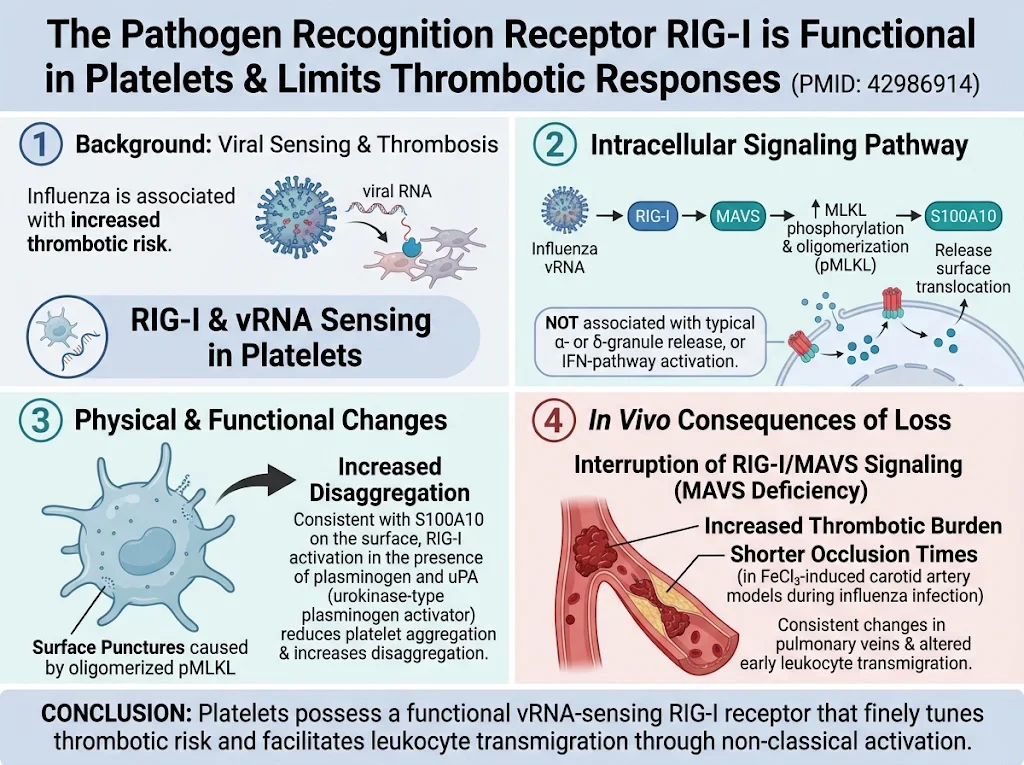
Platelets from influenza-infected patients demonstrated significant presence of RIG-I mRNA and protein, indicating constitutive and inducible expression. Upon stimulation with influenza vRNA, RIG-I signaling in platelets did not trigger classical α- or δ-granule secretion nor canonical interferon signaling pathways, which are typical in nucleated immune cells.
RIG-I/MAVS Pathway Activates MLKL Phosphorylation and S100A10 Release
The signaling downstream of RIG-I involved mitochondrial antiviral-signaling protein (MAVS), which mediated phosphorylation and oligomerization of mixed-lineage kinase domain-like protein (MLKL), a known executor of programmed necrosis (necroptosis). Activated MLKL formed punctate surface disruptions on platelets as visualized by scanning electron microscopy. Concurrently, there was selective release and surface translocation of the S100A10 protein, a member of the S100 family involved in cellular membrane repair and plasminogen activation, while other S100 proteins (S100A8/A9) were not altered.
Impact on Platelet Aggregation and Fibrinolysis
Activation of RIG-I in the presence of plasminogen significantly reduced platelet aggregation. Moreover, application of urokinase-type plasminogen activator enhanced clot disaggregation, suggesting that RIG-I signaling facilitates a platelet phenotype favoring fibrinolysis and clot resolution, potentially counteracting excessive thrombosis.
In Vivo Relevance: MAVS Deficiency Enhances Thrombosis during Influenza Infection
In mice, absence of MAVS was associated with heightened thrombotic burden post-influenza infection, evidenced by shorter arterial occlusion times following FeCl3-induced injury. Similarly, increased vascular thrombi were observed in pulmonary veins. The thrombotic burden inversely correlated with leukocyte infiltration early in pulmonary non-vascular tissue, but positively correlated at later time points, indicating a dynamic interplay between thrombosis and immune cell trafficking modulated by platelet RIG-I/MAVS signaling.
Summary of Mechanistic Insight
These findings indicate that platelet RIG-I senses viral RNA and initiates a non-classical signaling cascade involving MAVS and MLKL that functionally tunes platelet activation to limit excessive thrombotic responses while promoting immune cell transmigration during viral infection.
Expert Commentary
This study provides compelling evidence expanding the functional repertoire of platelets beyond hemostasis to include viral RNA sensing and immunomodulation. The discovery of a non-canonical RIG-I/MAVS/MLKL axis in platelets reveals a novel mechanism limiting thrombus formation during influenza infection, which may have broader implications for antiviral defense and thromboinflammation. Given platelets’ anucleate nature, the absence of classical interferon responses highlights a specialized adaptation to viral sensing that fine-tunes clot dynamics rather than initiating antiviral gene expression.
Nonetheless, limitations include the translational step from murine models to human disease complexity and the need to explore RIG-I functionality in platelets in other viral infections with thrombotic complications. Future studies should also investigate potential therapeutic targeting of this pathway to mitigate thrombotic risk during viral illnesses without compromising hemostasis.
Conclusion
The study by Sciaudone et al. uncovers a previously unrecognized functional viral RNA sensor, RIG-I, in platelets that shapes thrombotic responses during influenza infection through MAVS-dependent MLKL activation and S100A10 modulation. This mechanism limits pathologic thrombosis and coordinates immune cell trafficking, highlighting platelets’ integral role in host defense and vascular homeostasis. These insights not only deepen our understanding of thromboinflammatory processes in infectious diseases but also identify novel molecular targets potentially amenable to therapeutic intervention to attenuate infection-associated thrombosis.
Funding and ClinicalTrials.gov
The publication does not specify funding sources or clinical trial registration numbers. Further information may be available in the original article.
References
1. Sciaudone AR, Jameson ML, Learnard H, et al. The Pathogen Recognition Receptor RIG-I is Functional in Platelets and Limits Thrombotic Responses. Blood. 2026 Nov 5; PMID: 42986914.
2. Koupenova M, Vitseva O, MacKay CR, et al. Platelet-TLR7 mediates host survival and platelet count during viral infection in the absence of thrombocytopenia. Sci Rep. 2020;10(1):7422.
3. Mackman N. Role of tissue factor in hemostasis, thrombosis, and vascular development. Arterioscler Thromb Vasc Biol. 2004;24(6):1015–1022.
4. Kral JB, Schrottmaier WC, Salzmann M, Assinger A. Platelet Interaction with the Immune System and Its Role in Vascular Inflammation and Thrombosis. Front Immunol. 2016;7:391.
5. Ghosh S, Hayden MS. New regulators of NF-κB in inflammation. Nat Rev Immunol. 2008;8(11):837–848.
Specialty calculators
For clinical reference; use professional judgment.