Highlight
- The development of a simple Pre-COPD score accurately predicts progression to COPD in individuals without airflow obstruction at baseline.
- The score incorporates smoking history, active smoking status, respiratory symptoms, asthma diagnosis, and specific spirometry thresholds including PRISm.
- Validation in three large cohorts (CGPS, CCHS, COPDGene) shows consistent performance with area under the curve (AUC) ranging 0.76 to 0.88.
- Pre-COPD score stratifies 5- and 10-year risk of incident COPD and correlates with exacerbation risk, supporting its clinical utility for early identification and intervention.
Study Background
Chronic obstructive pulmonary disease (COPD) is a leading cause of morbidity and mortality worldwide, characterized by persistent airflow limitation and progressive respiratory symptoms. Early identification of individuals at risk before the onset of overt airflow obstruction—the so-called “pre-COPD” phase—remains a critical unmet need. Current clinical practice often detects COPD after significant lung function decline, limiting opportunities for preventative interventions. Defining a standardized, evidence-based method to predict COPD development could facilitate timely monitoring, risk reduction, and tailored management strategies to improve outcomes.Study Design
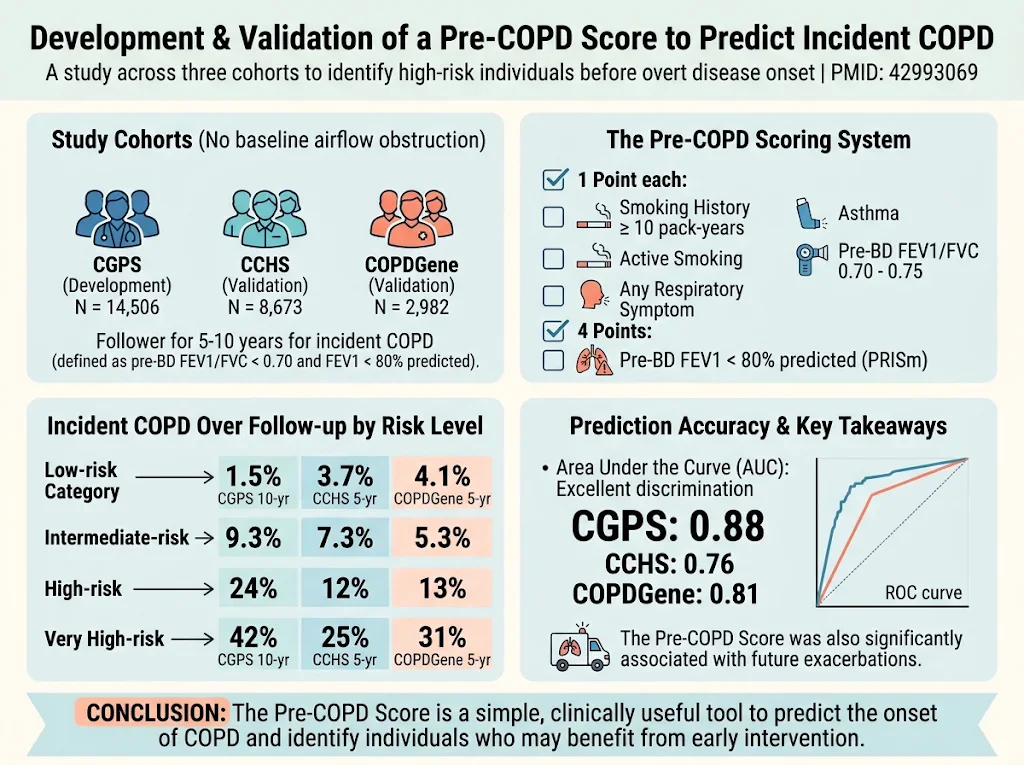
This study aimed to develop and validate a simple Pre-COPD score designed to predict incident COPD among individuals without airflow obstruction. Participants were selected from three large epidemiological cohorts: – Copenhagen General Population Study (CGPS; n=14,506) – Copenhagen City Heart Study (CCHS; n=8,673) – Genetic Epidemiology for COPD (COPDGene) Study (n=2,982) Inclusion criteria mandated absence of airflow obstruction at baseline, defined by pre-bronchodilator forced expiratory volume in 1 second (FEV1)/forced vital capacity (FVC) ratio ≥0.70 and above the lower limit of normal (LLN). Incident COPD was defined as pre-bronchodilator FEV1/FVC ratio <0.70 combined with FEV1 <80% predicted during follow-up (5–10 years). The Pre-COPD score assigned points based on: – Smoking history ≥10 pack-years (1 point) – Active smoking status (1 point) – Presence of any respiratory symptom (1 point) – History of asthma (1 point) – Pre-bronchodilator FEV1/FVC ratio between 0.70 and 0.75 (1 point) – Presence of Preserved Ratio Impaired Spirometry (PRISm; FEV1 <80% predicted with FEV1/FVC ≥0.70) (4 points) The score was developed in the CGPS cohort and externally validated in CCHS and COPDGene.Key Findings
The study demonstrated that the Pre-COPD score stratifies risk across four categories: low, intermediate, high, and very high risk. – In CGPS (10-year follow-up), incident COPD occurred in 4.6% overall, with risk by category: – Low risk: 1.5% – Intermediate risk: 9.3% – High risk: 24% – Very high risk: 42% – In CCHS (5-year follow-up), COPD incidence was 7.9%, with respective category risks of 3.7%, 7.3%, 12%, and 25%. – In COPDGene (5-year follow-up), incident COPD occurred in 12%, stratified as 4.1%, 5.3%, 13%, and 31% for the corresponding risk categories. The discrimination ability of the Pre-COPD score, measured by area under the receiver operating characteristic curve (AUC), was excellent: – CGPS: 0.88 – CCHS: 0.76 – COPDGene: 0.81 Furthermore, the score was positively associated with exacerbation risk, highlighting its relevance beyond COPD onset prediction. The higher weighted points for PRISm reflect its strong contribution to future COPD risk.Expert Commentary
These findings underscore the clinical and epidemiological importance of characterizing patients in the pre-COPD phase using accessible clinical and spirometric parameters. The inclusion of PRISm is particularly noteworthy, as it captures lung function abnormalities not meeting classical COPD obstruction criteria yet prognostic for subsequent decline. Given the simplicity of the scoring system, incorporating widely available information such as smoking status and basic spirometric indices, it lends itself well to implementation in primary care and pulmonary screening settings. A limitation includes reliance on pre-bronchodilator spirometry, which may overestimate airflow obstruction compared with post-bronchodilator measures. Future studies could assess the added predictive value of imaging, biomarkers, or genetic information to refine risk estimates. Additionally, the cohorts have differing baseline risk profiles and ethnic compositions, necessitating assessment of generalizability across more diverse populations. Importantly, this Pre-COPD score aligns with emerging concepts in COPD pathogenesis emphasizing gradual lung function decline and symptom development before diagnostic thresholds are met. It offers a pragmatic tool for clinicians and researchers to identify high-risk individuals who may benefit from smoking cessation, environmental exposure reduction, or close monitoring.Conclusion
The development and external validation of a simple Pre-COPD score provides a robust method to predict incident COPD in individuals initially without airflow obstruction. This tool demonstrates consistent discrimination across three large, independent cohorts with varying risk profiles. Early risk stratification using this score can facilitate targeted preventive interventions, potentially altering COPD’s natural history and improving patient outcomes. Integration of the Pre-COPD score into clinical workflows warrants further exploration, alongside studies to validate its practical impact on downstream management and healthcare utilization.Funding and ClinicalTrials.gov
Funding sources and clinical trial registrations were not detailed in the current publication; readers are referred to the original article for such information.References
1. Çolak Y, Bhatt SP, Kinney GL, Casaburi R, Nordestgaard BG, Vestbo J, Lange P, Afzal S. Development and Validation of a Pre-COPD Score to Predict Incident COPD. Am J Respir Crit Care Med. 2026 Nov 6; PMID: 42993069. 2. Haroon SM, Jordan RE, Obeidat M, Sadhra SS, Hall IP. Chronic obstructive pulmonary disease. Lancet. 2022;400(10349):141-160. 3. Celli BR, Wedzicha JA. Update on Clinical Aspects of Chronic Obstructive Pulmonary Disease. N Engl J Med. 2019;381(13):1257-1266. 4. Regan EA, Hokanson JE, Murphy JR, et al. Genetic Epidemiology of COPD (COPDGene) Study Design. COPD. 2010;7(1):32-43. 5. Miller MR, Hankinson J, Brusasco V, et al. Standardisation of spirometry. Eur Respir J. 2005;26(2):319-338. 6. Balestro E, Amaral AF, et al. Imaging and Biomarkers for Early COPD Detection: Current Perspectives. Eur Respir Rev. 2021;30(160):200290. (Additional references should be consulted based on institutional access.)Specialty calculators
For clinical reference; use professional judgment.