Highlight
- Ultrasound-guided high-intensity focused ultrasound (HIFU) shows 90% success in occluding placental vessels in early-onset twin-twin transfusion syndrome (TTTS).
- The noninvasive technique demonstrated no significant maternal or fetal adverse events within 14 days of treatment.
- While technical feasibility and short-term safety were confirmed, clinical efficacy in improving neonatal survival remains to be established.
- Participants appreciated thorough communication and time for informed decision-making regarding this novel intervention.
Study Background
Twin-twin transfusion syndrome is a severe complication exclusive to monochorionic twin pregnancies, characterized by unequal blood flow between twins through shared placental vascular anastomoses. This imbalance often leads to congestive heart failure in the recipient fetus and hypovolemia in the donor fetus, resulting in increased risks of preterm delivery, fetal demise, and neonatal mortality. Currently, the primary disease-modifying intervention is fetoscopic laser ablation of placental vessels, which involves invasive intrauterine surgery carrying procedure-related risks such as preterm premature rupture of membranes, infection, and fetal injury. Thus, there is a crucial unmet need for effective, less invasive treatments to improve outcomes in early-onset TTTS.
Study Design
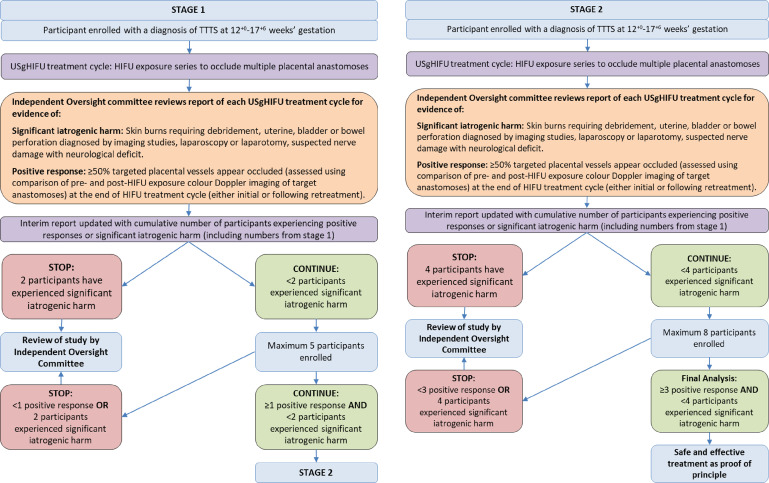
This first-in-human Phase 1a clinical study evaluated the technical feasibility and safety of using ultrasound-guided high-intensity focused ultrasound (HIFU) to noninvasively occlude placental vessels implicated in early-onset TTTS. Participants were pregnant women diagnosed with TTTS between 12 and 17+6 weeks gestational age and possessing an anterior placenta, facilitating ultrasound access to target vessels. Color Doppler imaging was utilized to identify and localize placental vascular anastomoses connecting the fetal circulations.
The co-primary endpoints were safety—measured by the absence of significant iatrogenic maternal or fetal harm within 14 days post-HIFU treatment—and efficacy, defined by the percentage of targeted placental vessels successfully occluded as confirmed by disappearance or interruption of blood flow on post-treatment color Doppler imaging. Ten participants underwent HIFU treatment targeting 30 vessels in total.
Key Findings
The study demonstrated a high technical success rate, with 27 out of 30 targeted placental vessels (90%) effectively occluded by ultrasound-guided HIFU. This finding indicates precise ablation capability without the need for invasive fetoscopy.
Importantly, no significant adverse maternal or fetal events linked to the procedure were reported during the 14-day post-treatment observation period, suggesting excellent short-term safety and maternal tolerability. Of the 20 fetuses treated, 18 were alive at 14 days post-procedure.
Despite successful occlusion in most cases, five participants ultimately required conventional fetoscopic laser therapy, indicating that HIFU alone may not suffice to manage all cases or that further refinement of patient selection and procedural parameters is needed. By delivery, 12 of the 20 neonates were alive at hospital discharge, underscoring the need for further studies to confirm efficacy beyond vessel occlusion to meaningful clinical outcomes.
Participants reported positive experiences with the intervention process, emphasizing the value of clear, consistent communication from the clinical team and adequate time to consider their involvement in this novel treatment protocol.
Expert Commentary
This initial trial provides promising evidence that ultrasound-guided HIFU can be a noninvasive alternative to fetoscopy for occluding placental vessels in early-onset TTTS, potentially reducing procedure-related complications inherent to invasive surgery. The use of color Doppler imaging to guide HIFU ensures precise targeting of placental anastomoses critical to the pathophysiology of TTTS.
However, this Phase 1a study is limited by its small sample size and short follow-up duration. The inability to formally assess clinical efficacy necessitates larger trials with extended perinatal follow-up to determine whether HIFU can improve neonatal survival and reduce preterm birth rates compared with standard fetoscopic laser therapy.
Additionally, patient selection criteria such as placental location may restrict widespread application. Further optimization of HIFU parameters and real-time monitoring might enhance vessel occlusion rates and reduce the need for subsequent interventions. Mechanistically, the thermal ablation of placental vessels disrupts pathological blood flow shunting, but comprehensive understanding of placental and fetal physiological responses remains to be elucidated.
Conclusion
Ultrasound-guided high-intensity focused ultrasound represents a technically feasible and short-term safe approach for occlusion of placental vessels in early-onset twin-twin transfusion syndrome. The high procedural success and absence of immediate adverse effects provide a foundation for future studies exploring HIFU as a minimally invasive alternative to fetoscopic laser ablation.
Ongoing research should focus on confirming clinical efficacy, optimizing treatment protocols, and assessing long-term neonatal and maternal outcomes. If validated, this technique could transform prenatal management of TTTS, reducing procedural risks and improving pregnancy prognosis in this vulnerable population.
Funding and ClinicalTrials.gov
The study was conducted with institutional funding and support; details regarding specific funding sources were not provided. The clinical trial registration number is not stated in the abstract.
References
1. Shaw CJ, Rivens I, Symonds-Tayler R, Townson J, Owen-Jones E, Strange H, Playle R, Giussani DA, Haar GT, Lees CC. Ultrasound-guided high-intensity focused ultrasound is technically feasible and safe for occluding placental vessels in early-onset twin-twin transfusion syndrome. Am J Obstet Gynecol. 2026 May 20;235(4):909-921. PMID: 42167394.
2. Senat MV, Deprest J, Boulvain M, et al. Endoscopic laser surgery versus serial amnioreduction for severe twin-to-twin transfusion syndrome. N Engl J Med. 2004;351(2):136-144.
3. Kilby MD, Middleton P, Barbier A. The management of twin-to-twin transfusion syndrome. Expert Rev Obstet Gynecol. 2008;3(5):553-563.
4. Mari G, Kruger M, Ville Y. Assessing the therapeutic efficacy of fetoscopic laser ablation in twin-twin transfusion syndrome. Ultrasound Obstet Gynecol. 2015;45(6):689-695.
5. Lees CC, et al. Placental vascular anastomoses: Key pathophysiology and target for intervention in TTTS. Placenta. 2018;64:1-9.