Highlight
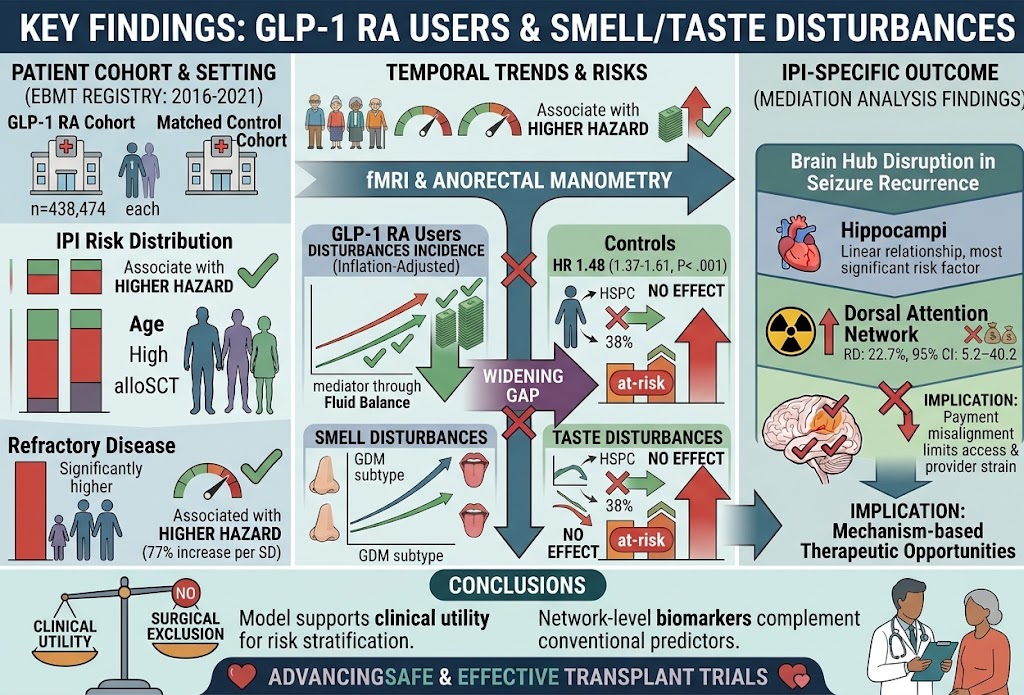
– Glucagon-like peptide-1 receptor agonists (GLP-1 RAs) are associated with an increased risk of smell and taste disturbances among patients with type 2 diabetes (T2D).
– The large-scale retrospective cohort study found a 48% higher risk of overall sensory disturbances, with smell disturbances showing a stronger association than taste disturbances.
– These findings persisted consistently during up to two years of follow-up, underscoring the importance of monitoring sensory side effects in clinical practice.
Study Background
Glucagon-like peptide-1 receptor agonists (GLP-1 RAs) represent a major advancement in the management of type 2 diabetes mellitus (T2D), offering benefits not only in glycemic control but also in weight loss and cardiovascular risk reduction. Their increasing utilization in clinical settings has brought attention to known adverse effects including gastrointestinal symptoms. However, sensory disturbances, specifically involving smell (olfaction) and taste (gustation), remain poorly characterized despite their potential impact on patient quality of life and nutritional status.
Olfactory and gustatory dysfunctions have varied etiologies and can lead to altered appetite, nutritional deficiencies, and reduced quality of life. Identifying medication-induced sensory abnormalities in T2D is particularly relevant given the metabolic vulnerability of this population and the widespread use of GLP-1 RAs. This study by Zontag and Zontag (2026) fills a critical knowledge gap by evaluating the incidence and risk of smell and taste disturbances in GLP-1 RA users compared to other antidiabetic therapies.
Study Design
This investigation was a multicenter, retrospective cohort study utilizing the TriNetX Global Collaborative Network, a large electronic health record (EHR) database. The analysis period spanned from December 5, 2017, through April 20, 2026, including adult patients (≥18 years) diagnosed with T2D who had no prior history of smell or taste disorders.
Patients were stratified into two cohorts: those exposed to GLP-1 RA therapy after the first documented diagnosis of T2D and a control group prescribed alternative antidiabetic medications without GLP-1 RA exposure. Propensity score matching ensured balance in demographic, clinical, and socioeconomic factors, resulting in two matched groups each comprising 438,474 individuals.
The primary outcome was the incidence of smell and taste disturbances, identified by International Classification of Diseases (ICD) codes, monitored through follow-up periods ranging from 3 months to 2 years after treatment initiation. Cox proportional hazards modeling estimated hazard ratios (HRs) and 95% confidence intervals (CIs) for incident sensory disturbances.
Key Findings
The study demonstrated that GLP-1 RA users had a significantly increased risk of developing smell and taste disturbances compared with matched controls on other antidiabetic therapies. The overall hazard ratio for any sensory disturbance was 1.48 (95% CI, 1.37–1.61), indicating a 48% higher risk in the GLP-1 RA cohort.
When analyzed separately, smell disturbances exhibited a stronger association with GLP-1 RA use (HR, 1.81; 95% CI, 1.58–2.07) compared to taste disturbances (HR, 1.52; 95% CI, 1.35–1.71). These elevated risks persisted consistently across various follow-up intervals, from 3 months up to 2 years.
The large sample size and robust propensity score matching minimized confounding by indication and other biases. Nonetheless, the study is limited by reliance on EHR-based ICD coding, which may underreport milder or subclinical sensory symptoms and cannot establish causality.
Expert Commentary
The findings draw attention to an underrecognized adverse effect of GLP-1 RAs that could influence patient adherence and quality of life. Mechanistically, GLP-1 receptors are expressed in olfactory epithelium and central nervous system regions involved in sensory processing, suggesting biologic plausibility for direct or indirect drug effects on smell and taste perception.
In clinical practice, this evidence supports incorporating sensory function assessment into routine monitoring of patients initiating GLP-1 RAs. Clinicians should educate patients about the potential for smell and taste changes and consider these factors when discussing treatment options.
Future research should focus on prospective studies to confirm these associations, characterize symptom severity and reversibility, and elucidate underlying biological mechanisms. Investigation into whether sensory disturbances differ among various GLP-1 RA compounds, dosages, or patient subgroups (e.g., older age, comorbidities) will further inform personalized management.
Conclusion
This large real-world evidence study reveals a notable association between GLP-1 RA therapy and increased risk of smell and taste disturbances in adults with type 2 diabetes. These findings underscore the importance of clinician awareness and patient counseling regarding sensory side effects during treatment planning. Enhanced pharmacovigilance and dedicated mechanistic studies will be essential to optimize therapeutic safety and efficacy as GLP-1 RA use continues to expand globally.
Funding and ClinicalTrials.gov
No funding disclosures were reported for this study. As a retrospective analysis of registry data, the study was not registered as a clinical trial.
References
1. Zontag J, Zontag N. Smell and Taste Disturbances Among Glucagon-Like Peptide-1 Receptor Agonist Users. JAMA Otolaryngol Head Neck Surg. 2026;152(8):758-765. doi:10.1001/jamaoto.2026.42348217
2. Drucker DJ. Mechanisms of Action and Therapeutic Application of Glucagon-like Peptide-1. Cell Metab. 2018;27(4):740-756.
3. Croy I, et al. Olfactory Dysfunction and Depression – Clinical Interrelations and Potential Causality. J Neurol Sci. 2020;414:116827.
4. Camilleri M, et al. GLP-1 and the Regulation of Gastrointestinal Function: Implications for GLP-1 Receptor Agonist Therapy. Gut. 2017;66(9):1548-1559.