Highlights
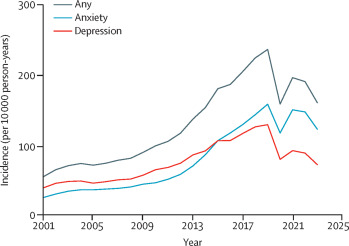
- Incidence of common mental disorders in children and young people (CYP) quadrupled between 2001 and 2019 in England, then declined slightly by 2023.
- The demographic profile shifted towards younger age at diagnosis, increased representation of White ethnicity, and rising psychiatric or neurodevelopmental comorbidities.
- Referrals to Child and Adolescent Mental Health Services (CAMHS) increased, while antidepressant prescribing rates halved but treatment intensity per patient increased.
- Clinical risk for adverse outcomes (self-harm, alcohol and drug misuse) remained stable, suggesting no dilution of severity despite rising incidence.
Background and Disease Burden
Common mental disorders (CMD)—predominantly anxiety and depression—constitute an important public health concern among children and young people (CYP). Over the past two decades, primary care presentations for these disorders have surged substantially in several high-income countries, including England. Understanding trends in incidence, clinical characteristics, treatment patterns, and associated risks is critical to inform mental health service planning, resource allocation, and policy interventions.
CMDs in CYP are associated with significant morbidity, psychosocial impairment, and risk of adverse outcomes such as self-harm and substance misuse. Despite increased recognition and health system attention, questions remain whether rising recorded incidence reflects true increases in prevalence or changes in presentation and recording practices. Furthermore, how treatment approaches and risk profiles have evolved over time is not fully elucidated.
Study Design and Methods
This retrospective, population-based cohort study utilized anonymized electronic primary care data from the Clinical Practice Research Datalink Aurum (CPRD-Aurum), covering the entire period from 2001 to 2023. The cohort comprised children and adolescents aged 10 to 18 years registered in English general practices, with linked hospital and mortality data.
Incident cases of common mental disorders were identified based on the first recorded symptom or diagnosis codes consistent with anxiety or depression. Study endpoints included trends in incidence, demographic and comorbidity profiles, referrals to Child and Adolescent Mental Health Services (CAMHS), and antidepressant prescribing patterns following diagnosis.
The study compared CYP with incident CMD to matched controls to assess risk of hospital admissions for self-harm, alcohol misuse, and drug misuse within two years, evaluating changes over calendar years via interaction models.
Key Findings
Incidence Trends: Over 6.2 million CYP were registered with CPRD-Aurum practices during the study period. Among these, 379,802 had a first recorded CMD symptom or diagnosis. The incidence of CMD increased from 57 per 10,000 person-years in 2001 to a peak of 240 per 10,000 person-years in 2019—a fourfold rise—followed by a decline to 163 per 10,000 person-years in 2023.
Demographic Shifts: The mean age at incident CMD decreased slightly from 15.5 years to 15.0 years. Females represented approximately two-thirds of cases, with a predominance of White ethnicity (80.2%) that increased relative to the general population. Psychiatric or neurodevelopmental comorbidities nearly tripled, from 5.1% in 2001 to 13.8% in 2023, indicating increasing complexity in clinical presentation.
Treatment Patterns: Referrals to CAMHS following incident CMD more than doubled, increasing from 6.8 to 17.8 per 100 person-years (rate ratio [RR] 2.64). Conversely, initiation of antidepressants halved over the same period, dropping from 38.8 to 17.9 per 100 person-years (RR 0.46). Interestingly, the number of prescriptions per treated patient increased, suggesting longer or more continuous pharmacotherapy among those prescribed.
Clinical Risk and Adverse Outcomes: Compared to matched controls, CYP with incident CMD exhibited elevated risks of hospital admissions for self-harm, alcohol misuse, and drug misuse within two years post-diagnosis. These elevated risks remained broadly stable from 2001 to 2019, with no significant reduction in risk magnitude observed despite increasing incident cases.
Expert Commentary
The quadrupling incidence of CMD presentations concurs with other surveillance data and contemporaneous reports of rising mental health problems among youth, possibly influenced by sociocultural factors, increased awareness, and improved detection in primary care settings.
Nevertheless, the lack of attenuation in clinical risk and increasing psychiatric comorbidities argue against the notion that the rise solely reflects identification of milder cases. Instead, it suggests that the burden of clinically significant mental disorders is increasing.
The divergence in treatment patterns—with rising CAMHS referrals and declining antidepressant prescribing—may reflect evolving clinical guidelines promoting non-pharmacological interventions or caution towards medication use in youth. Longer prescription durations may denote targeted pharmacotherapy for more severe or persistent cases.
Limitations include the reliance on routinely recorded primary care data, which may be influenced by changing coding behaviors and access to care. Additionally, the study did not involve patient or public involvement, which may inform contextual interpretation.
Conclusion and Implications
This comprehensive longitudinal analysis reveals a substantial rise in recorded common mental disorders in English CYP over two decades, paired with shifts in demographic and clinical complexity. Treatment has evolved with increased specialist referrals but reduced initiation of antidepressants.
Crucially, the stable clinical risk of adverse outcomes underscores the continuous need for early identification, robust risk assessment, and effective intervention strategies. The findings emphasize the importance of consistent diagnostic and therapeutic approaches, improved recording standards including psychometric assessments, and transparent care pathways.
Future research should explore determinants of incidence changes, the impact of health service reforms, and outcomes using patient-centric approaches. Policymakers must prioritize mental health resources commensurate with the rising clinical severity and complex needs of this vulnerable population.
Funding
The study was supported by the National Institute for Health Research (NIHR), the Wellcome Trust, and Place2Be.
Reference
Taxiarchi VP, Abel KM, Senior M, Chew-Graham C, Newlove-Delgado T, Gordziejewicz A, Ford T, Pierce M. Changing characteristics, treatment patterns, and risk among children and young people with a first recorded common mental disorder symptom or diagnosis in primary care in England (2001-23): a retrospective, population-based cohort study. The Lancet Psychiatry. 2026 Dec;13(12):1009-1020. PMID: 43051191. Available at: https://pubmed.ncbi.nlm.nih.gov/43051191/
Specialty calculators
For clinical reference; use professional judgment.