Highlight
- Patient-created TikTok videos about implant-based breast reconstruction receive higher engagement and more positive sentiment than physician-made content despite lower informational quality.
- Quality assessment with the modified DISCERN tool indicates overall low reliability and accuracy of breast reconstruction-related TikTok videos.
- Number of views and video duration positively predict audience likes, while physician status correlates with fewer likes but higher content quality.
- The medical community needs to address the gap in accessible, accurate educational content on implant-based breast reconstruction within social media platforms like TikTok.
Background
Implant-based breast reconstruction is a pivotal component of breast cancer treatment and survivorship, serving both reconstructive and psychosocial needs. As breast cancer diagnosis rates remain significant globally, the demand for reliable patient education about reconstructive options is substantial. Traditionally, patient education has been delivered via clinical consultations and curated institutional resources; however, the rise of social media platforms fundamentally transforms information dissemination. TikTok, with its brief video format and highly interactive user base, has emerged as a new medium for sharing medical experiences and advice. While increasing accessibility, TikTok content lacks regulatory oversight, risking dissemination of misinformation influencing patient decisions regarding implant-based breast reconstruction. This study explores the landscape of TikTok videos on this topic, focusing on source credibility, content quality, audience reception, and implications for clinical practice.Study Design
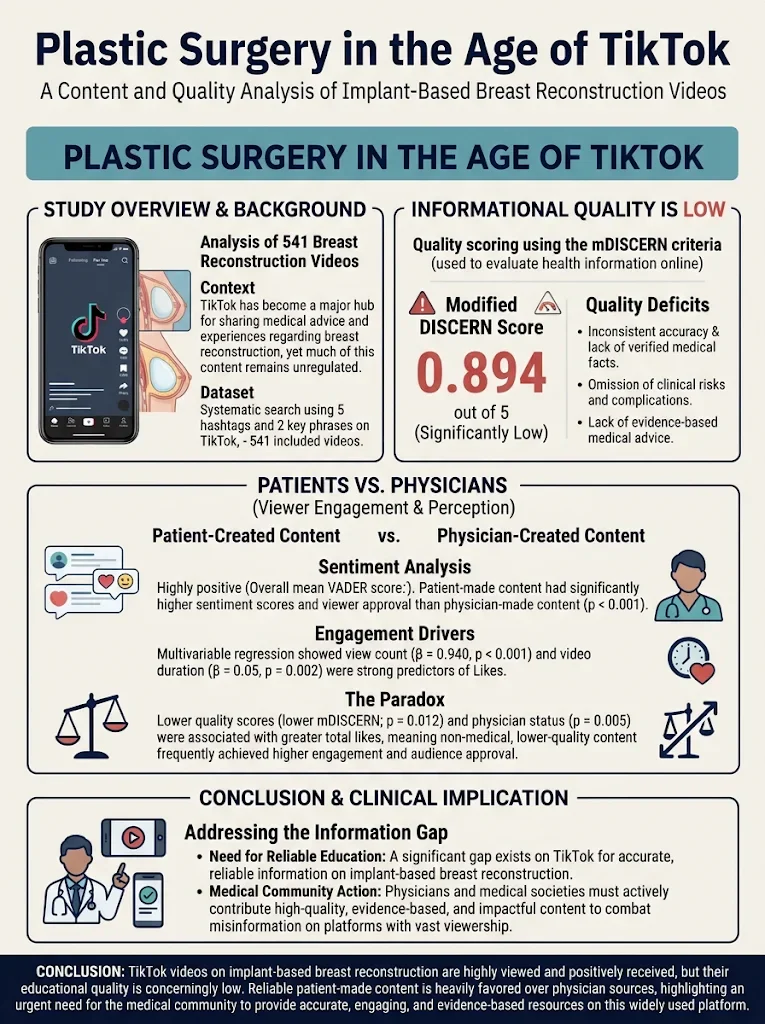
Researchers conducted a systematic content analysis of TikTok videos related to implant-based breast reconstruction. The dataset was gathered by searching five relevant hashtags and two key phrases commonly associated with this type of surgery. A total of 541 videos meeting inclusion criteria were evaluated. Content quality was rated using the modified DISCERN (mDISCERN) tool, a validated instrument assessing reliability and quality of health information. Audience perception was measured through automated sentiment analysis of video comments with the VADER (Valence Aware Dictionary and sEntiment Reasoner) algorithm. Statistical methods included multivariate regression models to identify factors predicting popularity metrics such as likes and views. Videos were categorized by source, notably patient-generated content versus physician content.Key Findings
The average mDISCERN score across the dataset was 0.894, reflecting generally poor informational quality and reliability. Notably, videos created by healthcare professionals scored higher on mDISCERN, indicating relatively more accurate content compared to those made by patients. However, the engagement metrics told a contrasting story; videos from patients typically garnered higher total likes and viewer sentiment as measured by the VADER scores (mean 0.339, denoting positive audience perception). Multivariable regression analyses revealed that video view numbers (β = 0.940, p < 0.001) and duration (β = 0.05, p = 0.002) were significant predictors of log-transformed like counts. Interestingly, a lower mDISCERN score and physician status were independently associated with greater likes (p = 0.012 and p = 0.005, respectively), suggesting that less rigorous medical content from non-professional creators resonated more with viewers. Interaction analysis demonstrated significantly higher positive sentiment toward patient videos compared to those posted by physicians (Mann-Whitney U = 5809.0, Z = -4.696, p <0.001). This underscores a potential preference or emotional connection patients feel toward peer-shared experiences over formal expert advice.Expert Commentary
This study exemplifies the double-edged nature of social media in health communication. While platforms like TikTok democratize information sharing and peer support, they also pose challenges in ensuring that disseminated content meets standards of accuracy and safety. The preference for patient-created content with lower informational quality emphasizes the human need for relatable narratives rather than purely factual data. Medical professionals must recognize the growing influence of social media on patient perceptions and decision-making in plastic surgery. By actively contributing credible, engaging, and understandable content tailored to such platforms, clinicians can fill the current void and potentially improve patient knowledge and outcomes. Additionally, integrating social media literacy into patient education could empower users to critically assess online information. Limitations of the study include potential selection bias in hashtag discovery, inability to assess longitudinal patient outcomes, and exclusion of non-English content which may affect generalizability. Future research should explore intervention strategies incorporating physician-generated content to assess impact on health literacy and surgical decision-making.Conclusion
The analysis reveals a concerning disparity: TikTok videos about implant-based breast reconstruction originating from patients tend to receive higher engagement and more favorable sentiment despite poorer informational quality. This phenomenon highlights an unmet educational need and a critical opportunity for the plastic surgery community to proactively engage with social media content creation. By delivering accurate, accessible, and appealing information, healthcare providers can improve patient education, support informed consent, and ultimately enhance surgical outcomes in breast reconstruction.References
1. Coyle L, Odoom G, Moretton N, Schechter I, Barone S, Tanna N, Ricci JA. Plastic Surgery in the Age of TikTok: A Content and Quality Analysis of Implant-Based Breast Reconstruction Videos. Plastic and reconstructive surgery. 2026 Nov 17. PMID: 43043852. 2. Chao GF, Hsiung RL, Yu JC, et al. Accuracy and readability of online patient education materials on breast reconstruction. Plast Reconstr Surg. 2020;146(4):479e-488e. 3. Tran BM, Parker ER, Brown NA. Social media use in plastic surgery: risks, benefits, and future directions. Aesthet Surg J. 2021;41(9):NP1184–NP1191. 4. Chundury RV, Shih C, Lam TC. Impact of social media on patient decision-making in plastic surgery. Plast Reconstr Surg Glob Open. 2019;7(2):e2103. 5. Vraga EK, Bode L. Defining misinformation and understanding its bounded nature: Using expertise and evidence for describing misinformation. Political Communication. 2020;37(1):136-144. 6. Gilbert C, Hutto CJ. VADER: A parsimonious rule-based model for sentiment analysis of social media text. Proceedings of the international AAAI conference on web and social media. 2014;8(1):216-225.Specialty calculators
For clinical reference; use professional judgment.